Ahead of the 2024 election, Donald Trump’s critics warned that once he returned to the Oval Office, he would immediately implement a tough strategy known as “Project 2025“. They argued that this initiative would endanger democracy and open the door to authoritarianism. The first weeks of the Teflon Don’s second term have confirmed these fears: the decisions made bear a striking resemblance to the recommendations laid out in this political road map.
“Project 2025” is not just a reform plan, but a clear instruction for dismantling the traditional balance of power in the USA. The developer of the project – the think tank Heritage Foundation, founded in Washington in 1973 – proposes to transfer all executive power to the hands of the president, destroying the autonomy of federal agencies.
Loyalty instead of professionalism, control instead of independence. Tens of thousands of officials – under the knife, key institutions – under liquidation. The principle of separation of powers? Rule of law? This is for the naive. Critics call the project authoritarian. In fact, this is a draft of the future, where the president is not the head of the state, but its only master.
“Project 2025”: how Republicans are preparing for a radical transformation of the US federal government
“Project 2025” pond a key factor in the 2024 presidential campaign in the United States, and his radical ideas were used by Democrats to illustrate the possible actions of Donald Trump after his return to the White House. Although Trump himself has denied any connection to the initiative, its developers are closely associated with his previous administration, and the proposed changes are in line with his policy.
The leader of the Heritage Foundation, Paul Dance, and his team sought to fundamentally change the structure of the US federal government, returning it to the model that existed before the key reforms of the 20th century. They see the measures introduced by the administrations of Woodrow Wilson, Franklin Roosevelt, and Lyndon Johnson as the reason for the formation of a powerful, uncontrolled bureaucratic system that, they say, gravitates toward liberal views.
Russell Vought, who previously headed the Administration and Budget Office during the presidency of Donald Trump, is one of the main ideologues of “Project 2025”. He believes that, over time, many state departments have actually come out of the direct influence of the president, and their oversight mechanisms have lost their compliance with constitutional principles, turning into a separate, uncontrolled force.
“Project 2025” exists not only as a strategy for the administration of the Republican leader, but also as base out of approximately 20,000 potential candidates for positions in the Trump White House and government structures. In addition, it includes a yet-to-be-released “180-day plan” containing specific steps the new president could implement after the last inauguration.
The document envisages a large-scale reduction in funding for the Department of Justice, the elimination of such key agencies as the FBI and NSA, as well as the complete closure of the Departments of Education and Commerce. In addition, independent government agencies, including the Federal Communications Commission, should come under the direct control of the president, which would radically change the balance of power in Washington.
Kevin Roberts, head of the Heritage Foundation and “Project 2025”, emphasizes the determination to implement the plan, assuring supporters that the initiative will not stop. Launched in 2023, the program is aimed at dismantling the administrative apparatus. Its authors, many of whom worked in the Trump 1.0 team, sought to avoid previous mistakes and ensure the rapid implementation of the political course.
Similar road maps were developed by the Heritage Foundation during the Reagan era. According to experts, the implementation of “Project 2025” can significantly affect the foreign policy of the United States, in particular the support for Ukraine, or rather the lack of this support.
More than a hundred conservative organizations, including many former officials of the Trump administration, have come together to develop a plan for a large-scale reform of the US federal government. Initiatives include increasing political influence in the Department of Justice, strengthening the fight against illegal immigration, eliminating the Department of Education and simplifying the firing of thousands of civil servants through the restoration of the “Schedule F” policy.
The latter was introduced in the US in 2020 by the then Trump administration and was intended to make it easier to fire federal employees who perform politically sensitive tasks. Officially – to improve the efficiency of public administration, unofficially – to get rid of “disloyal bureaucrats”.
In 2021, Joe Biden was one of the first decrees to cancel this initiative, emphasizing the risks of politicization of the civil service. But with Trump’s return to power, this topic has gained momentum again. Supporters of this decision see it as a chance to clean the state apparatus from sabotage and bureaucratic clumsiness. Opponents are convinced that this is a dangerous way to turn the civil service into a mechanism controlled exclusively by one administration.
How the Republican initiative shook the United States and why Democrats fear it
President Joe Biden on the dangers of “Project 2025”. warned the public as early as 2023. It is quite natural that the initiative aimed at a large-scale reorganization of the US federal government could not but worry the Democrats.
In June of the same year, the Democrats in the House of Representatives created a special task force to counter Project 2025, seeking to draw public attention to the potential threats it poses to democratic institutions and civil rights.
Comedian John Oliver on his HBO show also mocked the odious program, emphasizing its extremist nature and potential negative consequences for society.
After a tense debate between Biden and Trump in June, during which “Project 2025” was not directly mentioned, interest in it has increased dramatically. Discussions of the topic on social media, particularly on the X platform, have received almost 20 million views, indicating deep public concern.
Actress Taraji P. Henson during his performance at the BET Awards as well turned attention to “Project 2025”, urging viewers to take seriously its possible consequences for civil and reproductive rights.
Young tiktokers also actively discussed the threats that, in their opinion, posed by “Project 2025”, spreading videos with explanations and calls to action.
That is, “Project 2025” became the central topic of political discussions, causing a wide reaction both among politicians and in the media space, which emphasizes its significance and potential impact on the future of the USA.
Joe Radosewicz of the Center for American Progress called the public reaction to “Project 2025” an uprising of ordinary people who rejected the proposed program. After the Supreme Court’s decision to strike down constitutional protections for abortion, Democrats sought to show how the presidential election would affect the lives of citizens, rather than simply reducing the campaign to a personality contest.
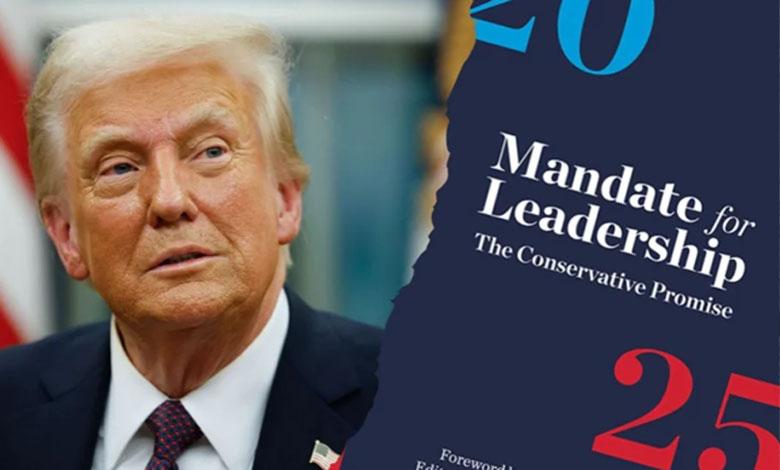
Last summer, the number of searches for “Project 2025” on Google rivaled the intensity of searches for information about the National Football League and Taylor Swift. And when a demonstratively large copy of the odious project was brought to the stage for satirical speeches at the Democratic convention, not only liberals and celebrities began to criticize it, but also conservatives themselves, condemning the project for reducing Trump’s chances in the elections.
How Republicans distance themselves from the initiative, which has become a weapon in the hands of Democrats
For its part, the Trump campaign distanced herself from Project 2025, although its ideas and participants are related to his previous administration. The campaign staff repeatedly asked Heritage not to associate the project with Trump, but that did not stop his supporters.
In July, following the Supreme Court’s ruling on presidential immunity, the head of the Heritage Foundation and the author of Project 2025 said that the United States was experiencing a “second American revolution,” drawing criticism. Trump soon publicly distanced himself from the project, saying that he had nothing to do with it and did not support some of its ideas. At the same time, he presented his own program developed by Russ Vaught, who also worked on the ill-fated Project 2025.
In August 2024, Paul Dance, the chief architect of Project 2025, left his position at the Heritage Foundation, which Trump’s team saw as a positive signal. His campaign managers said: “The announcement of the end of Project 2025 will be very welcome and should serve as a warning to anyone or any group that tries to distort their influence on President Trump and his campaign – this will not end well for you”.
Amid an intensifying battle for control of Congress, Project 2025 has become a tool for Democratic groups seeking to portray Republicans as associated with his radical proposals. The House Accountability Project has created micro-websites for Republicans holding the most competitive seats, linking their past votes on abortion, government funding and other issues to Project 2025 proposals. A representative of the War Room Accountability War Room noted, “As we speak, the House Republican Party is actually advancing the policies that are in Project 2025. They are already taking these policies to the Capitol.” (For reference: “War Room Accountability” or “Trump Accountability War Room” is an initiative launched by the organization Accountable.US. Its purpose is to monitor and analyze the appointments, executive actions and legislative initiatives of the administration of Donald Trump, as well as his allies. This initiative is aimed at identifying conflicts of interest, corruption and other problems that may affect American society).
In response, the press secretary of the National Republican Congressional Committee stated, that their candidates have nothing to do with Project 2025, and that the Democrats’ attacks are an attempt to divert attention from their own policies on borders and inflation. He called the attacks “desperate lies” as House Democrats “see their chances of regaining the majority shrinking.”
… Vitaly Portnikov warns that “Project 2025” is not just an internal matter of the USA. A radical shift in Washington could change the world order, calling into question support for Ukraine in its struggle with Russia. American politics is more than decisions in the White House. It is a choice between stability and chaos, between freedom and concessions to the aggressor.
Tetyana Viktorova