
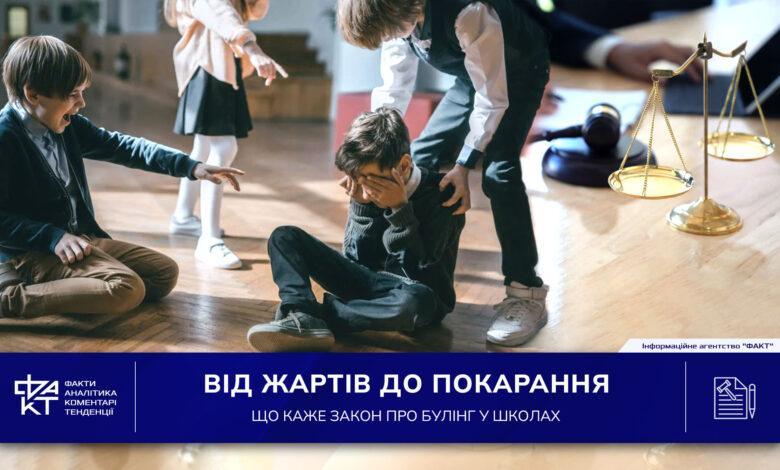
Recently, there have been rare cases when the news or social networks gain publicity about the abuse of children against children. Sometimes it’s just bullying, and sometimes it’s a severe beating. Of course, recent years have put a heavy burden on the psyche of not only adults, but also teenagers. Bullying in schools is not just children’s conflicts or jokes. This is a phenomenon that can have devastating consequences for a child’s psyche, self-esteem, and future. While some look for ways to help the victims, others often remain indifferent or even support the aggressor. In their turn, parents try to remove responsibility from themselves, justifying that they do not have time for constant care of children due to hard work for survival.
In the period from November 2023 to January 2024, the Ministry of Science and Education of Ukraine conducted a large-scale study entitled “Bullying and tolerance in educational institutions after February 24, 2022.” 5,576 students of grades 5-9, aged 10-14, from all regions of Ukraine, with the exception of temporarily occupied territories, took part in the event. The results of the study confirmed that bullying remains a significant problem that requires attention, decisive action and systemic change.
More than half of the respondents, namely 51.3%, admitted that they had faced bullying at least once in their life. This especially applies to girls, among whom there were more such cases than among boys – 55.9% versus 46.2%. After the start of the full-scale invasion, 24.7% of students were bullied, and this problem turned out to be most urgent in large cities, in particular Kyiv, where bullying affected 33.7% of schoolchildren. At the same time, 25.3% of students in rural areas reported similar situations. Bullying was the least common phenomenon in the east (18%) and south of the country (22%), which may be related to the specifics of the social environment or a lower degree of openness about this topic.
Schoolchildren cited appearance as the most common reason for bullying, especially for girls (35.2% vs. 26.9% among boys). Other factors included behaviors that seemed “out of the ordinary,” differences in outlook, hobbies, or even a linguistic trait. The problem of bullying based on the language barrier also turned out to be relevant: 8.3% of children were bullied because of the Russian language, and 6.9% – because of the Ukrainian language.
As for seeking help, 59.4% of children who were bullied reported it to their parents or teachers. Interestingly, girls sought support more often than boys — 62.4% versus 55.8%. But with age, this indicator decreased: if among 5th graders 68.1% sought help, then among 9th graders this indicator fell to 47.9%. This indicates the need for special attention to high school students, who may be less trusting of the environment.
Schools have tried to respond to incidents of bullying, but the results have shown that the effectiveness of such measures depends on the approaches. In 12.4% of cases, the parents of both parties – both the offender and the victim – were called, in 14.7% – only one of the parties. The best results were demonstrated by the work of school psychologists, who helped stop or significantly reduce bullying in 68.4% of cases. However, it was the combination of different methods of solving the problem that gave the best effect.
Are there legislative instruments that actually work in such situations? Who is responsible for bullying a child – parents, teachers or the school itself? For an answer to these questions, IA “FACT” turned to the lawyers of the “Repeshko and Partners” bar association, who explained how to prevent bowling and what punishments are provided for the guilty.
Indeed, the problem of bullying remains a painful topic for Ukrainian schools, especially in the conditions of the war, which brought new challenges to the educational environment. As lawyers who love the accuracy of facts, first of all, we want to provide relevant statistics. In 2024, the Ukrainian police recorded 219 cases of bullying in schools, in 2023 there were approximately 100 such cases. And this is only official information… As we can see, the trend is not very encouraging.
According to the Law of Ukraine “On Education”, bullying or harassment is not only physical violence, but also psychological, economic or even sexual, which can occur directly or through means of electronic communication, such as messengers or social networks. The main signs of bullying are systematicity (repetition of actions at least twice), the presence of parties (offender, victim, as well as observers) and consequences in the form of mental or physical harm to the victim. Yes, even offensive messages in Viber, Telegram or other messengers can already be considered bullying.
In 2018, Article 173 was adopted in Ukraine-4 the Code of Ukraine on Administrative Offenses (KUpAP), which regulates the issue of bullying. According to it, any actions that harm a minor or a minor are subject to administrative responsibility. For such a violation, fines are provided: from 850 to 1,700 hryvnias, or community service for a period of 20 to 40 hours. If the harassment is committed by a group of persons or repeatedly within a year, the fine increases to 3,400 hryvnias, and community service may last up to 60 hours.
It is important to note that if the perpetrator is a child between the ages of 14 and 16, the responsibility rests with their parents or guardians. This means that parents are not only responsible for the upbringing of their child, but are also legally responsible for their actions. Fines in this case range from UAH 850 to UAH 3,400, depending on the severity and frequency of the violation. At the same time, the management of the educational institution is also responsible for improper response to cases of bullying. If the school director does not report the bullying to the police, this also entails a fine of 850 to 1,700 hryvnias or correctional work for a period of up to one month. Police representatives draw up a report on this offense, and the case is further considered by a local court on the basis of this report.
In general, responsibility for bullying among minors is a complex topic that touches on many aspects: legislative, social and psychological. However, in cases of bullying, it is important to remember that administrative responsibility in Ukraine begins at the age of 16. This means that persons of this age can already be held responsible for their actions on general grounds. However, for teenagers from 16 to 18 years of age, the legislation provides for certain features. According to Article 24–1 of the Code of Ukraine on Administrative Offenses, special measures of influence may be applied to such persons.
For example, they may be required to publicly or otherwise apologize to the victim, receive a warning, a reprimand or a severe reprimand. Also, a teenager can be placed under the supervision of parents, teachers or even individual citizens who are ready to take on such responsibility. It is important that the judge chooses a specific type of punishment, taking into account the circumstances: living conditions, the characteristics of the offender, the quality of his education, the severity of the committed act and other factors.
In the event that persons between the ages of sixteen and eighteen commit administrative offenses provided for in Article 173-4 KUpAP, they bear responsibility on general grounds. However, the legislation takes into account the specifics of the age of such offenders and provides for the possibility of applying special measures of influence, defined Article 24–1 KUPAP This is done in order to take into account the nature of the committed act and the personality of the offender, which is important for education and prevention of repeated offenses. Among the measures provided for in this article, it is possible for the teenager to publicly or otherwise apologize to the victim. A warning, a reprimand, or even a severe reprimand may also be issued. In some cases, the violator may be placed under the supervision of parents or persons who replace them. In the case of their consent, supervision can be carried out by the teaching or labor team or even by individual citizens who have expressed a desire to take on such responsibility.
These measures are not only aimed at correcting the adolescent’s behavior, but also take into account his age and psychological characteristics. At this age, a person is not always aware of the consequences of his actions, so educational influence remains a key element in working with juvenile offenders. The court, taking into account life circumstances, personal characteristics, degree of severity of the act and other factors, determines the optimal punishment or educational measure.
As for the parents of juvenile offenders, their responsibility is clearly spelled out in the legislation. No excuses such as “I work from morning to night”, “the child is unruly” or “the school has to deal with education” do not exempt from obligations. Parents must be willing to take responsibility for their child’s actions, including paying fines or doing community service. Schools also play an important role in the fight against bullying. They are required to report all incidents of bullying to the police and children’s services. But, unfortunately, in real life, some educational institutions often do not want to “take the garbage out of the house.” This complicates the situation for parents who want to help their child.
How to act in such cases? A difficult question. In our opinion, a lot depends on the duration of bowling, its forms and seriousness. The main thing is to teach children to respect others, to explain that it is unacceptable to bully someone because of their appearance, other interests or views. After all, each person is unique, and this is what makes our world diverse and interesting.
However, administrative responsibility for bullying is not the only possible sanction. If the bullying leads to tragic consequences, such as suicide or attempted suicide, the situation moves into the realm of criminal law. Article 120 of the Criminal Code of Ukraine provides punishment for suicide if the actions were directed against a minor. It can be cruel treatment, blackmail or systematic humiliation of the victim. The punishment for such a crime is imprisonment for a term of seven to ten years. It is important to remember that criminal responsibility begins at the age of 16.
It must be taken into account that the unstable psyche of a teenager can lead to unpredictable actions that an adult would never even think about. The age from 14 to 18 years is a period when children’s psyche is very vulnerable, and even small, at first glance, conflicts can lead to serious consequences. So, a big request to parents is to teach their children respect and benevolence, because the world is multifaceted, and this is what makes it so special. It is also necessary to remember that children are always quite cruel.
The main thing is that the problem of bullying cannot be silenced, because impunity gives rise to a feeling of permissiveness. As our practice shows, timely referral to a psychologist or other specialists helps to effectively deal with this problem. The main thing is to act quickly and not leave the child alone with his trouble. If your child is a victim of bullying or shows aggression, do not delay – contact the school, the police or a psychologist. The legal aspect also plays a key role. Know your rights and responsibilities: Parents, schools, and even children themselves are legally responsible for their actions.


