
The US federal debt has been growing gradually for decades, but new projections show a record pace of debt accumulation. Whereas previously additional trillions came after long economic cycles, crises, and large government programs, in the coming decades the country could move to a pace at which $10 trillion in new debt would be added in just 1-2 years.
According to analysts’ estimates, the US national debt has grown from $51 billion in 1940 to almost $40 trillion in 2026. By 2056, it could reach $182 trillion in nominal terms, if calculations prepared on the basis of data from the US Congressional Budget Office and the White House as of March 2026 are correct.
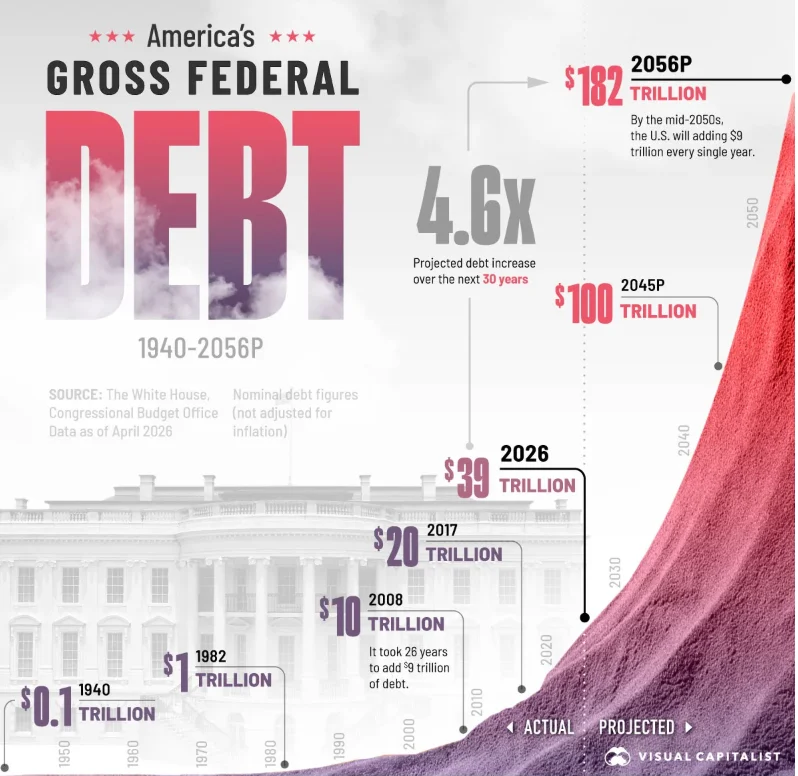
What is most striking about these figures is not only the final amount, but the pace at which the country passes each new debt milestone. The first $10 trillion of the US was accumulated for almost 70 years, while the next $10 trillion was added in just nine years after the 2008 financial crisis. In the 2020s, pandemic spending further narrowed this gap, and a new $10 trillion increase took about five years.
By mid-century, this dynamic could become even more dramatic. In a baseline scenario that does not take into account new major wars, deep recessions, or sharp jumps in interest rates, every additional $10 trillion in debt could appear in one to two years. This projection is especially telling because even without extraordinary shocks, the US debt could still grow to levels several times higher than current records.
The $182 trillion figure would represent a jump of about 4.6 times from the current level of about $39 trillion. For scale, this is almost three times the current combined valuation of all companies in the S&P 500 index, meaning the federal government’s debt burden could become larger than what is currently perceived as the core of the US stock market.
It should be noted that the main threat to such a scenario is the cost of servicing the debt. As the total debt becomes larger, more of the federal budget goes to interest payments, leaving less room for defense, infrastructure, social programs, healthcare, education, and other government needs. Debt, in this logic, gradually begins to compete with all other budget expenditures.
If the cost of borrowing continues to rise, the pressure could extend far beyond government finances. Higher interest rates for the government often affect credit for businesses and households, making investment more expensive, cooling economic activity, and reducing the potential for long-term growth. The $182 trillion forecast is therefore important as a warning that debt could increasingly determine U.S. financial decisions for decades to come.