
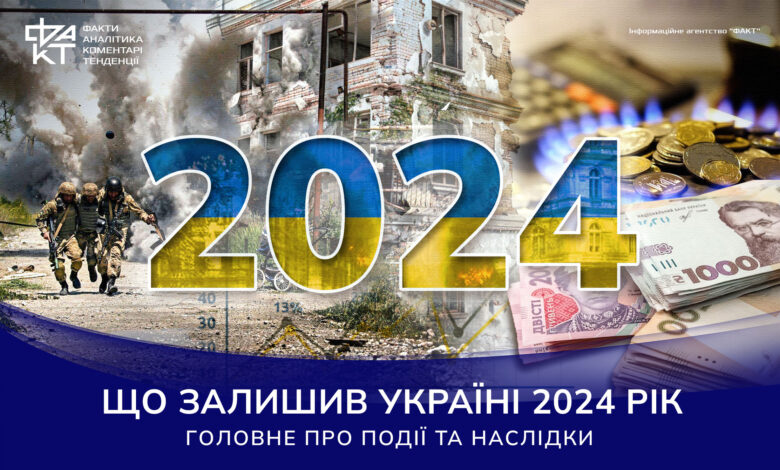
The year 2024 for Ukraine became another year of endurance tests, where daily realities often crossed out great hopes. It took place in the conditions of an ongoing war, political instability, the adoption of laws that caused popular indignation, a series of corruption scandals with top officials, economic turbulence, as well as social frustrations, where society balanced between fatigue and the struggle for survival. At the same time, one cannot help but notice the attempts to move forward: Ukrainians continued to fight for their rights, business tried to adapt to new challenges, and science, culture and sports looked for opportunities for development, despite the lack of support. This period further exposed the problems that had been accumulating for years. Let’s consider the main events of the year 2024, this will be an honest view without unnecessary embellishment or exaggeration, based on data from official sources.
War in Ukraine
The year 2024 became a real test for Ukraine and extremely difficult for the Defense Forces. To call this a difficult year is to downplay the scale of the tragedy and struggle. Many military personnel openly admit that the situation this year was even more acute and difficult than in 2022. This is eloquently evidenced by the intensity of the fighting, the scale of human and territorial losses.
Complex defensive battles, constant pressure from the enemy, which uses tactics of attrition, significantly affected the fighting capacity of the Ukrainian army. The high intensity of hostilities led to significant losses in manpower, equipment and ammunition. At the same time, Western equipment, in particular F-16 fighters, was never put into operation on a sufficient scale, which limited the possibilities of air support and reinforcement of the front. Despite the fact that we cannot fail to note the significant assistance to our troops from foreign countries, the pace of deliveries of foreign equipment in 2024 remains slow, which affects Ukraine’s ability to conduct effective offensive operations.
The most painful page of 2024 was the loss of thousands of military lives, as well as territories in the Vugledar district, in the Pokrovsk direction, the advance of the enemy from Avdiyivka to Pokrovsk, and the cutting of the bridgehead of the “Khortytsia” OSUV on the Oskil River. Despite the heroism of the Ukrainian military, the Russian Federation managed to achieve local successes, putting significant pressure on the Ukrainian defense forces. Russia, without changing its policy, continues its bloody attacks, concentrating its efforts in the Donetsk region and making a breakthrough in the Kharkiv region. However, the Ukrainian troops were able not only to stop the repeated attack on Sumy region, but also to strike at the enemy by attacking the Kursk region.
This year, an important event was the change of leadership of the Armed Forces: on February 8, Colonel-General Oleksandr Syrsky was appointed commander-in-chief instead of Valery Zaluzhny. These personnel reshuffles were explained by the president as the need to accelerate the technological modernization of the army and improve the efficiency of military operations management.
The Russian Federation is gradually expanding the “axis of evil”, involving allies in the war. A new worrying factor in 2024 was that soldiers from North Korea started fighting on her side. Thus, Ukraine is actually facing two nuclear states at once.
Despite incredible difficulties, Ukraine continues to strike at the Russian Federation not only on the front lines, but also in their rear. Ukrainian attacks on enemy airfields, oil refineries, and enterprises of the military-industrial complex demonstrate that the struggle continues, and the strength and spirit of our nation remain indomitable.
However, the number of casualties among the military and civilians reaches a terrible scale. According to Western sources, during the entire period of the war, losses of the Ukrainian military amounted to tens of thousands of dead and hundreds of thousands of wounded. The real numbers may be even higher, as official data often contradict estimates from independent sources. In 2024, people continue to die. In particular, in September 2024 alone, at least 208 civilians were killed and 1,220 were injured in Ukraine, making this month the most tragic month in terms of the number of civilian casualties of the year. The alarming trend of an increase in the number of victims, which began in July, continues to grow. Among the dead were nine children, another 76 children were injured. Almost half of the victims (46%) are people over the age of 60. Such data was published by the UN.
In total, at least 12,162 civilians have been killed and more than 26,900 injured since the start of the full-scale invasion. Among the dead were 591 children, and another 1,695 children were injured. At the same time, 19,546 Ukrainian children were kidnapped and deported to the Russian Federation, only 388 of them managed to return home.
More than 8 thousand Ukrainians, both civilians and military, still remain in Russian captivity. Since the start of the full-scale war, 2,681 servicemen and 147 civilians have been returned home as part of exchanges. One of the largest exchanges was the one that took place on December 30, 2024, when 189 Ukrainians were released.
Russia occupied almost a fifth of the territory of Ukraine. By 2022, it controlled 7.28% of the territory, including Crimea and part of Donbas — almost 44,000 square kilometers. With the beginning of the full-scale war, another 11.12%, or 67 thousand square kilometers, was added to these areas. In total, 18.4% of Ukraine is currently under occupation, including parts of the Kharkiv, Kherson, and Zaporizhzhia regions. The price of resistance is huge, now Ukrainian defenders continue to fight for every meter of their land.
Mined areas are another terrible consequence of war, as a result of which people continue to die. 144 thousand square kilometers of Ukrainian land are considered potentially dangerous due to mines. According to the estimates of the World Bank, more than $35 billion will be spent on demining.
By the end of 2024, the number of Ukrainian refugees abroad reached more than 10 million people. Of them, more than 4 million, namely 4.163 million, found temporary shelter in the countries of the European Union. This is the largest forced flow of migrants in the modern history of Europe, caused by a brutal war. These people left their homes, fleeing the occupation, shelling and humanitarian disaster.
As of October 22, 2024, 4,646,735 internally displaced persons were officially registered in Ukraine. These are people who were forced to leave their homes due to war, shelling and occupation, but remained within the country. They live in difficult conditions, often losing not only their housing, but also their means of livelihood, and they need constant support from the state, international organizations and society.
As a result of the war, the number of destroyed and damaged objects in Ukraine exceeded 200,000. These are schools, hospitals, residential buildings, critical infrastructure — everything that forms the basis for normal life. Over $500 billion will be needed to repair this colossal destruction.
The war in Ukraine also caused enormous damage to the environment, the total damage of which is estimated at $62.9 billion. Russian aggression destroyed and damaged 79.3 thousand hectares of forests and green areas, 9.7 million trees and plants, and 75 thousand animals. The damage caused to red book species of animals and plants is $14.5 billion.
A separate environmental disaster was the waste from the destroyed Russian equipment, which reached 1.4 million tons. These pollutants will have long-term effects on soils, water resources and air. The ruined nature of Ukraine is another front of struggle that requires significant efforts to restore. The consequences of this damage will be felt for decades, and its elimination will require billions of investments and global support.
In addition, the enemy’s massive attacks on the energy infrastructure during this year created serious pressure on the rear areas. However, thanks to the supply of modern air defense systems (Patriot, NASAMS, IRIS-T, SAMP-T), it was possible to reduce the effectiveness of Russian missile and drone strikes. In autumn, the effectiveness of kamikaze drone attacks decreased significantly, which was one of the positive results of the year.
Ukraine has also made progress in the development of attack unmanned aerial vehicles. They were actively used to launch strikes against the enemy’s rear facilities, military airfields, ships of the Black Sea Fleet, as well as against logistical targets in Crimea and on the territory of Russia. This innovation made it possible to partially change the dynamics of the war and demonstrate the technological potential of the Ukrainian army.
At the same time, 2024 was marked by the development of the Ukrainian defense industry. More than 1,300 samples of weapons and military equipment were introduced, of which 75% were of domestic production. In particular, new unmanned aircraft systems, electronic warfare equipment, updated ammunition and engineering equipment were put into mass production. The Ministry of Defense of Ukraine implemented NATO standards for the certification of these samples, which greatly simplified and automated the production processes.
The main conclusion of 2024 is that Ukraine retains the ability to resist the enemy, but the achievement of a strategic turning point has not yet occurred. The ability to maintain the support of Western partners, accelerate the adaptation of modern technologies and ensure the stability of the rear will be key success factors in 2025.
Economic sphere
2024 turned out to be a year of serious economic problems for Ukraine, the pace of economic recovery remains low. Among the key factors are high security risks, shortage of energy resources, tight monetary policy, lack of labor resources and low investment activity. The manufacturing sector of Ukraine is in dire need of investment for recovery and expansion, but the “expensive money policy” of the National Bank of Ukraine (NBU) and insufficiently effective fiscal support instruments are hampering economic growth.
Since the recent signing by the president of the law on raising taxes, 22,521 individual entrepreneurs have ceased their activities. In total, 254,288 entrepreneurs were affected by the closure since the beginning of the year. The largest number of applications for the termination of FOP work was submitted in March – 28,690 businessmen ended their activity then.
Ukraine’s indirect losses from the Russian invasion reached a staggering $1.164 trillion. This amount exceeds the country’s GDP in 2021 by almost two times and reflects the scale of the loss of economic potential. The productive sectors of the economy suffered the biggest blow. Trade lost $450.5 billion, industry including construction and services lost $410 billion, and agriculture lost $83.1 billion.
The country’s infrastructure was critically affected. Losses in the energy sector amount to $43.1 billion, and in the transport industry – $38.8 billion. In addition, additional costs for demining areas exceed $42 billion, and rehabilitation of the housing sector will require another $22 billion.
No branch of the economy, with the exception of public administration, was able to restore the pre-war level. High dependence on imports and significant demand for foreign currency create a structural deficit of the balance of payments, which will increase by $8.4 billion in 2024, reaching $37 billion. The main channels of foreign currency outflow were the deficit of the trade balance ($23.6 billion), accumulation of cash outside banks ($13.3 billion) and payments on foreign loans and investments ($7.3 billion). The receipt of foreign aid made it possible to cover this deficit, but it was not possible to increase the productivity of domestic enterprises in order to reduce imports.
In 2024, the NBU began a policy of currency liberalization, which included the transition to flexible exchange rate formation. However, this only increased the instability of the foreign exchange market: NBU interventions to support the exchange rate increased by 20%, and the population tripled the purchase of currency, spending $12 billion. Increased demand for foreign currency led to increased inflation expectations, which affected the average annual exchange rate of the hryvnia, which reached UAH 43.4 per dollar.
Inflation rose to 11.2% at the end of 2024, up from 3.3% in May. Although the key interest rate has been above inflation for more than two years, it has not helped to contain its rise. The main factors of inflation remain expenses, which indicates the failures of the NBU’s policy, which spent more than UAH 200 billion on the implementation of “high rates”, but did not achieve the desired macro-financial stability.
More than 2.5 trillion UAH of deposits are concentrated in the banking system, of which more than 700 billion UAH are free liquid funds. At the same time, the level of lending to the economy is decreasing: working loans of banks decreased by UAH 40 billion during the war, while investments in debt bonds of other countries increased by $3.2 billion. Banks prefer to invest in NBU certificates of deposit, which leads to an increase in the cost of servicing domestic debt.
The high discount rate of the NBU and the government’s dependence on the domestic debt market cause the cost of servicing the public debt to rise. In 2024, interest expenses on the domestic debt reached UAH 252.3 billion, which significantly narrows the possibilities for financing other priorities. Public debt is already 90% of GDP and is likely to exceed 100% in 2025.
Funding for defense needs remains insufficient. In 2024, UAH 675 billion was allocated for defense, but this was only enough to partially meet the needs of the Armed Forces of Ukraine. Military production has not yet become the main driver of the economy, and the lack of ammunition, armored vehicles and other material and technical means significantly complicates the effectiveness of military operations.
It should be noted that despite the colossal losses in the production sector, the economy of Ukraine is gradually recovering. Real GDP grew by 3.9% in 2024, which indicates the effectiveness of adaptation to the conditions of war. At the same time, the productivity level of the economy is only 80% of the pre-war level. Stability is ensured by the conversion of industry to military rails: the defense-industrial complex (OPK) has increased its capacity 20 times, attracting more than 500 companies.
An additional impetus to economic recovery was the opening of the Black Sea transport corridor, which, together with the improvement of land logistics, made it possible to increase the export of goods by 12.7%. Exports of food, metals and mineral products remained the key focus, while imports grew by only 6.9%.
Since February 2022, Ukraine’s partners have announced the provision of $421 billion in aid, of which $176 billion is intended for military support. In 2024, direct financial infusions from donors exceeded $41 billion, representing about 20% of GDP each year. Thanks to these funds, it was possible to preserve the functioning of the budgetary system, meet the critical needs of defense and reduce the fiscal deficit.
In addition, the concluded agreements for 2025 open up prospects for covering the deficit of external financing, in particular at the expense of $13.7 billion from the EU, $19.1 billion from frozen Russian assets, as well as funds from the International Bank for Reconstruction and Development, the IMF, and Great Britain. Continued cooperation with the IMF remains critical for maintaining the confidence of international investors.
Despite the war, the banking system remained stable and showed a record profit in 2024 — about 200 billion hryvnias. Preferential loans in the amount of 230 billion hryvnias, granted to businesses and the population, made up 30% of the portfolio of working loans and became an important factor in supporting the economy.
At the same time, the level of budget revenues in 2024 reached the pre-war level, which became possible thanks to the growth of revenues from VAT, income tax and other payments. However, the state budget deficit remains high, and public debt is already 90% of GDP, with a forecast to exceed 100% in 2025. This poses significant risks to financial stability in the future.
It should be emphasized that the economy of Ukraine in the conditions of war is undermined not only by external challenges, but also by an internal enemy – large-scale corruption, which intensified in 2024, penetrating into all spheres of life. This phenomenon is particularly shameful in the military sphere, where every stolen hryvnia means a shortage of ammunition, armored vehicles or equipment for soldiers who risk their lives at the front. At a time when every resource should be directed to strengthening the country’s defense capabilities and supporting the country, the discovery of embezzlement schemes, misappropriation of funds or inflated prices for critical goods causes not only anger, but also undermines trust in the authorities. Corruption scandals in military procurement, fuel supply, equipment repair and even food supply significantly undermine the economic foundation of the state, as well as its ability to fight.
Olympic and Paralympic triumphs
And a little positive. The year 2024 became one of the brightest and at the same time the most difficult in the recent history of Ukrainian sports. Despite the full-scale war, which has been going on for the third year, Ukrainian athletes not only continued to compete, but also made history, setting records and winning awards on world arenas. Ukraine once again demonstrated that even in the most difficult conditions it is possible to achieve outstanding results.
An important achievement is the historic triumph of Oleksandr Usyk, who became the first absolute world champion in boxing in super heavy weight, having united four belts. His victory over Tyson Fury entered the history of world boxing. Usyk also successfully defended his titles in the rematch, finishing the year with an unblemished record of 23 consecutive professional victories. His success was joined by Vasyl Lomachenko and Denys Berinchyk, who won the belts of world champions in the lightweight division.
The Olympic Games in Paris became a real triumph for Ukrainian athletes. Six “gold” medals adorned the national team’s coffers, and Yaroslava Maguchih and Oleksandr Khizhnyak became the main heroes of the Games. Maguchih made history by combining the titles of the champion of all the most prestigious high jump tournaments. Khyzhnyak, after the dramatic final in 2021, came back stronger and won the coveted “gold”. The team “gold” was won by the Ukrainian sabers, who defeated the Republic of Korea in the final.
The Paralympic Games in Paris became the most medal-winning for Ukraine, collecting 82 awards, of which 22 were gold. Swimmers Andrii Trusov and Yaroslav Denisenko, as well as track and field athlete Ihor Trusov, climbed to the top step of the podium twice. Andriy Trusov became the most decorated athlete of the Games, winning five medals.
Ukrainian athletes set several world records in 2024. Yaroslava Maguchih surpassed the legendary result of Stefka Kostadinova in the high jump, overcoming the mark of 2.10 meters. Her achievement became a symbol of the year in athletics. Paralympians Andriy Trusov and Mykhailo Serbin set records in swimming, and Oleksandr Yarovy and Anastasia Moskalenko – in the shot put. Kateryna Sadurska, a freediver, set three world records, ending the year with a historic 84m.
2024 was a memorable year for Ukrainian teams in various sports. The men’s volleyball team won the Gold EuroLeague, defeating Croatia in the final. The Ukrainian futsal team won bronze at the World Championship, achieving such a result for the first time in history. In hockey, the men’s and women’s national teams of Ukraine won their divisions at the world championships without suffering a single defeat.
In addition, Ukrainian youth demonstrated a high level at junior and youth tournaments. The diving team became the best at the European Championship, and the youth boxing team won the continental championship. In adaptive sports, Ukraine dominated the medal standings of the European and World Championships, demonstrating strength and skill on the international stage.
So, the year 2024 became a year of difficult realities and unused opportunities for Ukraine. The country continues to pay a high price for the war, losing not only Ukrainian lives and territory, but also economic potential. Policy decisions often seemed ill-timed or ill-thought-out, which only reinforced the sense of stagnation.
Despite the efforts of civil society and business, which adapt to the circumstances, and sometimes even find innovative solutions, systemic changes have not yet occurred. At the same time, 2024 demonstrated that Ukraine is not only able to withstand the blows of war, but also to find resources for survival in harsh realities, as well as to achieve certain successes in sports. However, even these achievements clearly demonstrate a key lesson: without an end to the war, they will all remain fragile, and the prospects for reconstruction only a distant dream.
The next year 2025 will be decisive for the country. Will Ukraine be able to achieve the main strategic goal of ending the war as soon as possible? This question lies in the plane not only of military strength, but also of the power’s ability to effectively manage, consolidate resources and resolutely fight internal problems. Without the political will of the authorities to act in the interests of the country and the people, and not for short-term gains, the end of the war in 2025 will remain only a ghostly hope. Peace will not come by itself, it requires clear decisions, the courage to take responsibility and a strategy that takes into account all challenges. Without it, war will continue to deplete resources, destroy the future, and deprive the nation of its chances of survival and regeneration.


