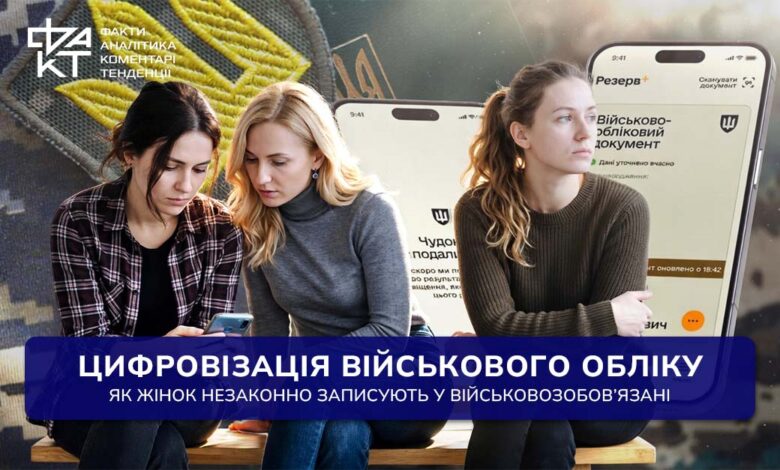
The digitalization of military registration in Ukraine, which was supposed to become a benchmark for transparency, is increasingly demonstrating a critical crisis in data administration. Instead of the promised accuracy, users of the “Oberig” registry and the “Reserve+” application are massively recording a systemic dissonance between a person’s legal status and their digital representation. The main evidence of this chaos is the false “digital mobilization” of women, when the system arbitrarily records them as conscripts, ignoring their real profession and the rules of law.
Wrongful registration of women for military registration: between the norm of law and the practice of the CCC
The arbitrariness of the bureaucratic machine is confirmed by the indignation of Ukrainians on social networks, as well as a number of lawsuits that have recently shaken the legal field due to the groundless registration of women for military registration. The situation in which a Kyiv philologist and HR department head found herself, having found herself in the “Oberig” register as a “soldier-artist” with a fictitious VLK twenty years ago, ceased to be an isolated case, turning into a disturbing precedent.
According to report by Radio Liberty journalist Yegor Loginov, he knows of at least seven cases in which women were illegally entered into military records, after which they were declared wanted. At the same time, the refusal of the Territorial Recruitment Centers to correct obvious errors, motivated by the loss of archives during hostilities, creates a legal trap, where the lack of documents from the state becomes the fault of the citizen.
The conflict lies in the gross disregard of Part 11, Article 1 of the Law of Ukraine “On Military Duty and Military Service“, which clearly distinguishes between duty and right. The legislator has identified only two narrow paths that lead a woman to military registration:
- the presence of medical or pharmaceutical education as an unalternative requirement;
- voluntary expression of will, provided that she has a related specialty.
It is interesting that the geography of incidents demonstrates a particular concentration of cases in Kharkiv, where references to archives destroyed in 2022 have become a universal shield for the CCC in attempts to justify the chaotic filling of the register. However, the Kharkiv District Administrative Court in February 2026 (case No. 520/19726/25) gave a clear signal that the lack of paper confirmations from state bodies does not give them the right to grant a person a fictitious status. The case of a lawyer, who was mistakenly identified by the system as a doctor, emphasizes the critical importance of data verification through EDEBO, because a lawyer’s diploma a priori excludes mandatory registration.
A similar logic can be traced in the decision of August 2025 (case No. 520/14052/25), where an organization management specialist successfully proved the illegality of the CCC’s actions. The court stated that the inaction of the body that refuses to delete incorrect data is a form of legal nihilism. An important aspect of these decisions is not only the restoration of justice, but also the financial punishment of the state in the form of collecting court fees, which should stimulate the system to self-cleanse from phantom records.
However, , the analysis of judicial practice also reveals the dark side of the coin, where formalism prevails over the essence of the law. The decision of the Dnipropetrovsk District Administrative Court of December 2025 (case No. 160/30421/25) became a cold shower for many. Then the court rejected the claim of a woman who had a valid temporary military conscription certificate, issued back in 2020. In this case, the presence of a document, even if issued in error or contrary to the logic of the specialty, becomes a legitimate chain for the court that keeps the person in the register. This creates a complex procedural requirement, when it is first necessary to cancel the document, and only then to attack the fact of being on the register.
The current version of the law “On Military Duty and Military Service” continues to maintain a line of demarcation, where mandatory mobilization remains the prerogative of men, while for women the door to the army is open exclusively through the mechanism of conscious signing of a contract. This approach erases gender differences only at the moment of acquiring the status of a serviceman, because after the legal registration of obligations, both women and men become equal before the orders of the command, which includes the performance of combat missions directly in the frontal conflict zone.
Despite the absence of forced conscription, the state machine is deploying a large-scale inventory of human capital, focusing special attention on women with skills that are scarce for defense. The medical sector, which includes doctors, nurses and pharmacists, has effectively become an integrated part of the mobilization reserve, where registration is not a right but a regulatory requirement. This specific status does not trigger immediate dispatch to the front lines, but creates a clear legal link for female specialists to territorial recruitment centers, turning their professional competencies into a strategic resource that can be used in the rear or hospital units at the first state need.
Currently, the information space is filled with discussions around legislative initiatives, which are often interpreted in the media as harbingers of the forced conscription of women, although there is still no legal basis for such statements. It is noteworthy that state authorities refrain from publishing any directives or lists of categories of women who would be subject to forced mobilization, leaving such scenarios only as a subject of parliamentary debate. The Ministry of Defense admits that state registers may contain some inaccuracies. This is explained by the large volume of mobilization work, the human factor, and problems that arise during data entry or synchronization. In public explanations, the ministry also emphasizes that automatic processing of information is designed to simplify registration, reduce queues, and eliminate unnecessary paperwork, but at the same time leaves it up to the citizen to contact the CCC if erroneous data is detected. However, the Ministry of Defense has not yet provided detailed explanations of the reasons and mechanisms for correcting errors.
Being in the CCC registers, even in the absence of active mobilization plans for female doctors, imposes a number of strict administrative obligations on the person that cannot be ignored. Graduates of specialized educational institutions are required to appear for a military medical examination within two months of receiving their diploma, which automatically includes them in the movement monitoring system. The obligation to report a change of residence and readiness for calls for training events creates a specific regime of legal restrictions, which requires women to be constantly vigilant and disciplined.
The search for a balance between individual rights and the interests of defense continues against the background of statements by representatives of the relevant parliamentary committee on the preparation of new proposals from the defense department. These initiatives are aimed at creating a model of interaction where the mechanisms for involving citizens in the defense of the state will become less conflictual, but at the same time will be accompanied by stricter responsibility for ignoring the established rules. Thus, Ukraine’s modern strategy is to smoothly integrate female specialists into defense structures while maintaining the principle of free choice for all other categories of women.
For women who unexpectedly found their profile in the “Reserve +” application,
the court currently remains the only way out in a situation with erroneous registration for military service.
Consequences of erroneous military registration of women
The problem of erroneously registering women in military registration goes far beyond a database failure, since in such cases a woman faces the state already in the status of an offender and is forced to prove her innocence in court, although there may not have been any grounds for this in the first place. It should be noted that the law defines the grounds for removal or exclusion from military registration, but there is currently no separate procedure for cases of erroneous registration in the register.
At the same time, there have been many cases in Ukraine where women are illegally or mistakenly registered in military registration, after which they are fined (17,000 UAH) for violating registration rules and even declared wanted. In addition, such actions are often accompanied by fictitious passing of the VLK.
The most serious consequence in such stories concerns trust in state institutions, because citizens evaluate the state by how it treats them in a conflict situation. When a woman who should not have been registered with the military suddenly finds herself on the register or learns of her wanted status, the basic sense of legal certainty is destroyed, because the line between a legal procedure and a mistaken intervention begins to seem blurred.
This effect is further enhanced by the fact that the Ministry of Defense defines the register as an effective centralized system for collecting and using data on conscripts, conscripts, and reservists. However, it turns out that it is unreliable.
This raises another risk that already applies to migration decisions. During mobilization, the right to demand a military registration document at the border applies to male citizens aged 18 to 60, that is, the general rule does not apply to all women. At the same time, stories of mistaken registration can form a completely different public reaction, because people usually focus not only on the norm of the law, but also on the risk of unpredictable application of the system. Therefore, erroneous military registration of women may lead to their departure abroad, which will further exacerbate the demographic crisis in the country.