
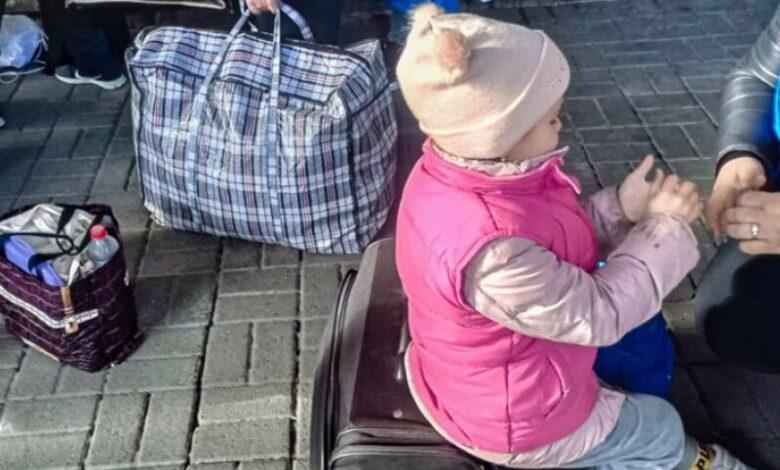
Since the beginning of Russia’s full-scale invasion of Ukraine, the evacuation of the civilian population, including children, has become one of the priority humanitarian tasks. Military actions in the territory of Donetsk region created critical conditions for civilians, which forced the Ukrainian authorities to implement forced evacuation from dangerous settlements. However, despite all efforts, a significant number of children still remain in the war zone.
Current evacuation status
As of now, 65 children from 45 families remain in the forced evacuation zone in Donetsk region. They continue to live in 14 settlements, where the situation remains extremely tense due to constant shelling and threats to life. At the same time, it was possible to evacuate 44 children who lived in 32 families only in the last week. About this reported Acting Head of the Children’s Service of the Donetsk Regional Military Administration, Yulia Ryzhakov.
According to her, the largest number of children who are still in the war zone was recorded in the Komarska rural territorial community – 49 children from 35 families, as well as in the Shahivska rural territorial community – 12 children from seven families This suggests that despite the danger, some parents or guardians are slow to leave their homes, putting their children at significant risk.
Problems of forced evacuation
Evacuation of children from dangerous areas faces a number of difficulties. First, many parents categorically refuse to leave their homes, fearing the uncertainty that awaits them in new places. Some hope that the situation will stabilize, or simply do not have the resources to set up in a safe area. In such cases, public services are forced to carry out information work and explain the risks associated with being in a combat zone.
Secondly, the organization of evacuation requires significant resources and coordination between various government structures and humanitarian organizations. Evacuated children must be provided not only with a safe shelter, but also with psychological support, educational opportunities and basic conditions for a normal life.
Children in the zone of active hostilities
In addition to the children who are in the zone of forced evacuation, another 218 children remain in the zones of active hostilities in the Donetsk region. This is an extremely worrying fact, as such areas are constantly bombarded and destroyed, and access to medical care and basic needs in these areas is limited or completely absent.
It is worth noting that currently 19 communities remain in the Donetsk region, where settlements are classified as active combat zones. These include Pokrovska, Chasovoyarska, Toretska, Bakhmutska, Soledarska, Zvanivska, Siverska, Illinivska, Kostyantynivska, Lymanska, Grodivska, Kurakhivska, Marinska, Myrnogradska, Novogrodivska, Ocheretynska, Selydivska, Vugledarska and Novoselivska communities. It is in these regions that the largest number of children who need evacuation remain.
Prospects and further actions
In view of the difficult security situation and the significant number of children who still remain in dangerous areas, the Ukrainian authorities and humanitarian organizations continue active work on the evacuation of the population. An important role in this process is played by volunteer initiatives, international partners and local authorities, which make efforts to create safe conditions for children and their families.
It is also necessary to continue the information campaign among the population, explaining to parents the dangers of being in war zones. It is important that the state provides not only physical evacuation, but also further support for displaced persons, providing them with housing, work and the possibility of returning to normal life.
Therefore, the situation with the forced evacuation of children in Donetsk remains critical, so it is necessary to continue active evacuation measures, expand support programs for families leaving dangerous areas, and strengthen the information campaign to convince parents of the importance of rescuing their children. Only a comprehensive approach and cooperation of the state, international organizations and the public will help to minimize risks and save the lives of children who find themselves in the war zone.


