Artemis II astronauts enter the Moon’s gravitational sphere for the first time in half a century

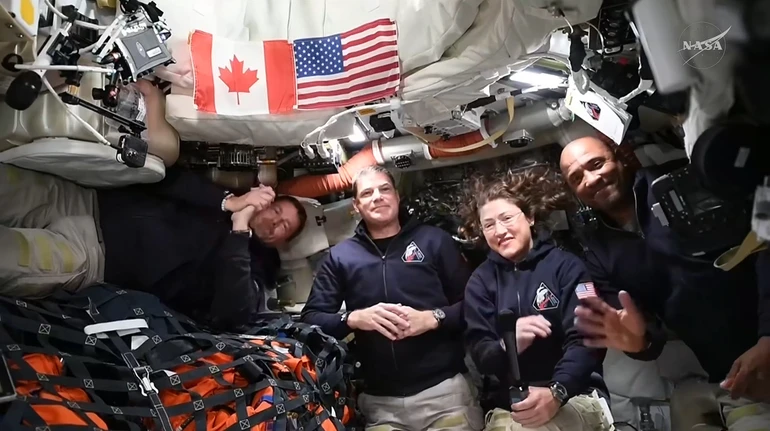
Four astronauts on NASA’s Artemis II mission have entered the Moon’s “sphere of influence.” The spacecraft is now subject to a stronger gravitational pull than Earth’s. The crew reached this point after four days, six hours and two minutes of flight, at a distance of 62,800 km from the Moon. This is reported by The Guardian.
Furthermore, according to the mission plan, the astronauts are to carry out a seven-hour flyby of the Moon. During this time, they will observe the satellite with the naked eye and record its surface using special cameras.
The most important stage will be the flyby over the far side of the Moon, when the ship will be without communication with Earth for 40 minutes, as radio signals will be blocked by the surface of the satellite.
Reed Wiseman, Victor Glover, Christina Koch and Jeremy Hansen became the first astronauts to go to the Moon in the last half century. They will surpass the record for the longest human spaceflight, set by the Apollo 13 mission in 1970, and will fly approximately 6,437 km further.
This will allow astronauts to see the entire spherical surface of the Moon, including areas that were previously out of view, including areas near both poles.
According to NASA, the broadcast of the flyby will start on April 6 at 20:00 Kyiv time. Loss of communication is expected at around 01:47 on April 7, and it should be restored at approximately 02:27. It is expected that at 02:05 the mission will reach the farthest point from the Earth, and at 02:07 it will be at the minimum distance from the Moon.
After flying around the Moon, Orion should return to Earth in four days. In the event of a successful completion of the mission, NASA plans to splash down in the Pacific Ocean on April 10. The total duration of the flight will be nine days.
NASA launched the Artemis II mission on April 1 at 18:35 local time, which corresponds to April 2 at 01:35 Kyiv time, from the Kennedy Space Center. The results of Artemis II will be part of the next stages of the Artemis program, which include docking with landing modules and subsequent landing of people on the Moon.
Earlier, NASA released a photo of the Earth taken from the Orion spacecraft during the flight.