
Astronomers have for the first time recorded the process of forming rings around an icy body

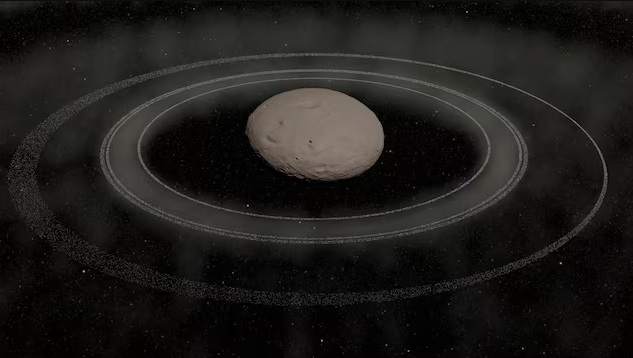
Astronomers have for the first time in the history of observations recorded the process of formation and development of rings around a small icy celestial body – Chiron, which rotates between the orbits of Saturn and Uranus. Researchers have established that the object has four rings and a diffuse substance surrounding it. This is reported by Reuters.
Chiron belongs to a class of celestial bodies known as centaurs – objects located between Jupiter and Neptune and combining the properties of asteroids and comets. They consist of ice, rocks and organic compounds. Chiron is about 200 km in diameter, and it takes about 50 years to orbit the Sun.
Since its discovery in 1977, scientists have suspected that there is material around Chiron. Only new observations in 2023 using a telescope at the Pico dos Dias Observatory in Brazil clearly confirmed the existence of a ring system for the first time. Astronomers found that Chiron has three dense rings at distances of 273, 325 and 438 km from the center, as well as a fourth one at a distance of about 1,400 km, which was detected for the first time. This outer structure needs further study to confirm its stability, as it is located much further away from the previous ones.
“We are seeing Chiron’s ring system changing right now – this is a rare opportunity to observe the formation of such structures in real time,”, said Cristian Luciano Pereira, a postdoctoral fellow at the National Observatory of Brazil and lead author of the study.
According to Pereira, Chiron’s rings are likely composed mostly of water ice with admixtures of rocky particles, similar to Saturn’s rings. He stressed that water ice plays a key role in the stability of the rings, preventing particles from clumping together into larger objects, such as satellites.
A team of scientists from Brazil, France and Spain used the stellar occultation method: they studied how Chiron passed in front of a distant star, temporarily blocking its light. This approach made it possible to reconstruct the shape of the body and its surroundings with high precision.
“We can recreate the shape of the object and its surroundings with an accuracy of a few kilometers”, — added Pereira.
According to the researchers, Chiron’s rings could have arisen after a collision with another celestial body that destroyed its satellite, or formed from material that Chiron itself threw into space. It is likely that several factors combined in the process.
Today, the four major planets of the solar system have rings – Jupiter, Saturn, Uranus and Neptune, with Saturn’s system being the most famous. At the same time, since 2014, rings have also been discovered in smaller objects – in the centaur Chariklo, as well as in the distant icy bodies Haumea and Quaoar. Now Chiron has joined this list.
“The diversity of these systems shows that ring formation is a universal process that can occur in any part of the solar system if the right conditions are present”, – concluded Pereira.


