
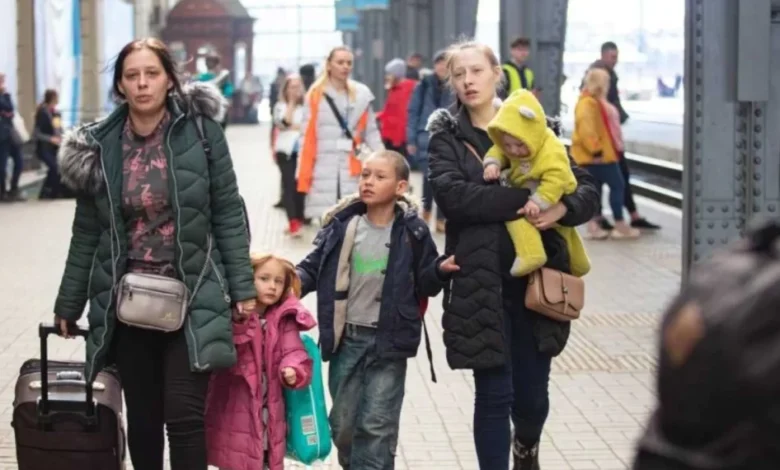
The social consequences of the war in Ukraine are shaping new dynamics of relationships between different population groups, in particular between those who left the country due to fighting and citizens who remained in government-controlled territories. International and domestic experience shows that conflicts not only destroy physical infrastructure, but also change the social fabric of society, giving rise to new categories of people and new forms of perception of each other. Researchers studied how Ukrainians relate to their fellow citizens who have left abroad to understand the level of solidarity, tolerance, and possible social divisions.
General picture of social distance
The Kyiv International Institute of Sociology conducted an all-Ukrainian Omnibus survey, which included questions about attitudes towards refugees, internally displaced persons, Russian-speaking citizens and representatives of other groups. 1,008 respondents were interviewed using the telephone interview method (CATI), who at the time of the study were living in the territory controlled by the government of Ukraine, including internally displaced persons. The survey allows for a highly representative assessment of social attitudes, despite the limitations associated with wartime conditions.
To assess the willingness of Ukrainians to accept representatives of different categories of the population, an adapted Emory Bogardus social distance scale was used. Respondents had to determine how willing they were to allow representatives of each group into their environment: as family members, friends, neighbors, work colleagues, as residents of Ukraine, guests of the country, or not to allow them into Ukraine at all. Based on these answers, the average social distance is determined, which allows us to assess the level of tolerance or prejudice.
The average social distance to refugees abroad in October 2025 was 3.6, which practically corresponds to the average indicators of social distance to ethnic groups recorded in long-term studies by KIIS. This indicates a stable willingness of Ukrainians to integrate refugees into their society and maintain contact with them in various spheres of life.
Attitudes towards refugees
The survey showed that 47% of respondents are ready to allow refugees into their immediate social environment – as family members, friends, neighbors or work colleagues. Another 43% agree that they should live in Ukraine, even if they are not part of their immediate circle of friends. Thus, in total, 89% of Ukrainians demonstrate tolerance and readiness to accept refugees into their society. Only 11% expressed a negative or xenophobic attitude, foreseeing the possibility of preventing refugees from entering the country or limiting their stay to guests only.
These data confirm the stability of social solidarity that was evident in the early stages of the war. A comparison with the September 2022 survey showed that there were no significant changes in attitudes towards refugees: the negative assessment remained marginal, and the position of acceptance and understanding remained dominant, even if we take into account certain categories of refugees, such as young men, towards whom some respondents demonstrated greater skepticism.
Comparison with other social groups
For comparison, the average social distance to Ukrainian-speaking citizens of Ukraine who did not leave the country was 2.4, while to citizens of Russia it was 6.5. This illustrates the extreme differences in attitudes towards “their own” and potentially “strangers”, and also underlines that the social distance towards refugees remains closer to acceptance than towards categories of the population perceived as outsiders or linked to the enemy.
The attitude towards internally displaced persons (IDPs) who have left their homes and moved to other parts of the country is even more tolerant: 58% of respondents are ready to accept them into their closest circle of friends, and the average social distance is 3.1. This indicates a high level of solidarity and understanding of internally displaced persons, despite the possible social and economic difficulties they face.
Ukrainians who remained in the occupied territories are perceived more difficultly: 41% of respondents are ready to allow them into their social environment, 41% agree to their residence in Ukraine, and 9% express a xenophobic attitude. The social distance towards this group is 3.9, which indicates somewhat greater caution and distance associated with political and security factors.
The attitude towards Russian-speaking citizens of Ukraine and citizens of Ukraine of Russian nationality demonstrates the greatest social distance among the assessed groups. The average distance towards Russian-speaking people is 3.6, and towards citizens of Russian nationality is 4.3. This reflects historically formed stereotypes, linguistic differences and political factors that influence the perception of these categories in society.
The KIIS study shows that Ukrainian society maintains a high level of solidarity and tolerance towards refugees, even in conditions of war and the emergence of new social categories of the population. The vast majority of citizens are ready to integrate refugees into the social environment, allowing them to live in Ukraine and participate in community life. Negative attitudes are limited and are not a mass phenomenon.
At the same time, the analysis of social distance shows that certain groups of the population, in particular those who remain in the occupied territories, as well as citizens of Russian nationality, are perceived with caution or distrust. This indicates the complexity of integration processes and the need for sociological monitoring to understand the risks of division and the formation of programs to support mutual understanding in Ukrainian society.
The attitude towards refugees, which can be characterized as tolerant, demonstrates the stability of Ukrainian social capital even in difficult conditions, which creates the basis for the formation of policies to support displaced persons and the development of social cohesion in the long term.


