Officials with cryptocurrency during the war: who owns millions in Bitcoin, Ethereum and USDT

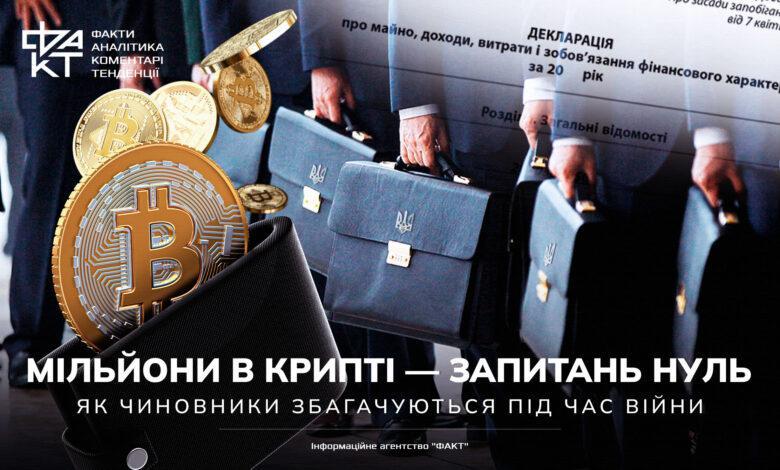
While the country is at war, thousands of officials have officially declared millions in cryptocurrency — bitcoin, ethereum, and cryptodollars. While some are looking for money for new housing, medical treatment and military assistance, others are recording ownership of digital assets worth as much as a new fleet of drones. In 2024, there will be more than two thousand such declarations. The entire top of the state vertical – deputies, judges, prosecutors, police officers – “honestly” count their tokens, and even generally declare other people’s wallets. From a purely technical line in declarations, cryptocurrency gradually turned into a marker of political class: who has how much, what they invested in, what they declared — and what they suddenly “lost.” At the same time, the state officially recognizes the shadow financial instrument, but does not ask questions about where the officials got millions in cryptocurrency. They calmly enter them in the declarations, without explaining the sources of origin and without bearing any responsibility for illegal enrichment. Against the background of the war, this does not look like technological progress, but rather a mockery of the trust of Ukrainians.
Who declared cryptocurrencies and how much
For data “Opendatabot”, Ukrainian officials increasingly actively indicate cryptocurrency in their declarations. According to the results of 2024, there were more than 2,100 such declarations – this is 10% more than in 2023, and 2.2 times more than in 2021 – before the start of the full-scale invasion of Russia. The numbers are shocking: both the number and the amounts that are officially declared (one can only guess what they have unofficially). It is striking that representatives of law enforcement agencies declare the most crypto-assets, and the National Police of Ukraine is the undisputed leader: 15.2% of all crypto-declarations. These are 322 officials who own wallets that often amount to tens of millions of hryvnias. The prosecutor’s office is almost not far behind – 11.4% (240 declarations). In third place are judges: 10.7%. Altogether, this is almost 40% of all crypto-declarants. At the same time, we are talking about people with access to investigations, criminal proceedings and court decisions.
Against the background of the first three leaders, the figure of 3.6% of crypto-owners in the ranks of the Armed Forces looks quite modest, but it raises another question: how and why do the military need crypto-assets in the midst of hostilities? In city councils, 5.6% of officials declared cryptocurrency, 3.5% in regional councils, and another 1.7% in district councils. NABU is also “in the game”: 1.8% of their employees have tokens in their declarations, but whether they conduct inspections of their colleagues and other officials at the same time is a rhetorical question. That is, even those who should have checked such declarations declared crypto-assets themselves. So, the control mechanism has become a part of the process and this system does not require explanations. NAZK does not check the origin of digital assets, the tax office does not ask questions. Cryptocurrency is convenient and invisible to classical mechanisms of financial control. There is no bank seal on it, it is not in a safe, it is not kept in official assets. But at the same time, it can be an asset worth tens of millions of hryvnias. If it is easy to lose it, write in the declaration: “lost access”, and no evidence is needed. And most importantly, without any legal liability.
You can see familiar names in the crypto light league of leaders. Chairman of the Parliamentary Committee on Environmental Policy Oleg Bondarenko declared 80 bitcoins. At the exchange rate for April 1, 2025, this is almost 280 million hryvnias. People’s deputy Serhii Maizel was the largest owner of Ethereum – 200 ETH tokens, which is equal to 15.5 million hryvnias. But the record for the number of USDT crypto-dollars belongs to Vitaly Brovka, head of the department of the Prosecutor General’s Office: 847,908 units worth more than 35 million hryvnias.
There are also interesting cases of lost assets. For example, Roman Saramaga, former deputy head of the State Geodesy, declared 380.95 BTC back in 2021 — approximately 1.33 billion hryvnias for 2025. However, he noted that he had lost access to his wallet. A similar story is with Igor Osipov, a deputy of the Podilsk District Council of the Odesa Region: he had 1,800 ETH, which is equal to more than 140 million hryvnias, but in the last declaration he also reported the loss of access to his digital assets.
Here is another illustrative example. People’s deputy from “Servant of the People” Oleksandr Marikovsky declared cryptocurrency worth more than 24 million hryvnias in 2020, stating that it belongs to him since 2019. Four years later, in 2024, NABU and SAP established that the declared wallet never belonged to him, and the purchase of cryptocurrency was carried out by citizens of another state who are not related to Marikovsky.
In other words, a digital asset with a clearly defined value appeared in the declaration, but without any real connection with the person of the declarant. No transactions, no proof of ownership, no wallet control. This case raised an issue that was previously preferred not to be discussed: cryptocurrency in the declaration may not be property, but a formality that allows you to declare an asset without any confirmations. And while law enforcement officers deal with individual cases, the system itself remains open to such manipulations.
Which cryptocurrency most often appears in the declarations of civil servants
The absolute leader in terms of the number of mentions in the declarations was Tether (USDT), a stable coin tied to the US dollar. It was declared by 6.1% of officials. This is a logical choice: USDT is not about speculation, but about convenient storage of assets bypassing the banking system. In wartime, when bank transfers are under control and currency rates jump, the cryptodollar looks like a bank cell with an anonymous key.
In second place is Bitcoin. It was declared by 5.5% of officials. In this case, we are already talking about investments: Bitcoin is unstable, volatile, but if the entry is successful, it is extremely profitable. It is followed by Ethereum (5.4%) – another classic choice of a crypto trader who has experience and understands how smart contracts, DeFi services and blockchain platforms work.
But then the real crypto mosaic begins. Ripple (XRP) — 3.1%, Binance Coin (BNB) — 2.8%, Solana (SOL) — 2.5%, Dogecoin — 2.4%, Cardano — 2.1%. All these currencies do not indicate stability, but a speculative game. Dogecoin, for example, started as a joke. But in Ukraine it is declared by civil servants. People who officially have to receive a salary in hryvnias declare a meme currency with a dog’s face. No comments.
It is interesting that the remaining cryptocurrencies — and there are hundreds of them — formally fell into the “other” category, which occupies a whopping 69.1%. That is, officials do not just buy bitcoin or ether, they diversify the portfolio, choosing tokens from the market, which even crypto exchanges do not always fully understand. And they do it without explanations, without public reports, without checking the origin of the funds. Just enter the token code and the amount in the declaration, and the case is closed.
Formally, everything is legal. But essentially we are seeing a process in which digital shadow cash is slowly being legalized through declarations. And if yesterday it seemed like a random exception, today it is already a regularity. The state still “does not know” how to react to it. And the officials seem to have long ago decided that cryptocurrency is a convenient answer to all uncomfortable questions.
Where in Ukraine do officials most actively declare digital assets
The distribution of cryptocurrency declared by officials by region eloquently testifies to inequality, concentration of wealth and “technological transparency”, which the state does not really control. Kyiv became the undisputed leader in this process, where 582 officials declared cryptocurrency. And this is not just a record, but absolute dominance. This is more than three times more than in Kyiv region, which comes next (185 declarations). It is followed by Kharkiv Oblast — 172 officials with crypto-assets, then Dnipropetrovsk Oblast (167), Odesa Oblast (117) and Lviv Oblast (133).
These regions have an active business, IT sector, access to investments, and most importantly, a high density of law enforcement and administrative structures. And they are the most represented in crypto declarations. It is interesting that less economically active regions, as well as frontline regions (for example, Luhansk region — 1 declared case, Kherson region — 8) are almost not included in this list. But whether there really is no crypt there is an open question. Perhaps there is simply no such habit, or there is less publicity.
A significant concentration of cryptocurrency declarations by officials in the capital is a telling point. It is Kyiv that accounts for almost 28% of all cases of declaration of digital assets in the country. This is not necessarily related only to the administrative role of the city. This result can be explained by access to financial infrastructure, higher awareness of the mechanisms of cryptocurrency circulation, as well as the peculiarities of the practice of declaration in central authorities. In a situation where cryptocurrency is declared but not verified, it is almost impossible to identify its source. This creates inequality in access to similar financial instruments between different groups of officials – depending on the place of work, authority and professional environment.
The distribution of cryptocurrency declarations by region demonstrates a different level of capabilities, resources, as well as unequal access to assets, which are difficult to verify. In a wartime environment, this highlights the lack of regulation under which public officials can declare significant digital assets without explaining their origin.
So, officials declare large amounts of cryptocurrency, but the state does not control the origin of these assets, does not verify their authenticity, and does not respond when the data raises obvious doubts. This is not surprising, because the leaders in terms of the number of cryptocurrency declarations are the National Police, the Prosecutor’s Office, the courts, as well as NABU. Those structures that should be the first to monitor the integrity of officials, check the sources of origin of property and detect signs of illegal enrichment. But instead of control – participation in the process, which the system not only does not eliminate, but has long accepted as a norm. And most importantly, no one asks: why do officials get rich during the war, when military personnel lose their lives and health on the front lines.
In modern conditions, cryptocurrency has become a convenient form of transferring wealth to a zone where neither tax supervision nor anti-corruption checks work. The system allows you to record any amount in the declaration without explanation and does not provide for real responsibility for illegal enrichment. Until this changes, cryptocurrency will remain not just an asset, but a tool to avoid public accounting of the income of officials, who will continue to enrich themselves on their modest salaries.