Ukrainians assessed the work of the chairmen of the Verkhovna Rada: low ratings as a sign of a systemic crisis of parliamentarism

The modern history of Ukrainian parliamentarism records an alarming trend: the gap between the formal influence of the Chairman of the Verkhovna Rada and his real perception by citizens is becoming deeper and deeper. Recent studies evaluating the activities of all speakers over the years of Ukraine’s independence have shown that the most dangerous thing for the state is total skepticism about the institution as a whole. 25.8% of Ukrainians are convinced that no Chairman of the Verkhovna Rada in history has brought real benefits to Ukraine. Now we are observing the final stage of public disgust, where the lack of a positive attitude towards the leadership of the parliament has long become the norm. The constant lowering of the bar of authority is finally eroding the remnants of respect for parliamentarism, turning the highest legislative position into an almost empty place in the eyes of society.
From Plyushch to Stefanchuk: what the research results showed
A joint study by the Politarena publication and the research company Active Group recorded extremely low assessments of the activities of the chairmen of the Verkhovna Rada over the years of Ukraine’s independence, and these results indicate not only the weak positions of individual politicians, but also the general devaluation of the institution of parliamentarism itself. The distribution of Ukrainians’ responses during surveys shows that the public perception of this position is predominantly negative. At the same time, Ivan Plyushch has the highest rating – 19.0%, followed by Oleksandr Moroz – 14.4%, Leonid Kravchuk – 11.8% and Oleksandr Turchynov – 10.9%. At the same time, even the leader of the rating does not receive even a fifth of the votes, which means that this is an extremely low rating.
Even more telling is the middle segment of the rating, in which Dmytro Razumkov, Arseniy Yatsenyuk and Volodymyr Lytvyn each have 9.8%, Oleksandr Tkachenko – 9.2%, and Volodymyr Groysman – 5.9%. Such indicators do not give grounds to speak of the strong authority of any of these politicians as chairmen of the Verkhovna Rada. Rather, they indicate that even the more recognizable figures of Ukrainian politics have not been able to establish themselves in the public memory as indisputably successful leaders of parliament. In this sense, the study records the systemic weakness of the position, which over the years of independence has never become an obvious symbol of effective political leadership for most citizens.
However, even more critical is the lower part of the rating, in which Volodymyr Rybak has 2.4%, Andriy Parubiy – 1.5%, and Ruslan Stefanchuk – 2.6%. For the current Speaker of the Verkhovna Rada, this result looks especially indicative, because he occupies only tenth place out of twelve, that is, he is among the outsiders of the rating. This indicator indicates that the current Speaker has an extremely low assessment of his work, has practically no independent weight and is not perceived by society as one of the key figures of the Ukrainian political system.
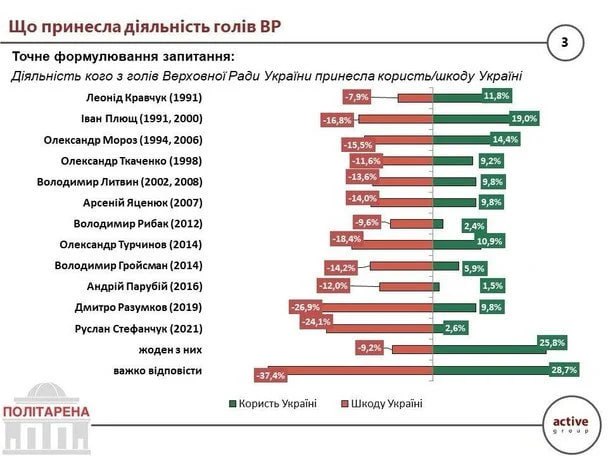
Two final figures deserve special attention, which actually set the framework for the entire study. 25.8% of respondents said that no chairman of the Verkhovna Rada in history has brought real benefits to Ukraine, and another 28.7% could not decide on an answer. In total, this is 54.5% of those surveyed. It is this indicator that most accurately conveys the state of public attitudes towards speakers, which seems to be a stable pattern.
Why Ruslan Stefanchuk was among the outsiders of the rating
Ruslan Stefanchuk’s stay at the bottom of the rating is a logical consequence of a number of his “political exploits”, which instead of strengthening parliamentarism led to the actual loss of subjectivity of the Verkhovna Rada. Instead of being an arbiter in the meeting room, the speaker has turned into a relay of the will of other government offices, which finally erodes the remnants of respect for the speaker.
In addition, the figure of Ruslan Stefanchuk at the head of the Ukrainian parliament is increasingly viewed through the prism of a deep dissonance between his academic experience and the harsh realities of political crisis management. Opponents and public institutions accuse the speaker of both a selective approach to compliance with the rules and the promotion of legislative initiatives, which are labeled by experts as a brake on democratic reforms.
The central point of tension was the bill on the renewal of the Civil Code, which, due to its volume of 2 thousand articles, should have become the foundation for the protection of labor rights of citizens, but instead became the object of sharp media criticism. The legal community sees in the norms of draft law No. 14057 hidden mechanisms of censorship, which, under the guise of protecting honor and dignity, create immunity for top corrupt officials. This approach sharply contrasts with the European vector of integration, which human rights activists have repeatedly emphasized, pointing out the document’s inconsistency with EU standards.
An additional reputational blow to the speaker’s initiatives was caused by an attempt to radically revise ethical principles: the rejection of the definition of “moral principles of society”, which Stefanchuk branded as a vestige of the Soviet era, and ambiguous proposals regarding the marriageable age from 14 only deepened the gap between lawmakers and the conservative part of society.
At the same time, support for the resonant draft law No. 12089, known as the “Ihor Mazepa law”, provoked accusations of legalizing dubious transactions with state resources. The European Parliament actually regarded this step as an attempt to amnesty the illegal seizure of strategic lands and forests, the statute of limitations for which exceeded a decade. Similar concerns were raised by the reform of state-owned enterprises No. 6013, where behind the facade of modernization, risks of shadow redistribution of assets without transparent privatization procedures are seen.
In addition, Ruslan Stefanchuk demonstrates a style of behavior in parliament that is called a “professor in a gladiator’s chair.” His desire to resolve acute political issues solely through a dry appeal to the rules of procedure often turns out to be powerless against blocking the rostrum or systematic ignoring of personnel issues, as was the case, for example, in the long-standing confrontation over the leadership of the National Security Committee. Compared to his predecessors, the current speaker often chooses the tactic of winding up the meeting instead of searching for solutions and compromises, which is perceived as a sign of political weakness and loss of control over the hall.
The situation is complicated by the current degradation of the monomajority, where Stefanchuk is finding it increasingly difficult to ensure a quorum for strategic votes. Instead of the role of an independent arbitrator, the speaker is forced to balance between the interests of the Office of the President and the requests of the deputy groups that were formed on the ruins of the former OPZZH. This dependence on “satellite groups” deprives the institution of the Chairman of the Verkhovna Rada of its independent weight, turning it into a technical registrar of agreements reached outside the walls of the presidium.
A separate layer of public discontent concerns the personal ethics and personnel policy of the Chairman of the Verkhovna Rada. Ruslan Stefanchuk’s calls to stop harassing people’s deputies caused an ironic reaction in society, which sees this as an attempt to build an information dome around the deputies and protect them from public responsibility. Against this background, his story with renting a Kyiv apartment from his mother-in-law has become a symbol of double standards and lies, causing a wave of sarcasm and indignation among Ukrainians.
The issue of nepotism also remains consistently acute in Ukrainian politics, which is strenuously fighting this phenomenon in words. The presence of Mykola Stefanchuk’s brother in the same party as Ruslan Stefanchuk creates the effect of family representation within the same mandate. Moreover, no one doubts how the speaker’s brother, engaged in scientific and teaching activities, suddenly became a people’s deputy. The work of the speaker’s wife, Maryna Stefanchuk, in the team of Danyla Hetmantsev, although it does not violate the direct prohibitions of the 2021 law, is perceived as a way to maintain influence through informal connections. The activities of the speaker’s daughter Zlata Stefanchuk in the status of assistant to the people’s deputy Maryna Bardina complements the picture of family involvement in the power vertical in parliament.
The practice of “political selection” in the issue of Ruslan Stefanchuk’s foreign trips also causes a sharp reaction from society. The sole right to sign for the departure of deputies has become a tool for pressure on the opposition, which, according to international partners, destabilizes internal political unity and undermines Ukraine’s reputation in the international arena as a democratic state with equal rights for all people’s representatives.
In addition, Ruslan Stefanchuk has long been associated with the term “watchdog” of the intellectual sector of the state due to his persistent strategy of subordinating academic verticals to the current political course. Using the position of speaker of parliament as a tool for influencing the legislative sphere, he is trying to institutionally tie part of legal science to the parliamentary agenda, which causes criticism in parts of the academic environment, concerned about the loss of distance between scientific expertise and state policy.
As an active academician of the National Academy of Legal Sciences (NAPrN), Stefanchuk not only receives lifelong financial payments from the State Budget, but also directly influences the academy’s personnel policy. The media has repeatedly reported on his attempts to influence the internal decisions of the NAPRN and promote loyal candidates to its leadership. The most notable episode was the promotion of Oleksandr Kopylenko to the position of president of the academy. Under such circumstances, this is at least political lobbying and an attempt to increase influence over the academy, which in professional circles is perceived as an encroachment on its autonomy.
It should be noted that Ruslan Stefanchuk’s systematic attempts to join the NAS of Ukraine as a corresponding member ended in two consecutive failures. His candidacy was officially nominated in 2024 and 2025, but he is absent from the lists of elected corresponding members in both cases. This fact alone does not prove the motives of the academic community’s vote, but it shows that even the status of the current Chairman of the Verkhovna Rada did not ensure his recognition in the National Academy of Sciences of Ukraine.
At the same time, the process of reforming scientific legislation, which Stefanchuk initiates and coordinates, is often perceived as a tool for establishing a manual management regime in the industry. His public rhetoric regarding a radical change in the funding system and a revision of research priorities conceals the potential for resource redistribution in favor of projects that have exclusively political or applied expediency for the authorities. This poses a threat to fundamental sciences, which cannot yield immediate results but are critically important for the future development of the country.
As we can see, the combination of the status of Doctor of Law, Professor, Academician of the National Academy of Legal Sciences with the powers of the Chairman of the Verkhovna Rada gives rise to a classic conflict of interest, where scientific activity becomes not an end in itself, but a mechanism for strengthening political influence. Having hundreds of publications in his oeuvre, Stefanchuk is actively integrating into the academic elite, but this process resembles the expansion of political resources into the closed environment of scientists. As a result of such a symbiosis, science risks losing its independence, becoming only an appendage of the state apparatus.
It is noteworthy that Ruslan Stefanchuk was the initiator of bills that gave a positive result in the field of intellectual property, copyright and legal regulation of the state. At the same time, it is difficult to call him a politician who is associated with laws of direct social action, which have noticeably improved the lives of Ukrainians.
Thus, instead of institutional evolution, Ukrainian parliamentarism is rapidly plunging into a phase of managed degradation, where each subsequent figure in the speaker’s chair is less authoritative than the previous one. If once the chairman of the Verkhovna Rada had a certain political leverage, was capable of internal resistance or at least a complex game of compromises, then the current governance model has actually reduced the role of the speaker to technical support for decisions made outside the parliament.
The biggest risk of this model is that the external manageability of the parliament hides a steady trend towards weakening its political role. Low assessments of the activities of the chairmen of the Verkhovna Rada over the years of independence show that the problem is systemic and cannot be reduced to one term or one surname. At the same time, the result of Ruslan Stefanchuk in this series is especially indicative, since we are talking about the current speaker, who should personify the institutional weight of the parliament, but instead ended up among the outsiders of the rating.
Under these conditions, the decline in the authority of the Speaker of the Verkhovna Rada should be seen as a consequence of a model in which the Speaker is expected to have less and less political independence and more and more procedural control. If this trend continues, the parliament will have less and less influence on the formation of the political agenda, and the gap between its official status and real authority in the eyes of Ukrainians will only deepen.