The Prime Minister does not see large-scale corruption in Ukraine: what to expect after Yulia Svyrydenko’s loud statement

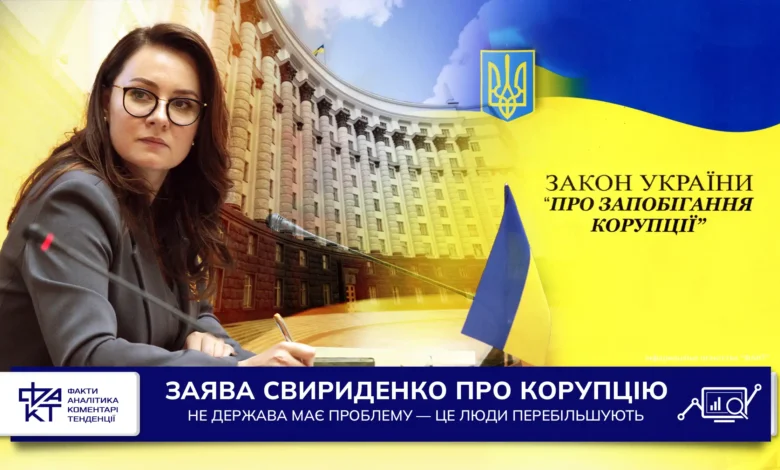
After decades of official recognition of the large-scale presence of corruption in public administration, newly appointed Prime Minister Yulia Svyridenko stated that this problem in Ukrainian society is excessively exaggerated. Her statement came against the background of numerous open criminal proceedings involving deputies and officials of all levels, as well as high-profile scandals in the areas of public procurement, distribution of humanitarian aid, customs control, land acquisitions, military tenders, justice and law enforcement activities. In this context, the statement of the head of the Cabinet of Ministers at the start of her work raises questions not only about the logic of her personal vision, but also about whether the new government considers corruption to be a real threat that must be fought hard and consistently.
Yulia Svyridenko’s statement on the problem of corruption in Ukraine
The problem of corruption, which traditionally occupies a prominent place in the Ukrainian public agenda, became the topic of a high-profile interview of the new head of government, Yulia Svyridenko, for the Bloomberg agency. In it, the official directly stated that the attitude towards corruption in Ukrainian society is “exaggerated and overinflated”, especially within certain social groups, and questioned the scale of the problem in its public representation. The phrase that Svyridenko used literally sounded like this: “Frankly, in Ukrainian society and certain social groups, this issue is intensified and exaggerated.” According to her, this creates a distorted picture, which, in combination with external perceptions, creates pressure on the government and state institutions. This assessment was voiced in the context of questions about anti-corruption risks, the effectiveness of reforms, and criticism, which comes from both Ukrainian citizens and international partners.
The Prime Minister also believes that internal attention to corruption topics, despite its unconditional importance, often does not correlate with the real experience of people. She referred to sociological surveys, which indicate a gap between the perception of the scale of corruption and a personal encounter with its manifestations. Svyridenko gave an example of the results, according to which the vast majority of Ukrainians consider corruption to be a common phenomenon, but at the same time, significantly fewer respondents had experience of direct contact with bribery or other corrupt practices.
In addition, Yulia Svyridenko also emphasized that external observers of Ukraine, in particular representatives of international organizations, evaluate the situation with corruption by other indicators. At the same time, she did not clarify which indicators are in question, but made it clear that their assessment takes into account institutional parameters, macroeconomic indicators, the dynamics of reforms and the stability of the government. At the same time, she did not deny that the issue of corruption remains in the field of view of Ukraine’s partners, but emphasized that the government has the right to propose its own approach to analyzing the situation and responding.
Thus, the issue of excessive attention to the topic of corruption, voiced by the Prime Minister, sounded in the context of an attempt to legitimize the government’s actions, which caused an ambiguous reaction both within the country and among external partners. At the same time, Svyridenko did not specify which social groups exaggerate the importance of the problem. She also did not give examples that could specify what the difference between Ukrainians’ perception and reality is. Her assessment was general, abstract, but sounded categorical.
What do Ukrainians really think about corruption in the state
The topic of corruption in Ukrainian society remains a subject of constant attention, concern and discussion. According to the results of a sociological survey conducted by the Kyiv International Institute of Sociology (KIIS), the absolute majority of Ukrainian citizens consider corruption to be one of the most serious problems in the state. According to published data, 92% of surveyed Ukrainians consider corruption to be a serious problem. This indicator became the second most important after full-scale war, which 95% of respondents called the most important challenge for the country. So, the public perception of corruption is close in terms of significance to the threat it poses to Russia.
Such assessments indicate an extremely high level of concern among citizens about the state of affairs in the sphere of government transparency, the effectiveness of public administration and justice. According to the results of the study, the most common situations in which Ukrainians faced the need to pay bribes are school education and obtaining medical services. These areas were named as examples of the most sensitive in the household dimension. At the same time, sociologists expectedly did not provide detailed data on the frequency of contacts of citizens with high-ranking officials, ministers or other representatives of the authorities.
So, the results of the survey indicate that perceptions of corruption in big politics, high echelons of government or power structures are not necessarily accompanied by real contact with these branches of power. Instead, direct communication and everyday experience are crucial in shaping attitudes towards the problem.
A separate block in the study dealt with issues of justice and permissible measures of punishment for committing corruption offenses. According to the answers of the respondents, the majority of Ukrainians consider a fair punishment for officials in the form of ten years of real imprisonment with mandatory confiscation of property. This approach shows the public demand for a tough reaction by the state to corruption crimes, as well as the fact that citizens do not consider soft or conditional measures of influence on officials exposed in illegal activities to be effective.
In addition, according to the results of the survey, a large part of citizens are convinced that the state authorities in Ukraine are becoming more corrupt over time. The high level of pessimism on this issue remains stable. This assessment applies to both executive bodies and law enforcement structures and the judicial system. In support of this trend, the research indicates that participants in the financial market, that is, representatives of the business environment, also note the risks associated with the activities of law enforcement agencies and courts. In the structure of answers, these threats were ranked fourth among all possible risks that negatively affect the economic environment.
However, it is worth paying attention to one more indicator of the survey. Although Ukrainians recognize that corruption is a widespread phenomenon in the country, this does not mean that everyone has had direct experience of interacting with corrupt officials. On the contrary, there is a gap between awareness of the existence of a problem and personal involvement in it. This difference in assessments — between the general belief about the magnitude of corruption and the comparatively smaller number of personal encounters with it — has been recorded by researchers in the form of a ratio of public perception and empirical experience. However, this does not reduce the level of anxiety with which most citizens perceive corruption in the state.
How many Ukrainians report corruption
A whole network of anti-corruption structures has been created in Ukraine — more of them than in many European countries. However, the fact of their existence does not mean real effectiveness. Closed-loop formation, corporate solidarity, and circular suretyship continue to prevail over law. At the same time, according to the NAKC, only 9.7% of Ukrainians who encountered facts of corruption reported it to the competent authorities. In the business environment, this indicator is slightly higher — 17.2%, but even compared to the average level for EU countries, where this indicator is about 18%, Ukraine demonstrates an extremely low level of activity.
The low percentage is not explained only by indifference — 12.3% of citizens and more than 21% of business representatives formally declare their readiness to be exposed. However, in practice it remains only an intention, not confirmed by actions. And this creates a gap between personal experience and real reaction: corruption is seen, but they do not dare to report it. The European Commission has identified the main reasons for this phenomenon, and all of them are associated with deep risks for a potential whistleblower.
The strongest restraining factor is the fear of legal consequences: it is reported by 93% of respondents. It is about the lack of effective protection mechanisms, the risk of prosecution, pressure from the system in case the application is found to be unfounded. Since law enforcement agencies themselves are often associated with possible corruption risks, even formally correct actions can be perceived as dangerous.
Financial losses rank second among deterrent factors: 92% of respondents are afraid of them. For citizens, these are possible expenses for legal assistance, the threat of losing a job or facing persecution by an exposed official. For business, this is the threat of additional inspections, tender rejections, problems with tax authorities or regulators. At the same time, the expected losses often outweigh the perceived benefit from a fair resolution of the issue.
No less important is the fear of reputational consequences. 86% of respondents believe that their personal or professional relationships may suffer after exposure. Despite the official rhetoric about the importance of whistleblowers, in the real world such behavior can be perceived as risky, uncomfortable or even socially unacceptable. In small teams, this often leads to isolation, loss of trust and prospects.
All these factors — legal, financial, social — form a stable pattern of avoiding any activity. And even in cases where the facts of corruption are obvious, the strategy of silence prevails as the least risky solution. This tactic is not out of indifference, but the understanding that the system is not on the whistleblower’s side. At the same time, anti-corruption bodies, despite loud reports and formal powers, could not change this behavioral model. Citizens do not perceive the system as reliable protection.
Examples of investigations lasting years, selective responses, and a lack of real accountability for those involved in high-ranking positions reinforce the atmosphere of mistrust. As a result, even those who declare their willingness to expose choose to remain silent, because the balance between personal risk and belief in justice remains unequal. And until this balance changes, the level of actual reports of corruption will remain critically low.
Therefore, the characteristic gap between the high level of perception of corruption in society and the relatively low percentage of personal encounters with it, referred to by Yulia Svyridenko, is not evidence of an exaggeration of the problem. On the contrary, he points to a different trend — the lack of reports of corruption due to fear of consequences, mistrust of law enforcement agencies, and belief in the system’s impunity. People do not record the facts of corruption officially, not because they do not encounter it, but because they do not see the meaning in their further actions. This silent experience accumulates in the mass imagination, and this is why sociology records high anxiety about corruption as a background norm, even in the absence of direct appeals or complaints. Thus, to interpret these data as evidence of “exaggeration” is to ignore the very mechanism of silencing in the process of evidence of systemic corruption.
Does the Verkhovna Rada contribute to the fight against corruption?
The Verkhovna Rada gives the appearance of fighting corruption by passing laws. Here is the latest example of their “unbearable struggle”. In May, the parliament registered draft law No. 13271-1 as a step towards “strengthening responsibility” for corruption offenses. At first glance, the document really looks like a strengthening of control, but in reality it contains a number of norms that, on the contrary, narrow the tools of verification. The draft law provides for the limitation of the period of monitoring of the lifestyle of the subjects of the declaration to four months and allows for verification only during the person’s tenure. This means that any assets acquired or registered after leaving office automatically fall out of the NAC’s purview, even if they have signs of illegal origin. Such a scheme allows you to get property out of control, for example, to issue it to relatives or delay the official acquisition.
It is also proposed to establish the maximum terms of data storage in the Register of Corruption Perpetrators: for administrative violations – according to the norms of the Code of Criminal Procedure, for criminal ones – according to the Code of Criminal Procedure. This undermines the idea of the registry as a tool of public control. Another innovation is automatic loading of personal data from registers in declarations. In case of discrepancies, the responsibility of the declarant does not arise, nor for technical failures or unavailability of systems. Threshold amounts for false declarations are updated, fines are increased, but at the same time the range of cases that NABU can investigate is reduced: the amount of discrepancies subject to investigation is increased to 1,000 and 2,000 subsistence minimums.
Formally, the draft law fulfills the requirements of the ECHR regarding the protection of personal data and privacy. However, it actually proposes changes that make it more difficult to detect property acquired through corruption. Thus, it may create new opportunities for avoiding responsibility rather than contributing to the real fight against corruption. That is, when adopting laws, the parliament also does not see big problems in this area, and in this, as we can see, it is in solidarity with the government.
Corruption in Ukraine has long ceased to be a shadowy phenomenon. It not only penetrated the state apparatus, but became an integral element of it, integrating into the structures of power, into the everyday life of officials and into the very logic of their decision-making. Since the beginning of independence, this system has not been weakened, but on the contrary, it has been consistently strengthened. Each subsequent attempt to “overcome” or “eliminate” it did not break its mechanisms, but only pushed it to transformation, adaptation and further growth. Even a large-scale war, which should have become a point of purification, did not stop these processes. On the contrary, in a country that is sustained by international support and public coercion, the scale of abuse, manipulation and embezzlement has only increased.
The level of corruption in Ukraine and trust in state bodies
Corruption in Ukraine, despite the full-scale war, not only did not disappear, but also retained its long-term systemic positions. Ratings, official indicators and large-scale sociological studies record the fact that distrust of state authorities is growing, while the effectiveness of the fight against corruption remains insignificant. In the absence of verdicts, given the regular scandals surrounding high-ranking officials, a persistent belief is forming in Ukrainian society: the justice system and anti-corruption bodies are more likely to imitate their work than to protect the interests of citizens.
In 2024, Ukraine ranked 105th out of 180 countries in the Transparency International Corruption Perceptions Index rating. This indicates a weakening of the position in the global anti-corruption context — the state has dropped one step compared to the previous year.
In addition, since 2014, the judicial reform has remained incomplete, and the anti-corruption infrastructure, despite the creation of key institutions — NAZK, NABU, SAP, VAKS — has not demonstrated effectiveness in the form of real punishments for top officials. Cases involving high-ranking officials often end not even with formal sentences, but with release on bail. At the same time, the participants retain their influence, positions and the opportunity to participate in public events at the international level. The latest example of this is the suspicion raised by NABU detectives against the Vice Prime Minister, the Minister of National Unity Oleksiy Chernyshov. He is accused of abusing his official position and receiving a particularly large bribe, but the court released him on bail in the amount of 120 million hryvnias, and after that the official continued to work in his position. This signals not only inequality before the law, but also the preservation of influence and protection for those involved in the cases, even in the most resonant episodes.
Currently, the level of public trust in state bodies and the judicial system is recorded as critically low. According to the Razumkov Center, 82% of citizens consider the authorities’ actions in the fight against corruption ineffective: 39% rated them as “very bad”, 43% – “rather bad”. Only 12% of respondents recognized the struggle as successful. Such results show that even against the background of threats of war, the population does not see the state’s systemic ability to detect, punish and prevent corruption crimes.
Of particular concern is the level of trust in the judicial branch of government. Only 16% of respondents believe that it works satisfactorily. The majority of the population associates courts with corruption, the influence of oligarchs, and the opportunity to “solve issues” with the help of bribes or connections. This level of mistrust actually destroys the basic principles of the rule of law — without judicial justice, there can be neither economic stability, nor social peace, nor predictability of the state’s actions.
Data on other bodies that should ensure compliance with the law also do not allow us to talk about the restoration of the authority of the state. 45% of citizens trust the State Bureau of Investigation, while 50% express distrust. The National Anti-Corruption Bureau, the General Prosecutor’s Office and the State Customs Service have even lower figures: trust in them is kept at the level of about 33%, while more than 60% of respondents declare complete distrust. These figures not only illustrate the despair in the state’s ability to fight corruption, but also highlight the growing public disillusionment with the institutions that are supposed to ensure justice.
Against this background, only a few structures maintain a high level of trust. Among them are the Armed Forces of Ukraine, which are trusted by 91.5% of respondents, volunteer organizations (80%) and the State Emergency Service (83%). Society explains their support by direct contribution to the defense of the state, human sacrifice and real results. Unlike law enforcement agencies, these structures are not associated with corruption or abuse of power, and that is why they maintain the highest level of trust.
The situation when against the background of war, which society perceives as a threat to the very existence of the state, certain officials and elites turn war into a source of enrichment is indicative. According to journalistic investigations, it is during a full-scale war that a number of embezzlements with state property, humanitarian aid, and purchases take place. The mechanism remains unchanged: funds are withdrawn through controlled structures, close circles or undercover persons, tenders are drawn up on notoriously unfair terms, and there is mutual “cover-up” at the level of the state apparatus.
The key factor in the preservation of corruption on the existing scale is not the imperfection of individual institutions, but the lack of political will to eradicate it. In a situation where almost no high-profile case has resulted in a real verdict, and “investigations” become a tool of political pressure or manipulation, the state loses its legitimacy in the eyes of its own people. Arguments about war, lack of resources, or a difficult situation only mask the deep-seated inability or unwillingness of the system to self-cleanse.
The consequences of this are obvious not only for Ukrainian society, but also for international partners. Rhetoric of diplomatic representatives, reports of donor structures and statements of key Western allies of Ukraine contain more and more hints about the need for systemic changes, real anti-corruption actions and transparency of resource management. The irresponsibility of officials, impunity for offenders and weak institutional capacity increasingly affect the international authority and level of trust in Ukraine as a partner.
Against this background, the statement of the head of the government, Yulia Svyridenko, that the attitude to corruption in Ukrainian society is “exaggerated and excessively inflated”, clearly outlined the framework of the further state strategy. At a time when society expects decisive steps, trust in state institutions is at a low level, and international partners demand real actions, such a position de facto legalizes the preservation of the status quo. This demonstrates that the new leadership of the government does not recognize corruption as a systemic threat and does not consider the fight against it as a priority of state policy. That is, such a position at the highest level signals the preservation of corruption as an acceptable norm of public administration.
Denial of the scale of the problem is a direct indulgence for those who are embedded in corrupt mechanisms and rely not on the law but on personal connections, immunity and the tacit consent of the system. This is a signal to the entire bureaucratic apparatus that no structural changes are expected, and public pressure can be neutralized through a change in rhetoric. Most likely, in such conditions, rebooting the government will not lead to the eradication of corruption. On the contrary, it is possible to predict even greater inertia, imitation of changes and strengthening of protective mechanisms for the current “elite”.