Children facing armed threat: recommendations from the head of the juvenile police after the shooting in Kyiv

The incident in the Holosiivskyi district of Kyiv, where an armed man opened fire on people, took hostages in a store, and shot at police officers during the arrest, shook Ukrainian society. Even more indignant was the fact that a child was among the victims. Against the backdrop of a war that creates an environment of increased danger for children every day, the threat comes not only from enemy shelling, but also from the aggressive behavior of mentally unstable armed people. After this incident, the juvenile police published advice on how children can escape if shots are heard on the street or a person with a weapon appears nearby.
On April 18, a man opened fire on people in the Holosiivskyi district of the capital, then took hostages in a store and shot at law enforcement officers during the arrest. Five people died on the spot, 15 people were injured, including a child, and two of the wounded later died in hospital.
After this shooting, the issue of children’s safety in public spaces became particularly acute, since the danger arose not in a combat zone or during an airstrike, but in the midst of city life, where passersby, shopkeepers, parents with children, and random witnesses could be nearby.
Head of the juvenile police Vasyl Bohdan suggested an algorithm of actions: run, hide, report. In a situation where seconds become decisive, a child should know the sequence of actions by heart, without long reflections and attempts to assess the attacker’s intentions. Parents should tell the child about this.
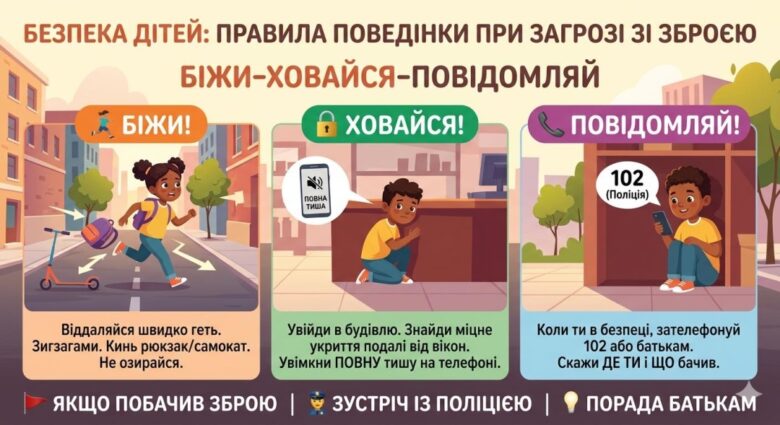
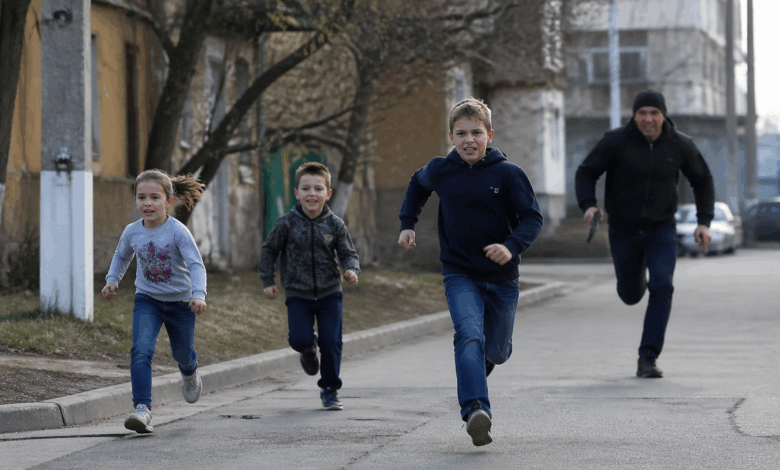
If a child hears gunshots somewhere ahead or sees an armed person in the distance, they should immediately move away in the opposite direction, without stopping to examine the scene. Police advise running in zigzags, using the walls of buildings as cover, and also throwing away things that interfere with movement, including a heavy backpack, scooter or other bulky objects. Waiting for friends or trying to convince someone to run together in such a situation takes up time that can cost a life.
In circumstances where movement could attract the shooter’s attention, the child should immediately drop to the ground and cover their head with their hands. If there is a depression, ditch, or high ledge nearby, police advise rolling over to reduce the risk of injury.
This scenario requires a child not to be brave, but to have quick reaction skills, so it is important for parents to discuss such actions in advance, without intimidation and without unnecessary details that can only increase anxiety.
If the attacker is nearby or the exit from the street is blocked, the child should go to the nearest building — a store, pharmacy, cafe, entrance or other room where they can hide from direct visibility. Inside, you need to choose a place away from windows, lie on the floor behind a solid object and stay there until the police arrive.
The head of the juvenile police draws special attention to the phone: it must be put in completely silent mode, even turning off the vibration alert, since in silence it can also give away the place where the child is hiding.
You should contact the police or parents only when the child has already hidden or run away to a safe distance. During the call, you should briefly report where they are, what they saw, and whether there are any injured people nearby.
For such a situation, it is important for the child to know their parents’ numbers by heart and be able to use the emergency call on a locked smartphone, since under stress, accessing contacts or searching for a number in the phone book may be too slow.
In the case where a child saw a person with a weapon before the shooting began, the police warn against any attempts to take photos or videos. Such a reaction, which for adults often becomes almost automatic, can attract the attention of the attacker and create additional danger.
Instead, the child should calmly move in the other direction, without making sudden movements or showing fear, and after leaving a safe distance, report what he saw to the police and contact his parents or relatives.
After the arrival of law enforcement officers, the child should keep his hands in sight, not make sudden movements, and follow all commands without objection. At the time of the arrest of an armed person, the police act as quickly as possible, so any unpredictable action by witnesses or victims can complicate the situation.
Vasyl Bohdan separately emphasizes that the child should not run to the law enforcement officers, touch them, show the phone, or try to explain something with gestures until asked.
Parents’ conversation with children about such risks requires a calm tone in which the child will hear the safety algorithm, and not feel additional fear. The police advise talking about these rules as a life skill, similar to the ability to swim or to handle hot objects with care.
For parents, such a conversation has another practical part: checking whether the child remembers the phone number, knows how to call 102, knows how to quickly turn off the sound on the phone, and understands where to seek shelter in the city – in a store, pharmacy, entrance or any accessible room.
After the shooting in Kyiv, the recommendations of the juvenile police sounded as a response to a situation in which the threat to children arose suddenly, in an ordinary urban environment and without any warning. In conditions of war, Ukrainian families are used to explaining to children how to act during an air raid or shelling, but cases of armed attacks in public places require separate training, where attentiveness, speed and clear implementation of a simple algorithm of actions become crucial.