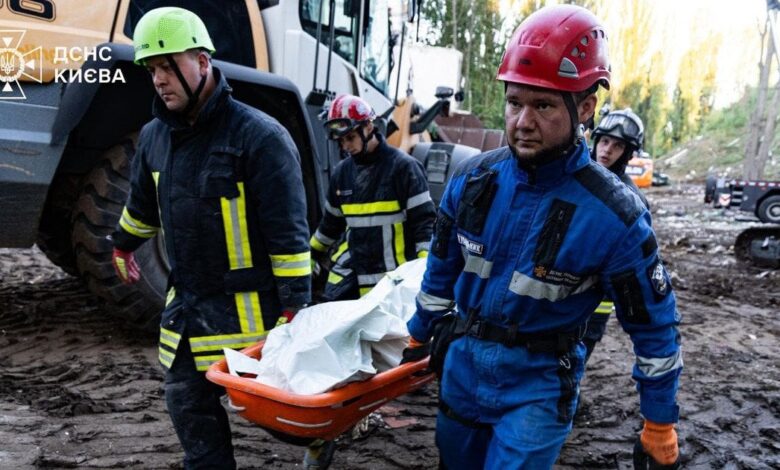
New details of the combined attack on Kyiv, which took place on the night of July 31, became known. The explosions killed 31 residents of Kyiv, among them were five children – two schoolgirl sisters, a six-year-old boy, a graduate of one of the capital’s lyceums, and a two-year-old child. It was one of the deadliest strikes on the capital since the full-scale invasion began. The events of that night proved that the issue of the security of the civilian population in Ukraine continues to remain open.
The death of the Humenyuk family and Vladyslav Gayovoy
The strike on residential areas took the lives of a family that had moved to Kyiv from Donbas. Alina and Anastasia Humenyuk studied at Kyiv Lyceum No. 13. Their mother died with them in the apartment that was supposed to be their refuge after moving from the region, where hostilities have continued since 2014. The lyceum where the girls studied released a statement about the tragedy, stressing that the family was trying to start a new life in safety. However, moving to the capital, which was considered relatively protected, did not save them from death.
The Lyceum also confirmed the death of one more of its students — Vladyslav Gayovoy, a graduate of the same institution. According to teachers, the boy was disciplined, attentive, active in school life.
The news about the death of the girls and Vladyslav was accompanied by an announcement of assistance to the families and an announcement about the preparation of a fundraiser. But within the framework of this event, not only the issue of local support comes to the fore, but also the scale of the tragedy as a result of targeted rocket fire on residential areas of the capital.
The death of Matvyi Marchenko
Six-year-old Matviy Marchenko also died as a result of the shelling. He was the youngest son in the family, practiced karate at the Saint-Bin club in Kyiv and, according to the coach, managed to become an example for many children in the team. The organization where the boy trained reported his death, calling it not only a family tragedy, but also a loss for the entire community.
Coach Ihor Yefimenko, who knew the boy personally, gave an example of a conversation with Matvii, when he set a specific sports goal – to surpass his older brother in the number of medals. According to Yefimenko, the boy had character traits characteristic of older children: self-discipline, concentration, and internal motivation. These qualities, combined with his age, make it difficult to perceive his death even in a society accustomed to loss.
The club where Matvii worked expressed condolences to the family and noted that the loss of a child of this age is the result of actions that cannot be justified by any political or military circumstances.
International reaction: declarations without consequences
Despite the scale of the shelling, the number of victims among the civilian population and the nature of the target (residential buildings where children were), the reaction of foreign countries and international organizations was, as always, limited. In most cases, these were standard statements by representatives of diplomatic agencies about concern, condemnation or expressions of support for Ukraine. At the same time, practical steps aimed at strengthening the security of the civilian population were not recorded.
Neither a change in the policy of supplying air defense systems, nor initiatives on the part of international institutions to bring responsibility for shelling of civilian infrastructure after the July 31 tragedy was noticed. Information about the death of children did not become the subject of separate debates within the framework of the UN or the Council of Europe. That is, the situation in which the death of minors as a result of direct shelling of the capital of one of the largest European countries does not cause any change in international rhetoric demonstrates the gap between the declared principles and real practice.
Systematic attacks and lack of legal mechanisms of influence
Attacks on civilian objects in which children die are not exceptional. Kharkiv, Mykolaiv, Chernihiv, Zaporizhzhia, Kramatorsk – each of these cities has recorded cases of death or serious injury of minors as a result of missile or drone attacks. Ukraine regularly transfers this data to international partners, in particular through the official channels of the Ministry of Foreign Affairs, the Prosecutor General’s Office, and the Commissioner for Children’s Rights. At the same time, these materials do not lead to legal or political decisions that could reduce the risks of repeating such attacks.
Currently, there is no mechanism that would force the Russian Federation to stop shelling civilian infrastructure precisely as a result of international pressure. Individual court decisions, such as the arrest warrant for Vladimir Putin issued by the ICC, are not accompanied by coercive sanctions. In the absence of a systemic response, even documented cases of child deaths — including those with photo and video confirmation, eyewitness accounts, and expert reports — remain a fact that does not change the logic of war.
The July 31 rocket strike showed that even in the capital, which is considered relatively safe, the threat to the civilian population remains critically high.