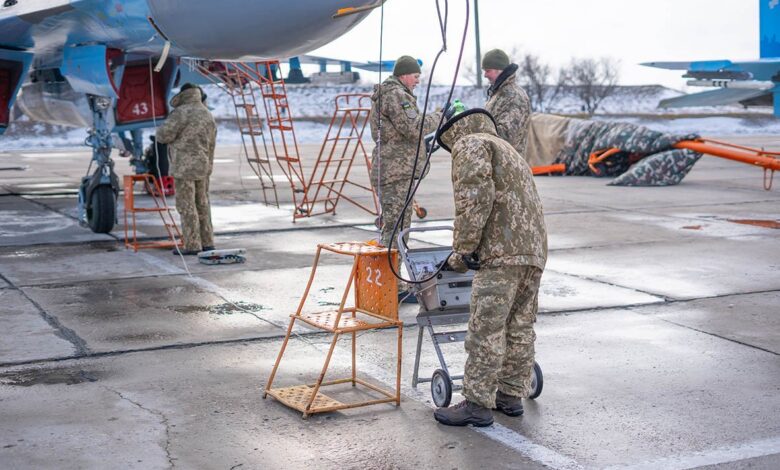
February 25 is the Day of the Aviation Engineering Service of the Armed Forces of Ukraine, Ukrainian Women’s Day, and Revolver Day. In different years, this day is associated with political changes, military events, scientific achievements, technological breakthroughs, and religious decisions that have influenced the development of different countries and societies.
Day of the Aviation Engineering Service of the Armed Forces of Ukraine
This day is dedicated to military personnel and employees who ensure the technical readiness of aircraft, helicopters, and unmanned systems to perform combat missions. The Aviation Engineering Service is responsible for maintenance, routine operations, diagnostics, repairs, and modernization of aviation equipment, as well as for preparing it for takeoff and recovery after flights and combat use.
The service’s specialists work with engines, avionics, weapons systems, hydraulics, electronics, and communications. In the conditions of a full-scale war, their work is associated with the operational restoration of damaged sides, the adaptation of equipment to new types of weapons and the integration of Western models of aviation equipment. The safety of the crews and the ability of aviation to perform combat missions in difficult conditions depend on their training and accuracy of actions.
Interesting facts
The first engineering units of military aviation on Ukrainian lands appeared back in the days of the Ukrainian People’s Republic, when special technical teams were created at aviation units to service aircraft.
During World War II, a significant part of aircraft repairs were performed in the field, and the average time to restore a damaged fighter sometimes amounted to only a few days thanks to the work of engineering teams.
In modern aviation of the Armed Forces of Ukraine, engineers simultaneously master Soviet types of aircraft, such as the MiG-29 and Su-27, and Western platforms, in particular the F-16 Fighting Falcon, which require different standards of maintenance, documentation and software.
In 2022–2024, the Ukrainian Aviation Engineering Service carried out a deep integration of Western aviation missiles into Soviet aircraft, which required the reworking of electronic systems and the creation of new interfaces for interaction between on-board equipment and weapons.
In many cases, damaged combat aircraft were restored after complex damage, including the penetration of fuselage and wing elements, and returned to service after replacing the power elements of the structure.
In the history of world aviation, it was the engineering services that first introduced a system of scheduled inspections based on hours worked, which significantly reduced the number of accidents due to technical malfunctions.
Ukrainian engineers are trained according to NATO standards, which provides for a different system of certification of technical personnel and strict accounting of each operation with the aircraft in digital maintenance logs.
During hostilities, some engineering and aviation units work at operational airfields near the front line, where technical work is carried out in shelters or at camouflaged positions to preserve aviation equipment.
Ukrainian Women’s Day
Ukrainian Women’s Day is proposed to be celebrated on February 25, the birthday of Lesya Ukrainka. The initiative arose in the context of rethinking the calendar of memorable dates and abandoning Soviet traditions, in particular, the celebration of March 8 in the usual format. The date is associated with the figure of the writer as a symbol of intellectual independence, civic position and cultural influence of Ukrainian women.
The holiday does not have state status and remains a subject of public discussion. Part of the public supports the idea of a separate day tied to Ukrainian history and culture, while others consider it inappropriate to create a new date instead of rethinking existing ones. Despite this, February 25 is increasingly mentioned in the public space as Ukrainian Women’s Day.
Interesting facts
In 1884, the “Society of Russian Women” was established in Stanislaviv, now Ivano-Frankivsk, one of the first women’s organizations in Ukrainian lands, which was engaged in education and publishing activities.
Lesya Ukrainka knew more than ten languages, including ancient Greek and Latin, and she wrote her first textbook for her younger sister at the age of 19.
In 1917, Ukrainian women received the right to vote in the Ukrainian People’s Republic before women in France, Italy, and Switzerland.
During the liberation struggle of 1917–1921, women served in the UNR Army as signalmen, scouts, and medics, and some of them participated in combat operations with weapons.
In the 1930s, women engineers worked in the aviation and mechanical engineering industries in Kharkiv, which was an atypical phenomenon for most European countries at that time.
Kateryna Bilokur created her paintings without professional art education, and her works were presented at an international exhibition in Paris in 1954.
During World War II, over a million Ukrainian women served in the Red Army, serving as snipers, pilots, medics, and radio operators.
In the modern Armed Forces of Ukraine, the proportion of women is constantly increasing, and they hold the positions of unit commanders, pilots of unmanned systems, and military medics in combat areas.
Revolver Day
The celebration of this day is associated with the appearance of the patented drum pistol, since on February 25, 1836, Samuel Colt received a patent in the United States for the design of a multiple-shot firearm with a rotating drum. His development involved the use of a capsule ignition system and made it possible to fire several shots without reloading after each of them. It was this technical scheme that became the basis for the further development of revolvers in the 19th century.
The patented model launched the mass production of revolvers at Colt’s Patent Fire-Arms Manufacturing Company. The rotating drum design provided a higher rate of fire compared to single-shot pistols of the time. Revolvers quickly spread in the military environment, among law enforcement officers and the civilian population, significantly influencing the development of personal firearms.
Interesting Facts
Colt’s first commercial revolvers, the Paterson model in particular, were initially not in great demand, and the company temporarily went bankrupt before receiving large military orders during the Mexican-American War.
The name “Colt .45” became common due to the popularity of large-caliber revolvers in the second half of the 19th century, although the original patent in 1836 was for capsule systems, not unitary metal cartridges.
The Colt Single Action Army revolver, known as the “Peacemaker”, was in service with the US Army for over 20 years and became one of the symbols of the development of the American West.
In the 19th century, revolver cylinders were loaded separately with powder, bullet and primer, and the shooter could carry interchangeable loaded cylinders with him to speed up reloading.
The design of the revolver influenced the development of other types of small arms, including early machine guns with rotating barrel blocks that used the principle of sequential feeding of cartridges.
Revolvers were manufactured in many European countries under license or without it, and the Belgian city of Liège became one of the centers of mass production of cheap copies of the Colt system in the 19th century.
In forensics, revolvers were long considered more reliable than self-loading pistols due to their simpler mechanics, and the lack of ejection of cartridges made it difficult to collect evidence at the scene of a crime.
Historical events on this day
1570 — Pope Pius V issued the bull “Regnans in Excelsis”, which excommunicated the English Queen Elizabeth I from the church. The document freed subjects from the obligation to obey her and exacerbated the confrontation between the Catholic Church and the Anglican monarchy, which had long-term political consequences for England.
1573 — Ivan Fedorovych founded a printing house in Lviv, where he later published “Apostol” and “Bukvar”. His activities contributed to the development of book printing in Ukrainian lands and the spread of education among the bourgeoisie and clergy.
1791 — The US Congress approved the creation of the First Bank of the United States with nationwide powers. The institution served as the state’s centralized financial instrument until 1811, influencing the stabilization of the currency and credit system.
1831 — the Battle of Grochów near Warsaw took place, one of the largest during the November Uprising of 1830–1831 against the Russian Empire. The battle did not bring a decisive victory to either side, but it witnessed significant losses and exhaustion of the rebel forces.
1836 — Samuel Colt received a patent in the United States for a six-shot .45 caliber revolver with a rotating drum. Its design initiated the mass production of multi-shot short-barreled weapons and influenced the military and civilian spheres of the 19th century.
1873 — the Russian imperial administration created the Southwestern Branch of the Russian Geographical Society in Kyiv. Ukrainian scientists participated in its work, collecting ethnographic and historical materials about the region.
1918 — The Small Council of the Ukrainian People’s Republic adopted laws on the transition to the Gregorian calendar and Central European Time, which synchronized time with most European states.
1928 — The Charles Jenkins Laboratory in Washington received the first television license, which was a step towards regular television broadcasting in the United States.
1940 — The first telecast of an NHL hockey game between the New York Rangers and the Montreal Canadiens took place, demonstrating the possibilities of television for mass sports.
1947 — The Allied Control Council decided to liquidate the state of Prussia as a political entity, which symbolized the dismantling of structures associated with Prussian militarism.
1956 — at the 20th Congress of the CPSU, Nikita Khrushchev delivered a closed report “On the Cult of Personality and Its Consequences,” in which he criticized the policy of Joseph Stalin. The text of the report initiated the process of de-Stalinization in the USSR and the countries of the socialist bloc.
1956 — in the USA, a hen laid an egg weighing 454 grams, which was recorded as a record size at that time.
1957 — the State Publishing House for Children’s Literature, now known as the Veselka Publishing House, was founded in the Ukrainian SSR, which became one of the leading centers for publishing books for children in the Ukrainian language.
1969 — The Beatles began work on the album Abbey Road, which became the last studio album recorded by the group.
1982 — The European Court of Human Rights in the case of Campbell and Cosans v. the United Kingdom recognized the right of parents to prohibit the use of corporal punishment of children in public schools.
1986 — After the overthrow of the Ferdinand Marcos regime, Corazon Aquino became president of the Philippines, the first woman to hold this position in the country and in Asia.
1994 — A terrorist attack occurred in the Cave of the Patriarchs in the city of Hebron, killing 29 Muslim worshipers; after the tragedy, access to the shrine was restricted on religious grounds.
1999 — In Argentina, Virginia Rivero gave birth to a baby in a traffic accident, and the newborn became the youngest person to be killed in a traffic accident.
2010 — Viktor Yanukovych, elected President of Ukraine, was inaugurated in Kyiv, but in 2014 the Verkhovna Rada of Ukraine adopted a decision to remove him from office.