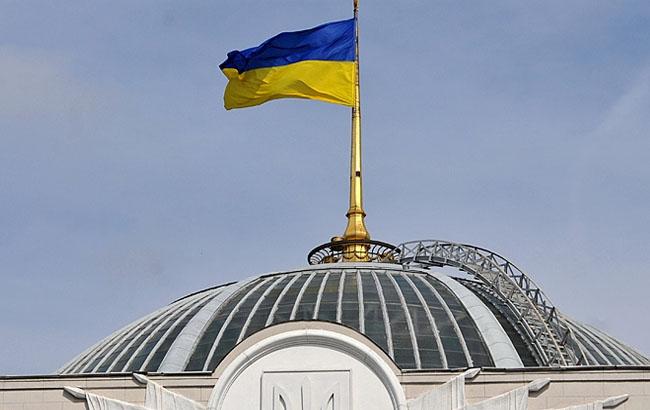
On October 4, 1991, the yellow-blue flag officially flew over the building of the Verkhovna Rada of Ukraine for the first time.
On October 4, Customs Broker Day, World Sexual Health Day, and World Taekwondo Day are celebrated.
On October 4, 1582, the Julian calendar (old style) was replaced by the Gregorian (new style).
On October 4, 1812, the Nikita Botanical Garden was founded in the Crimea.
On October 4, 1957, the world’s first artificial Earth satellite was launched.
Installation of a yellow-blue flag over the building of the Verkhovna Rada
After the declaration of Independence of Ukraine on August 24, 1991, the country began to actively form its own statehood. One of the most important symbolic steps was the official approval of the state symbols. The yellow-blue flag, which was previously considered a symbol of the Ukrainian national liberation movement, was adopted as the state flag.
On September 4, 1991, people’s deputies supported the decision to raise a yellow-blue flag over the building of the Verkhovna Rada. However, it officially happened on October 4, 1991 — a moment that remains in the memory of many as one of the most emotional manifestations of national unity.
Interesting facts
The yellow-blue flag has been a symbol of the struggle for Ukraine’s independence since the time of the Ukrainian People’s Republic (1917-1921). Its rise in 1991 was the culmination of decades of striving for freedom and sovereignty.
Historically, yellow and blue colors are associated with Ukrainian lands: blue sky and golden wheat fields. These colors symbolize peace, fertility and wealth of the native land.
The first attempts to raise the yellow-blue flag over state institutions took place during Perestroika in 1989-1990. Actions were held in various cities of Ukraine, where people demanded to recognize this flag as the official symbol of the state.
The installation of the flag over the Verkhovna Rada became a real national holiday. Thousands of people gathered near the building, who supported this step as a symbol of the people’s victory and hopes for a better future for Ukraine.
The yellow-blue flag was officially approved as the state symbol of Ukraine on January 28, 1992, when the Verkhovna Rada adopted the corresponding law. After that, the flag began to be used at all state institutions.
Day of the customs broker
This date is important for representatives of one of the key links in the country’s economy, because customs brokers play an important role in international trade, ensuring fast and correct clearance of goods when crossing the border.
Customs brokers are intermediaries between exporters, importers and customs authorities. They help businesses fill out customs declarations correctly, ensure compliance with legislation, and simplify customs clearance procedures. This profession requires a deep knowledge of international law, customs regulations and laws, because even a small mistake can lead to significant delays or fines.
Interesting facts
The profession of customs broker originated in the 19th century in Europe and the USA. Then, for the first time, specialized firms began to appear that helped traders overcome bureaucratic difficulties when crossing the border.
A modern customs broker must work under constant time conditions. How quickly the product reaches the end consumer depends on its speed and accuracy. Some customs brokers can issue documents on a consignment of goods in just a few hours.
Modern customs brokers actively use electronic customs clearance systems, which greatly simplifies their work. In Ukraine, there is a “single window” system, which automates many processes and reduces the time for processing documents.
In Ukraine, the number of customs brokers is growing due to the increase in the volume of international trade, in particular the export and import of goods. This is also related to the development of the European integration of Ukraine, which requires even greater professionalism in working with customs declarations.
To become a customs broker in Ukraine, it is necessary to obtain a special license, which is issued only after passing relevant courses and confirming knowledge in the field of customs law.
World sexual health day
It is an event that draws attention to the importance of sexual health and human rights in this context. The initiative was launched by the World Association for Sexual Health (WAS) in 2010 to promote healthy relationships, awareness of sexuality education and respect for everyone’s sexual rights.
Sexual health encompasses many aspects: it is not only the absence of disease, but also the physical, emotional, mental and social well-being associated with sexuality. Respect for sexual rights, access to information and services, and freedom to choose partners and lifestyle are key aspects of a healthy society.
Interesting facts
Each year, World Sexual Health Day takes place under different themes that focus on certain aspects of sexual health, such as sexuality education, rights of the LGBT+ community, prevention of violence and sexually transmitted infections.
In many countries of the world, the issue of sex education is still relevant. Correct information about sexuality helps to reduce the risks of unwanted pregnancies, diseases and violence.
The promotion of sexual health and rights is closely related to the fight for gender equality, as inequalities in access to information and health services often affect women and minorities.
Sexual health also includes access to qualified health care for the diagnosis and treatment of infections, contraception and other issues related to the health of the reproductive system.
Psychological health is closely related to sexual health. Maintaining healthy relationships, non-violence, and self-acceptance are important components of overall sexual well-being.
World Taekwondo Day
This day is dedicated to one of the most popular martial arts in the world. Taekwondo originates from Korea and has a thousand-year history of development. The modern version of this martial art appeared in the middle of the 20th century and quickly gained popularity, in particular due to its inclusion in the program of the Olympic Games.
Taekwondo literally means “the way of the foot and the hand”, which symbolizes the harmony of the physical and spiritual aspects of martial arts. This martial art is known for its dynamic kicks, speed and power of movements, as well as the development of discipline and self-control.
Interesting facts
Taekwondo became part of the Olympic Games in 2000 at the Games in Sydney. The inclusion of this sport in the Olympics contributed to its spread and popularization throughout the world.
Today, taekwondo is practiced by more than 80 million people in 206 countries, making it one of the most popular martial arts on the planet.
Taekwondo has a system of belts that show the skill level of the practitioner. From a white belt to a black belt, years of training, self-improvement and achievements pass.
Taekwondo teaches not only physical techniques, but also the philosophy of harmony between body and mind. Self-control, respect for the opponent and self-improvement are important aspects of this martial art.
Taekwondo competitions are held in many countries, and athletes compete not only to win, but also to develop their personal style, demonstrate skill and uphold the rules of fair play.
Historical events on this day
476: Fall of the Western Roman Empire
On October 4, 476, the leader of the Germanic mercenaries, Odoacer, deposed the last emperor of the Western Roman Empire, Romulus Augustulus. This day is considered the date of the fall of the Western Roman Empire and the beginning of the Middle Ages.
1837: Invention of the telegraph by Samuel Morse
On this day, the American inventor Samuel Morse developed an electromechanical telegraph device that allowed sending and receiving messages using the Morse code. It became a revolutionary breakthrough in communications.
1870: Proclamation of the Third Republic in France
After the defeat of Napoleon III at the Battle of Sedan and his capture by Prussian troops, Jules Favre and Léon Gambetta proclaimed the Third Republic and formed a government of national defense in Paris on October 4, 1870.
1886: The last Indian warrior, Geronimo, surrenders
On this day, the last American Indian warrior, Geronimo, surrendered to the US Army in Arizona. After that, he became a farmer and an adviser to the army.
1888: George Eastman patented the camera and founded the Kodak brand
On October 4, 1888, the American George Eastman received a patent for a camera that used roll film. On the same day, he registered the Kodak trademark, which became a symbol of the photographic industry.
1920: Petliura approved instructions for military agents of the Ukrainian People’s Republic
On October 4, 1920, Chief Ataman of the Army of the Ukrainian People’s Republic Simon Petliura approved the “Instructions for Military Agents”. This is the first document that regulated the activities of military attachés of the UNR.
1928: “Fiddler” spelling was approved
On this day in 1928, a new Ukrainian spelling was approved, known as “skrypnikovsky”, which was in effect until 1933. It became an important step in the standardization of the Ukrainian language.
1938: Creation of “Carpathian Sich”
On October 4, 1938, the Ukrainian National Defense, known as the “Carpathian Sich”, was created, headed by Stepan Rosokha. The organization was of great importance for the protection of Carpathian Ukraine.
1944: Finland stopped hostilities against the USSR
On this day in 1944, Finland officially ceased hostilities against the Soviet Union, which became an important event on the way to the end of the war.
2017: Discovery of a medium-mass black hole
On October 4, 2017, astronomers announced the discovery of a medium-mass black hole (about 100,000 solar masses) hiding in a gas cloud in the center of the Milky Way. It is the second largest black hole discovered in our galaxy.
Calendar reform of Pope Gregory XIII
On October 4, 1582, Pope Gregory XIII announced that the next day after that would not be October 5, but October 15. Thus, in Italy and other Catholic countries, the Julian calendar (old style) was replaced by the Gregorian (new style). This reform was an important step in the history of the calendar, the purpose of which was to more accurately determine the day of Easter.
The main reason for the calendar reform was the wrong determination of the day of Easter in the Julian calendar, which affected the violation of Great Lent, a serious sin in Christianity. Easter was associated with the day of the vernal equinox, and the inaccuracy of the calendar led to deviations in determining this important date. The Gregorian reform was to correct this and synchronize the calendar with astronomical events.
At the time of the introduction of the Gregorian calendar, the difference between it and the Julian calendar was 10 days. However, this difference was magnified by the different number of leap years in each calendar. According to the Gregorian system, for every 400 years the difference between the dates increased by three days.
In 1583, a church council of Orthodox hierarchs was convened in Constantinople, which recognized the inaccuracy of the Julian calendar, but the Gregorian calendar was not recognized as correct either. For Orthodox countries, including those that later freed themselves from the Turkish yoke, the old Julian calendar remained the preference, as it was more consistent with the traditional definition of the day of Easter.
The Gregorian calendar was introduced in the Ukrainian People’s Republic only on February 16, 1918. Then the country fell asleep on January 31, and woke up already on February 14. This decision was made in order to synchronize the calendar with other cultural countries of the world. In addition, it was an important step in the process of separation of church and state that took place in both countries.
Two options for calendar reform were discussed: gradual addition of one day every year for 13 years or one-time addition of the required number of days. The first option was more convenient for the church, but it would take more time to implement it. As a result, the second option was chosen – one-time addition of days, which allowed to quickly organize the calendar system.
Thus, the Gregorian calendar became a more accurate way of determining time and was introduced in many countries of the world, while the Julian calendar was kept in Orthodox countries.
Establishment of the Nikita Botanical Garden in the Crimea
On October 4, 1812, by decree of Emperor Alexander I, the Imperial State Botanical Garden in Crimea was established. The first planting of plants was carried out near the village of Nikita, which gave the name to this garden – Nikita Botanical Garden. The initiative to create this garden belonged to the military governor of Kherson, Duke Emmanuel Osipovich de Richelieu, who was then in charge of the Novorossiysk region.
The idea of establishing a botanical garden on the southern coast of Crimea was first put forward by Prince Grigory Potemkin-Tavriiskyi. Later, the famous founder of Odesa, Governor-General Armand de Richelieu, also known as “duke” or “duke”, returned to this idea. His idea was supported by one of the leading botanists of that era, Baron Friedrich August Marshall von Biberstein.
The famous scientist-naturalist Christian Steven, who was 31 years old at the time, was appointed to the post of director of the newly created “Imperial Taurian State Botanical Garden”. Steven was Bieberstein’s student and assistant. He organized the botanical garden as the first experimental garden institution. Already three years after its establishment, the garden released its first catalog of plants, which listed 95 varieties of apple trees, 58 varieties of pears, 6 berry and 15 ornamental species.
During the Second World War, when the Crimea was occupied, many plants in the botanical garden died, and the German troops took away the priceless herbarium. After the war, the director of the garden, Anatoly Koverha, went in search of the stolen collections. He managed to find and return a unique collection near Berlin, and thus the herbarium was once again in the Crimea.
During its history, the Nikitsky Botanical Garden won more than 1,150 awards, of which 70 were received at international exhibitions, including the achievements of the pre-revolutionary era. In September 1962, the garden was awarded the Order of the Labor Red Banner, and a commemorative medal with the slogan: “Science is strong in connection with practice, with life” was also created.
Today, the garden’s collection includes more than 28,000 plants from all over the world. The Nikita Botanical Garden remains one of the most important scientific and nature conservation centers of Ukraine, continuing its centuries-old history, which began in the distant 1812.
The launch of the world’s first artificial Earth satellite
On October 4, 1957, the world’s first artificial Earth satellite, PS-1 (Simple Satellite-1), was launched from the Tyura-Tam cosmodrome (now Baikonur). This event marked the beginning of the space age and a major breakthrough in world science and technology.
The first Earth satellite had the shape of a sphere with a diameter of 58 centimeters and weighed 83.6 kilograms. It was equipped with four antennas 2.4 and 2.9 meters long to transmit radio signals. Satellite signals, the famous “beep-beep”, became a symbol of the space age and were heard around the world.
295 seconds after launch, the satellite and the central unit of the rocket were launched into an elliptical orbit with an apogee height of 947 km and a perigee height of 288 km. After another 20 seconds, the satellite separated from the launch vehicle, and its signals began to be broadcast. This was confirmation of the successful launch of the first artificial satellite in human history.
The launch of “Sputnik-1” became a world sensation, and its radio signals were listened to by scientists and enthusiasts all over the world. This event not only opened a new era in the study of space, but also demonstrated the technical capabilities of the USSR, which caused a real “space race” between it and the United States of America.
The founder of this achievement was the famous designer Serhii Korolev. However, due to the Soviet system, where all achievements were considered “the victory of the whole people”, his name was not known to the general public for nine years after the launch of the satellite. Only later did it become clear who exactly was behind this historic event.
PS-1 was in orbit for 92 days and made 1,440 revolutions around the Earth, flying about 60 million kilometers. Its radio transmitters operated for three weeks after launch, transmitting signals in the form of telegraphic pulses lasting about 0.4 seconds (according to other reports – 0.3 seconds) with the same pauses between them.
This launch marked the first step in space exploration and paved the way for further exploration, including human spaceflight and the landing on the moon.