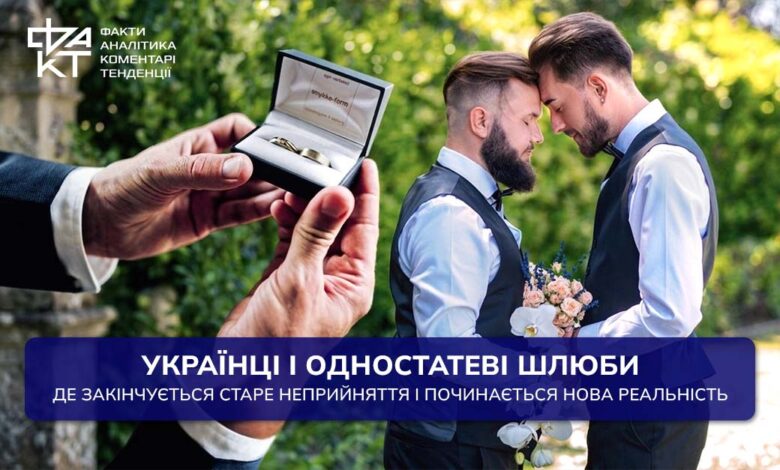
While the state declares a move towards European legal standards, the question has again arisen in Ukraine: is it ready to legally recognize marriage between same-sex couples? A new round of controversy was caused by recent court decisions and the registration of a draft law on the Civil Code, which may narrow the possibilities for legal protection of such couples. Against this background, the country has once again found itself at a point of conflict between the demand for equal rights and traditional family values. However, it is interesting to see how our society’s attitude towards same-sex marriages has changed.
New Civil Code and the controversy around same-sex partnerships
On January 22, 2026, the Chairman of the Verkhovna Rada, Ruslan Stefanchuk, announced the registration of a new edition of the Civil Code of Ukraine – draft law No. 14394. This document was signed by 138 people’s deputies, most of whom represent the Servant of the People faction. However, immediately after the registration of the draft law, human rights organizations drew attention to the provisions that narrow the possibilities of legal recognition of same-sex couples.
At the same time, the norm on “de facto family union”, which the document proposes to apply only to opposite-sex partners, caused the most criticism. Human rights activists believe that such an approach may deprive same-sex couples of even those instruments of partial legal recognition that have already appeared in judicial practice. This concerns, in particular, the possibility of establishing through the court the fact of living as one family without marriage.
At the same time, another norm of the draft law has also caused separate criticism. The document proposes to automatically recognize a marriage with a person who has made a gender transition as invalid, although it is not clearly defined from what point such a change should be considered legally significant. According to human rights activists, this may call into question even those marriages that were legally concluded after the official change of the gender marker in the documents.
Some civil society organizations insist that the recodification of the Civil Code should expand the scope of equality and legal protection, and not recreate norms that they consider outdated. In this context, the discussion on updating the code has gone far beyond the technical legal reform and touched on the question of whom the state is ready to recognize within the framework of family law.
Human rights activists also recall that within the framework of European integration, Ukraine has undertaken to ensure the possibility of registering same-sex families. That is why, in their opinion, such approaches should be reflected in the updated Civil Code. Otherwise, this may complicate the closure of certain negotiation chapters and affect the further prospects of Ukraine’s membership in the EU.
What the case law shows
The European Commission is not demanding that Ukraine introduce same-sex marriages, as is mistakenly believed in society, but legal recognition and legal protection for such couples in accordance with the case law of the ECHR. Moreover, the key here is the decision in the case of “Maymulakhin and Markiv v. Ukraine” from 2023, in which the court concluded that the state cannot leave same-sex couples outside the legal field and not provide them with any form of recognition.
The essence of this case law is that the ECHR does not oblige the state to open the institution of marriage to same-sex couples. At the same time, the court indicates that if the state is not ready for marriage equality, it must still create another mechanism of legal protection. We are talking about registered partnerships, separate legal status or other instruments that give the couple at least minimal guarantees in matters of inheritance, property, access to information about the partner’s health, social rights and recognition of family relationships.
Therefore, in European legal logic, the issue lies in the plane of practical protection of such couples. Judicial practice proceeds from the fact that the complete absence of any status for same-sex couples is a violation of the right to respect for private and family life. That is, to fulfill the minimum standard, it is not marriage that is sufficient, but a real legal mechanism that recognizes the existence of such couples and provides them with basic protection.
It should be noted that the recent decision of the Supreme Court in the case of Ukrainian diplomat Zoryan Kis and his partner Timur Levchuk became the first episode in history in the formation of Ukrainian judicial practice regarding same-sex couples. The court upheld the decision of a lower court that recognized the marital relationship between two men married in the United States in 2021 and dismissed the complaint of the public organization “All Together”. At the same time, the Ministry of Foreign Affairs refused to issue a diplomatic passport to Levchuk, because under Ukrainian law he was not recognized as a family member. Therefore, for the domestic legal field, this means the emergence of another landmark: courts are increasingly faced with the need to assess real family ties where the law does not provide a direct and exhaustive mechanism for their recognition.
The significance of this decision lies primarily in the fact that the court actually recognized the existence of family relationships between same-sex partners. In conditions where Ukrainian legislation has not yet introduced a separate procedure for registering partnerships for such couples, the courts remain one of the few instruments through which at least partial legal recognition can be sought.
However, it should be noted that this case does not set a precedent for all other couples. Ukrainian judicial practice does not move according to a universal rule, but rather individual cases, in which the circumstances of a specific case, the quality of evidence, and the method of legal argumentation are of decisive importance. Therefore, against the background of the decision in the Kis and Levchuk case, another story seems illustrative: the rejection of the Industrial District Court of Kharkiv in the claim of a serviceman of the 17th brigade of the National Guard, Dmytro Lyaskovetsky, to establish a de facto marital relationship with his partner, Yevgeny Donets.
This rejection demonstrates that even with a general movement towards the recognition of same-sex family relationships, the judicial outcome remains dependent on the evidentiary base. The court did not question the very possibility of such a relationship, but concluded that cohabitation was insufficiently proven. It was indicative that during the announcement of the decision and after it, opponents of the recognition of the de facto marital relationship of Dmytro and Yevheniy protested outside the courthouse. They called themselves “patriots of Ukraine”, “conscious youth” and representatives of the “nationalist movement of Kharkiv”, chanting: “Same-sex marriages are a threat to Ukraine”.
This difference between the two cases shows the current state of Ukrainian legal reality. On the one hand, courts no longer avoid the very issue of the existence of a same-sex family. On the other hand, each positive decision remains a point and does not eliminate general legal uncertainty. As long as there is no clearly prescribed legislative mechanism, each new case requires separate proof, and the right to recognition of family relationships actually depends on the ability to go through a complex and lengthy judicial procedure.
For Ukraine, the Supreme Court’s decision is likely to become an argument in new trials. It shows that the Ukrainian judicial system is already developing an approach according to which same-sex relationships can be considered in the categories of family law. At the same time, the Kharkiv case reminds us that public resonance or a general reference to human rights alone is not enough. The court requires specific facts, documents and testimony, and therefore subsequent similar lawsuits will most likely be built much more carefully.
In a broader context, these decisions indicate a gradual shift in the discussion about the attitude towards same-sex couples to the official level, when the state is already reacting to their presence in the legal field.
Changes in society’s attitude towards same-sex marriages
It should be noted that during the Soviet period, the attitude towards homosexuality in Ukraine was determined by criminal prosecution and the complete exclusion of this topic from the public sphere. LGBT people lived in conditions of fear, stigma and social invisibility, and the very possibility of openly talking about personal relationships or demanding legal protection was virtually non-existent. After 1991, decriminalization was the first formal step towards changing this situation, but it was not accompanied by a rapid change in public sentiment. During the first decades of independence, Ukrainian society remained predominantly conservative, and the issue of same-sex couples’ rights was hardly at the center of the political agenda.
Notable changes began after the Orange Revolution of 2004, when the public space expanded to talk about democracy, human rights and civic participation. This process was even more pronounced after the Revolution of Dignity of 2014, when the issue of dignity, freedom and equality became an important part of public awareness. In this political atmosphere, the issue of LGBT rights began to emerge from the margins, although it continued to remain sensitive for a significant part of politicians. Already in 2015, the National Strategy for Human Rights first recorded the idea of registered partnerships as one of the directions of future changes, but the state did not move beyond programmatic formulations at that time.
After the outbreak of full-scale war in 2022, the discussion about civil partnerships took on a new meaning and looked less and less like an abstract dispute about values and more and more related to specific legal problems that people faced in real life. At that time, a petition to legalize same-sex marriages and partnerships collected more than 28 thousand signatures, after which the president instructed the government to work on this issue. At the same time, draft laws on civil partnerships appeared, in particular initiatives related to Inna Sovsun and the Ministry of Justice. They were about inheritance, joint property, the right to make medical decisions, access to information about the partner’s condition, and basic legal protection without the introduction of adoption.
Despite this, the political will to bring the reform to fruition was not enough. Some deputies avoided supporting such initiatives out of fear of backlash from church circles, conservative movements, and their own voters, so the legislative process began to stall.
As shows the results of a survey conducted by the National Democratic Institute and the Kyiv International Institute of Sociology in 2024, 68% of Ukrainians completely (39%) or somewhat (29%) agreed that LGBT+ community members should be protected from discrimination. Another 13% of respondents were undecided and chose the option “I disagree, but I agree” or “I don’t know”. At the same time, 18% of survey participants rather or completely disagreed with the fact that LGBT+ representatives should be protected from discrimination.
Similar results were obtained by sociologists regarding the statement about equal rights, with 42% of respondents completely agreeing with it, another 26% answering that they rather agree. However, 11% of respondents gave a clearly negative answer. The idea of introducing the institution of civil partnerships in Ukraine was supported by 55% of survey participants, of whom 28% expressed unequivocal support. 15% of survey participants were completely against such a right. In addition, 71% of Ukrainians believe that crimes against members of the LGBT+ community should be investigated properly, and the guilty should be punished.
Sociologists also drew attention to the steady dynamics of changes in public sentiment. Since December 2019, the number of Ukrainians who support the protection of LGBT+ people from discrimination has increased almost fivefold. At the same time, the share of those who clearly negatively assess such a position has decreased by 16% during this period.
Research by the Center “Our World” shows that in 2025, 78.1% of respondents spoke out in favor of full equality of rights for all citizens regardless of their orientation. If we compare this figure with 2022, support has increased by an impressive 14.4%, and solidarity on this issue is observed in all demographic segments – from large cities to villages, regardless of age or wealth level. None of the social groups identified by sociologists has fallen below the mark of 72% support for equality, which makes this consensus one of the most significant in modern Ukrainian society.
That is, the issue of legalizing civil partnerships is becoming an area of rapid reduction in social distance, where the former gap between supporters and opponents has almost disappeared. Statistics for 2025 record 29.8% support and 30.1% indifference against 35.1% opposition, which means an actual reduction in the gap from 18.3% in 2022 to a symbolic 5.3% today. The turning point in the youth environment is especially significant, where among respondents under 29, supporters of partnerships already outnumber opponents (33.4% vs. 29.2%), and in the 30–39 age group this advantage becomes even more noticeable — 40.3% vs. 28.4%.
It is worth recognizing that it is the military context that has become a serious catalyst for empathy, as about 70% of Ukrainians express a positive attitude towards LGBTQ representatives who defend the country at the front. Even in traditionally conservative western regions and rural areas, the level of rejection of LGBTQ military personnel does not exceed 12%, which indicates the priority of military victory over private life in the social hierarchy of values.
However, the issue of marriage equality itself still leaves society divided, as indicated by 37% of respondents who support legalization versus 42% who do not accept such marriages. It is worth noting separately the institutional position of the leading denominations united in the Ukrainian Orthodox Church, which remains monolithically irreconcilable, but within the clergy itself, in particular in the OCU, alternative opinions are increasingly being heard. For example, Oleksiy Filiuk, a priest of the Ternopil diocese of the OCU, who is popular on social networks, without departing from the dogmas about the sinfulness of same-sex relationships, at the same time recognizes the right of a person to self-determination in private life, effectively separating the religious canon from the right of an individual to control his own destiny.
In 2026, the problem of supporting people of non-traditional sexual orientation manifested itself even more acutely, and now public sentiment in Ukraine is demonstrating gradual liberalization, although it remains uneven depending on the formulation of the issue. At the same time, support for the general principle of equal rights is the highest: part of society agrees that LGBT people should have the same rights as other citizens.
The level of support for civil partnerships is noticeably lower, but still stable: about 55% do not object to the introduction of such an institution, perceiving it primarily as a tool of legal protection. Support for same-sex marriage remains even more restrained and remains at about 37%, while a significant part of society still does not have a clearly defined position on marital status.
Against the background of these data, 2026 shows several important trends at once. First, Ukrainian society is increasingly ready to recognize the basic rights of LGBT people as part of the general system of civil equality. Second, civil partnerships are increasingly perceived as a compromise and practical model that causes less resistance than full marriage equality. Third, the legislative debate is moving slower than social change, which is why a gap remains between public sentiment, the human rights agenda, and real politics.
Gender and Age Empathy vs. Conservatism: A Map of LGBT Support in the Regions
The current architecture of public sentiment in Ukraine demonstrates a clear age distribution, where people aged 18 to 35 are most motivated to implement barrier-free living and accept diversity, demonstrating a readiness to accept the LGBT community at a level of about 70%. This value gap between generations is reinforced by a high level of socialization, as 68% of young people have personal acquaintances among representatives of the community, which actually neutralizes the effect of aggressive disinformation through direct human experience.
The gender dimension of human rights support reveals an even deeper asymmetry, as Ukrainian women demonstrate a significantly higher level of empathy, expressed in 66% willingness to support a loved one after revealing their sexual orientation, while among men this figure barely reaches 36%. Географічно епіцентром ліберальних трансформацій залишається столиця разом з центральними та західними областями, проте динаміка останніх років свідчить про поступове згладжування регіональних розбіжностей, перетворюючи питання рівності на загальнонаціональний консенсус, а не суто локальний феномен.
Опозиція до легалізації подібних союзів зазвичай апелює до кризи традиційної сім’ї та демографічних ризиків, хоча наукові дані послідовно спростовують прямий зв’язок між юридичним статусом шлюбу та показниками народжуваності. Крім того, критики часто висловлюють занепокоєння щодо виховання дітей у нетрадиційних сім’ях, попри офіційні висновки світових психологічних асоціацій, які акцентують увагу на важливості емоційної стабільності та якості стосунків між батьками, незалежно від їхньої статі. Водночас релігійні заперечення та побоювання щодо суспільної поляризації залишаються вагомими факторами, проте вони все частіше стикаються з аргументами про пріоритетність прав особистості над груповими догмами.
Трансформація суспільних настроїв, зафіксована у статистиці, виступає для українських парламентарів чітким сигналом до мінімізації політичних ризиків під час розгляду законопроєкту №9103 про реєстровані партнерства. Політичні сили, які раніше будували свою риторику на консервативних гаслах, тепер змушені адаптуватися до нової реальності, де права людини стають безальтернативним стандартом, а ухвалення закону виглядає як логічне завершення внутрішньої еволюції суспільства та вимога європейської інтеграції.
Поступове розмивання монолітності релігійного фронту, що проявляється у дискусіях всередині ПЦУ та появі лояльних до ЛГБТК-осіб священників, позбавляє консервативних політиків їхнього останнього ідеологічного бастіону. Коли духовні авторитети починають відокремлювати приватне життя людини від канонічних догм, Верховна Рада отримує можливість перевести питання партнерств у суто юридичну площину, зосередившись на реєстрації, майнових правах та соціальних гарантіях. Такий підхід дозволяє винести етичні суперечки за межі законодавчого процесу, фіксуючи юридично те, що українське суспільство вже фактично почало приймати.
Європейські цінності чи національний код: ціна механічної інтеграції
Незважаючи на статистичні дані про ліберальні погляди деяких українців, не можливо не помічати, що цей рух прямо зіштовхується з базовим розумінням традиційного шлюбу як союзу чоловіка та жінки для народження дітей. Спроба редукувати шлюбний союз до суто цивільно-правового контракту ігнорує його історичну роль як механізму демографічного самозбереження нації, що в умовах затяжної депопуляції виглядає не просто суспільним занепокоєнням, а питанням стратегічного виживання.
Природні закони, де союз протилежностей чоловіка та жінки є єдиним джерелом відтворення нації, залишаються незмінними і не можуть бути знеціненими соціологічними зрізами чи політичною доцільністю. Коли державні інституції починають орієнтуватися виключно на індивідуальні запити щодо комфорту та майнових гарантій, вони ризикують втратити з поля зору колективний інтерес до стабільність сім’ї, яка в українській традиції завжди була наріжним каменем соціальної архітектури.
Слід зазначити, що в європейських країнах є кардинально різним ставлення до інституту сім’ї — від ультраліберальних Нідерландів до консервативних Польщі чи Греції, де традиційні цінності залишаються частиною державного порядку денного. Отже, підгін українського законодавства під уніфікований стандарт ризикує перетворитися на деконструкцію національного коду, де на зміну автентичним традиціям приходить імпортована ідеологічна модель, що не пройшла тривалої перевірки часом у наших реаліях.
Поява альтернативних думок всередині духовенства та спроби відокремити релігійний канон від цивільного права свідчать про глибоку ерозію морального моноліту, який тримав суспільство в межах зрозумілих етичних координат. Хоча право особистості на приватність є незаперечним, перетворення шлюбу на гнучку категорію, позбавлену сакрального змісту, неминуче призводить до розриву зв’язків між поколіннями.
Молодь, яка демонструє готовності до прийняття нових норм сім’ї, формується в умовах глобального інформаційного поля, де традиційна родина часто маркується як архаїчний та обтяжливий конструкт. Це створює ситуацію, за якої емпатія, викликана військовим контекстом та особистими знайомствами, стає ширмою для глибинної трансформації суспільної моралі, де «правда кожного» важить більше за об’єктивну істину природного ладу.
Спроба механічного копіювання чужих соціальних стандартів заради політичного схрещення з боку ЄС несе в собі приховану загрозу розмивання національного обличчя України. Шлях до європейської спільноти не має перетворюватися на акт капітуляції перед ідеологічними поглядами, які суперечать багатовіковому досвіду українського народу та його уявленням про моральний лад і традиційні сімейні цінності.
Тож, замість того, щоб сліпо підлаштовувати свій світогляд під мінливі звички інших держав, Україна має відстоювати право на власний шлях розвитку, де міцна родина та повага до природних законів залишаються непорушними орієнтирами. Відмова від власного коріння заради короткострокових політичних дивідендів є занадто високою ціною, адже нація, яка зрікається своїх основ, стає вразливою до будь-яких зовнішніх маніпуляцій. Ми маємо входити до єдиної Європи зі своїми скарбами та переконаннями, а не як безликий об’єкт для соціальних експериментів, які нищать саму суть українського коріння.