
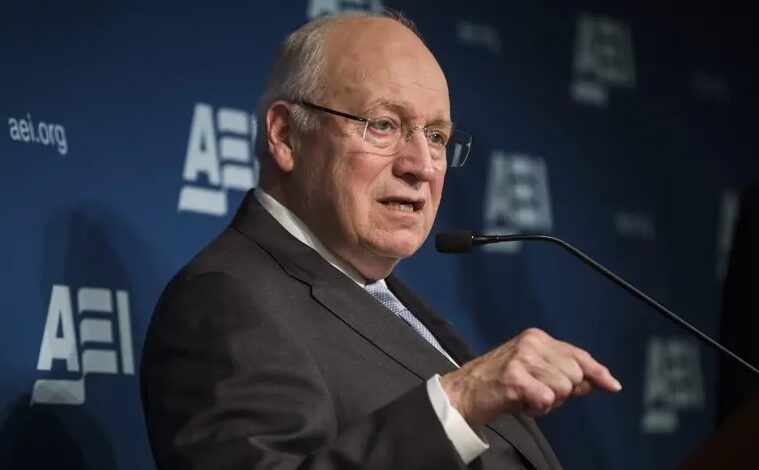
Dick Cheney, former US vice president under George W. Bush, died on November 4 at the age of 85. CNN reported this with reference to the politician’s family.
“Dick Cheney served our country for decades, including as White House chief of staff, congressman from Wyoming, Secretary of Defense and Vice President of the United States”, the family said in a statement.
Throughout his life, Cheney had serious heart problems, suffered several heart attacks and underwent a heart transplant in 2012. After the operation, he, according to his relatives, led a “full, energetic life.” Cheney himself called the heart transplant “the gift of life itself.”
In 1989–1993, Richard Bruce Cheney served as US Secretary of Defense in the George H.W. Bush administration, and from 2001 to 2009, he was vice president of the country during the two presidential terms of George H.W. Bush.
On September 11, 2001, when the terrorist attacks on the United States took place, Cheney was in the White House while the president was out of Washington. After the second hijacked plane crashed into the World Trade Center, he, in his own words, “became a different man,” determined to avenge the al-Qaeda attacks and to strengthen U.S. influence in the Middle East through the neoconservative doctrine of regime change and preemptive war.
The September 11 attacks were the impetus for the U.S. war in Afghanistan, which was aimed at overthrowing the al-Qaeda-backed Taliban regime. Cheney later advocated for an expanded military campaign, this time against Iraq and its leader, Saddam Hussein. During the first Gulf War, while still head of the Pentagon, he played a key role in the liberation of Kuwait from Iraqi forces.
It was at Cheney’s insistence that the US administration actively disseminated warnings about the alleged existence of programs to create weapons of mass destruction in Iraq, as well as about Baghdad’s possible ties to al-Qaeda. These statements became the basis for the decision to invade Iraq in 2003.
However, subsequent congressional reports and other investigations proved that Cheney and other administration officials significantly exaggerated or misinterpreted intelligence – no programs to create weapons of mass destruction in Iraq were discovered.
Against the backdrop of the wars in Iraq and Afghanistan, there were reports of “enhanced interrogations” of terrorist suspects, which critics called torture. But Cheney, who was one of the key architects of the global “war on terror,” insisted that such methods, including drowning, were “completely acceptable.”
He also strongly supported the practice of holding suspects without trial at Guantanamo Bay, Cuba, despite numerous allegations of human rights abuses. This policy was seen by many in the United States and abroad as incompatible with American values.
To the end of his life, Dick Cheney expressed no regrets for the decisions he made, remaining convinced that he had acted “as necessary to respond to an unprecedented attack on the U.S. mainland.”


