From commandment to law: does the right to alternative service apply in military Ukraine?


The biblical commandment “Thou shalt not kill” is one of the main moral guidelines followed by believers of various denominations. It requires believers not only to refrain from violence, but also to avoid situations where the need for killing may arise. In today’s world, where military service is mandatory for many, this commandment is often the subject of debate and legislative decisions.
The legal institution of alternative, i.e., non-military service for religious citizens has been operating in our country for over two decades, since it was introduced in 1992 with the adoption of the Law “On Alternative (Non-Military) Service in Ukraine”. Thanks to him, men who, at the time of the law’s adoption, were convicted of evading the draft for religious reasons, were released from punishment, and the criminal proceedings against them were closed.
Over the years, hundreds of citizens have used the right to alternative service, despite the fact that its duration is one and a half times longer than the term of military service. According to statistics, in 1992, 255 people completed alternative service, in 2011 – 499; in 2012 – 436; in 2013 – 215; in 2014 – 475 (https://www.msp.gov. ua/content/spivrobitnictvo-z-radoyu-evropi.html).
With the beginning of the war, the institution of alternative service revealed vulnerabilities and legal contradictions. From time to time in the media field there is information about diametrically opposed court decisions. The legal and judicial newspaper, for example, writes about two such cases. In the first, the Supreme Court upheld the man’s sentence of 3 years in prison, in the second, the court referred to the ECtHR’s position that the state must provide individuals with alternative (non-military) service, which is completely separate from military duty, and the right Refusal from military service based on religious beliefs is guaranteed by paragraph 1 of Article 9 of the Convention on Human Rights. (https://sud.ua/uk/news/publication/305055-religioznye-ubezhdeniya-ne-mogut-byt-osnovaniem-dlya-ukloneniya-ot-mobilizatsii-verkhovnyy-sud-ostavil-v-sile-prigovor-v -3-goda-tyurmy-uklonistu)
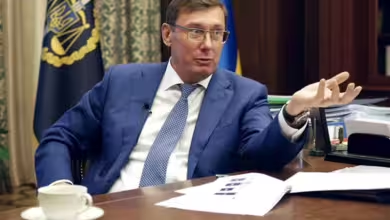
We turned to Ihor Volodymyrovych Repeshko, head of the “Repeshko and Partners” bar association, for an explanation of the Ukrainian legislation regulating military relations.
Article 35 of the Constitution of Ukraine enshrines the right of every citizen of Ukraine to freedom of outlook and religion. This right includes “freedom to practice any religion or not to practice any religion, to perform individually or collectively religious cults and rituals, to carry out religious activities.” This article also legislates the relationship between a person of faith and military institutions: “If the performance of military duty contradicts the religious beliefs of a citizen, the performance of this duty must be replaced by an alternative (non-military) service.” It seems to be a clear and quite specific norm. However, as in everything, there is a downside. In the same article, we read: “No one can be released from his duties to the state or refuse to comply with the laws on the grounds of religious beliefs.” Add to this the rule about: “Protection of the territory of Ukraine is the duty of every citizen aged 18 to 60”, and it becomes clear that representatives of any of the confessions that have a ban on killing will not be able to be insured against mobilization.
But do we have the Law “On Alternative Service”?
Yes, we have … no, it is better to say, there is the Law of Ukraine “On Alternative (Non-Military) Service”. He claims that alternative service during mobilization is still possible.
The constitutional provisions do not establish a specific idea about the content of religions, creeds and the meaning of religious beliefs. What denominations are we talking about?
The government decree approved the list of registered organizations that prohibit the use of weapons. It:
⁃ Adventists-reformists;
⁃ Seventh-day Adventists;
⁃ evangelical Christians;
⁃ Evangelical Baptist Christians;
⁃ holidaymakers;
⁃ Jehovah’s Witnesses;
⁃ charismatic Christian churches (and churches equated to them, according to registered statutes);
⁃ Christians of the evangelical faith (and churches equated to them, according to registered statutes);
⁃ Society of Krishna Consciousness.
What should believers – members of religious communities whose statutes do not allow to participate in military service?
In order not to take up weapons, believers should write an application to the TCC, in which they ask to perform military duty in the form of alternative (non-military) service and add a certificate from the religious community from the above.
A document confirming the truth of the beliefs should be attached to the application. According to the lawyer’s practice that has already developed, it is necessary to submit such an application even before a person is served with a summons, so that it is not perceived as evasion of conscription. Therefore, local authorities can find a place for such a person (for example, a drone manufacturing company) where he can do alternative service.
But this is only part of the problems that arise during alternative service. One of their features is the specific diet of believers, fasting, prohibition of certain types of food. Food in the army is the same for everyone… This issue is not settled in the legislation at all.
Military service in peacetime and wartime – is there a difference for “alternatives”?
Yes, it should be taken into account that by the decree of the President from February 24, 2022, conscription for military service was canceled in Ukraine and general mobilization was introduced. Conscripted service in peacetime is one thing, mobilization during a full-scale invasion is quite another.
The list of persons who are not subject to mobilization is given in Art. 23 of the Law of Ukraine “On Mobilization Training and Mobilization” and there is absolutely no mention in it of the possibility of deferment for persons who completed alternative service. Therefore, there is only hope for employees of local authorities and TCC, who can provide a religious person with a place in the war, without the possibility of taking up arms. Medicine, communication, logistics, transport, repair, kitchen, IT, engineering forces – there are opportunities. But taking into account the existing practice, it can be argued that such an option is unlikely. It remains only to ask your commander to give tasks related to the provision of troops, and not combat.
If a believer was not heard, his right was violated, does it make sense to go to court?
It should be taken into account that according to established judicial practice, most of the decisions of the court of first instance are not in favor of the applicant, who defends his rights as a person who cannot pick up a weapon, wear a military uniform and kill people because of his faith and relationship with God. She is found guilty of evading mobilization. But in this case, there is an opportunity to challenge the rendered decision and often this practice is successful. By the way, in the decision of the Supreme Court of Ukraine, cited by the “Sudovo-yuridychnya gazeta”, it is said that the absence of grounds for giving a conscript a deferment from the draft due to his religious beliefs does not mean that he will necessarily have to take weapons to hand. Such servicemen can be used to solve other important tasks, such as transporting supplies and ammunition, building fortifications, and even evacuating the wounded from the battlefield.
Is it even possible to appeal to the Convention on Human Rights in such cases?
If we apply the practice of the European Court of Human Rights, which established: the conscript must have “an objection to military service motivated by a serious and irresistible conflict between the obligation to serve in the army and the person’s convictions or deeply and sincerely held religious or other views”, then here we will have to prove not only the existence of beliefs, but also that certain political, philosophical, ethical or religious views are incompatible with military service.
How is the question of alternative service solved in the world?
In countries where there is no conscription, accordingly, there is no alternative service.
Previously, during the draft period, the right to such service had a permissive character. Candidates for alternative service did not collect references, but wrote whole works in which they explained why they could not serve in the army. The final decision in this matter was made by the alternative service organization. In recent years, the right to alternative service actually began to have a declarative nature, practically – at will. As an example, we can cite Germany, where before the abolition of compulsory military service in 2011, alternative service was recognized as a form of military service. It was also possible to refuse military service, both according to secular and religious beliefs. Alternative service has always been a mandatory service for the benefit of society, and citizens performed it mainly in the social sphere. By the way, in this country during the existence of military conscription in 1969, an Addendum to the law was adopted, in which it was determined that if recognized “refusals” due to the nature of their beliefs cannot undergo even alternative civil service, they are released from civil service and work under a free labor agreement.
For the completeness of the picture, it is also worth recalling the content of Article 22 of the Constitution of Ukraine, according to which, when adopting new laws or making changes to existing laws, it is not allowed to narrow the content and scope of existing rights and freedoms. And also question the completeness of the list of religious organizations, membership of which gives the right to alternative service. Using statistical data RISU portal, we counted the number of communities that belong to the listed organizations: Adventists – 969 communities; Baptists – 2,621 communities; evangelical Christians – 2519; charismatics – 1436 communities; Jehovah’s Witnesses – 372 communities; Society of Krishna Consciousness – 40 communities. In total, we have 7,957 communities. For comparison, let’s point to the number of active Orthodox communities – 18,132 and Catholic – 4,740.
So, as we can see, there is a significant number of religious organizations in Ukraine, in particular, Orthodox and Catholic communities, the number of which exceeds 22 thousand. It is certain that they also have their own moral and ethical norms that are against the performance of military duty with weapons in hand, but currently they do not have the right to alternative service.