Loss of moral values, development and lack of children’s press: consequences for the current generation of children

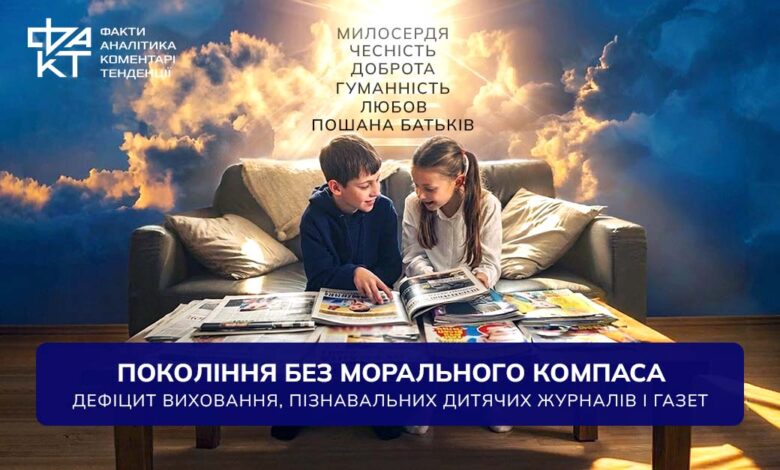
Ukrainian children are growing up in a country where there are no children’s newspapers and magazines left. Once they were a familiar part of childhood, through them children developed intellectually, learned to think, sympathize, distinguish between good and evil. Now their place has been taken by the Internet – without editors, responsibility and educational purpose. Social media algorithms have become new “teachers” that shape the idea of the world much more strongly than school, books or children’s press. Against this background, the news that finally at the state level they started talking about the spiritual and moral education of children sounded especially symbolic. In fact, for the first time in a long time, education officials openly admitted that school cannot be limited to the transfer of knowledge, it should form a personality. However, the disappearance of children’s newspapers and magazines leaves a void in the education system, which previously ensured the development of critical thinking and moral guidelines in children.
What does the Concept of Spiritual and Patriotic Education provide?
The work of the Council on Cooperation with Churches and Religious Organizations under the Ministry of Education and Science of Ukraine, the meeting of which was held on March 11, demonstrated a request for a fundamental transformation of the educational paradigm. The Chairman of the Council presented the Concept of Spiritual and Patriotic Education, which is designed to take schoolchildren beyond the limits of dry transmission of academic data.
The participants of the meeting emphasized that in conditions of full-scale war and complex social challenges, the school can no longer be limited to the transfer of academic knowledge. A modern educational institution should become a space for the formation of personality, a place of security, stability and spiritual and moral support for children and youth.
The presented Concept provides for a departure from the formal approach to educational work and a transition to the real embodiment of spiritual values in everyday school life. The point is that such traits as patriotism, mercy, responsibility, mutual respect and human dignity should not only be topics for discussion, but should become an integral part of students’ daily experience.
The document pays considerable attention to practical mechanisms for implementing educational work. It proposes tools that allow students, together with teachers, to form their own value orientations, join joint initiatives and track their personal development through monthly challenges and good deeds.
One of the key principles of the Concept is the interaction of the school, family and spiritual mentors. The participants in the discussion emphasized that effective education is possible only with close cooperation between the administration of educational institutions, teachers, school psychologists, parents and representatives of the educational chaplaincy institute. It was also emphasized that the formation of a personality that is aware of its national identity, is based on moral and spiritual values, and is ready to responsibly serve society, is an important factor in strengthening national security and rebuilding Ukraine.
So, finally, the state started talking about the spiritual education of children, which should have been implemented by educational officials long ago.
National-patriotic education without moral and spiritual
It should be noted that in Ukraine during the period of independence there was no single state ideology, since Article 15 of the Constitution prohibits its existence. Instead, public life is based on the principles of political, economic, and ideological diversity. Such legal pluralism acts as a safeguard against the revival of totalitarian practices, but in conditions of war it creates a complex dilemma between the need for national consolidation and the risk of restricting individual freedoms.
Despite the lack of a single ideology, the state operates an extensive system of national-patriotic education, the strategy of which is enshrined in a presidential decree. It focuses on three main areas:
- deep civic education with an emphasis on rights and responsibilities;
- intensive military-patriotic training of future defenders;
- systematic popularization of national culture and language.
Supporters of strengthening national-patriotic education emphasize that in times of war, the absence of a clearly articulated ideological concept creates a dangerous vacuum, which is instantly filled with hostile narratives and destructive propaganda. However, a clear strategy of national-patriotic education should build an unshakable national identity through the awareness of the continuity of Ukrainian history from the times of Rus to the present, so that a child or young person does not turn into a faceless “citizen of the world”, but feels his inextricable connection with the roots of his own people. Common value coordinates give society an exhaustive answer to the question of the collective goal and future vector of movement, which is critically important for preserving the unity of the nation in periods of historical upheaval.
At the same time, the liberal view of this problem warns against excessive ideologization of the educational space, seeing in the imposition of a single worldview a direct threat of sliding into authoritarianism, similar to the Soviet past or the modern Russian regime. Any attempt at forced education within the framework of an alternative paradigm conflicts with the constitutional right to freedom of thought, transforming the school from a platform for personal development into an instrument of state control. Instead of assimilating ready-made ideological templates, a modern educational institution should foster critical thinking, teaching students to analyze complex processes, doubt dogmas, and independently construct their own system of views.
The systemic crisis of Ukrainian education at the present stage is that patriotism is often perceived as a set of external attributes that are unable to replace the moral and spiritual upbringing of children. There is an obvious lack of a universal “code of honor” or moral guideline in state policy, as the school increasingly shifts the emphasis towards dry academic knowledge, focused on passing tests and the pursuit of grades, while ignoring the formation of character and moral values. The removal of the state from this issue under the pretext of secularism has led to the emergence of a worldview vacuum, where the main “teachers” of values for children are the algorithms of social networks, which broadcast the cult of aggression, thoughtless consumption, egocentrism and instant enrichment.
Upbringing without reading: the decline of the children’s press
The current crisis of Ukrainian children’s periodicals indicates much deeper destructive processes than simply the decline of the paper industry. While developed democracies consider children’s newspapers and magazines as an integral element of the state policy of educating the child’s personality, in Ukraine this sector is actually abandoned to its fate, relying only on the sacrifice of private publishers. A quality magazine serves as a reliable value framework, where through deep plots and artistic images a child learns such ethical guidelines as mercy, kindness, honesty and respect for parents much more effectively than through dry didactic guidelines. Moreover, the paper edition appears as the only real alternative to the aggressive “gadget” culture, since it stimulates prolonged concentration and analytical thinking, counteracting the fragmentation of clip content on social networks.
The process of dismantling points where printed products were sold for the sake of selling tobacco products and products demonstrates the cynical prioritization of quick profit over the cultural security of the nation. Statistics from the Kyiv International Institute of Sociology show that 60% of adult Ukrainians have not opened a single newspaper during the year, let alone children. This figure is a verdict not only on reading as a habit, but also on society’s ability to critically perceive information, since the lack of a culture of consuming the printed word among parents automatically deprives children of the opportunity to read together, that unique moment of transferring experience and spiritual connection.
The economic noose around the neck of publishers is tightened due to the monopoly of Ukrposhta, which has quadrupled delivery rates in recent years, while simultaneously reducing the number of postmen. This has led to the fact that even the district press is forced to cease its existence due to financial insolvency and lack of subscriptions. Currently, educational children’s newspapers and magazines, which were previously extremely popular among children, are not published at all.
World experience offers a completely different model of interaction between the state and children’s publishing, where periodicals are perceived as the foundation of literacy. For example, the American Highlights, published since 1946 under the slogan “Entertainment with a Purpose”, fundamentally refuses advertising, focusing on ethical upbringing and the child’s self-confidence.
In various European countries, children’s magazines have long been part of the cultural space in which children get acquainted with the world of literature, ideas and questions. They are read not only at home, but also in schools, libraries, and extracurricular activities. At the same time, each publication has its own character and pedagogical philosophy. For example, in France, one of the most popular magazines for younger schoolchildren is J’aime lire (“I love to read”). Its structure is very simple: one story is published at the center of each issue, but it is this simplicity that works. The stories are constructed so that the child not only follows the adventures of the hero, but also experiences complex feelings with him: resentment, fear, joy, compassion. French editors deliberately emphasize emotional development and the child’s ability to ask questions about the behavior of the characters and their own reactions.
In Great Britain, a different role is played by the weekly newspaper for children The Week Junior, which explains the world of news in a language understandable to schoolchildren. Children learn about politics, science, ecology, cultural events, but most importantly, they learn to analyze information. The materials are structured so that the reader can see different sides of the event and draw their own conclusions. This is a kind of first school of media literacy and civic thinking.
In Poland, one of the symbols of children’s periodicals is the magazine Świerszczyk (“Cricket”), which has been published since 1945. It is known for the high quality of texts and illustrations, the magazine contains many fairy tales, poetry, short stories, riddles and drawings. The Polish tradition is very clearly visible here, because of the attention to language, aesthetics, family relationships, kindness and natural children’s curiosity.
In Germany, a popular literary publication for children is the magazine Gecko, which is published without advertising in principle. It publishes short stories by contemporary authors and artists. Many texts are structured so that after reading the child remains with questions – about friendship, loneliness, honesty, choosing between right and easy. The magazine does not try to give ready-made answers, but rather stimulates conversation and reflection.
What these publications have in common is that they are not considered as a commercial product, but as part of cultural policy. In addition, many European countries have state programs to support children’s press: subsidies for postal delivery or the purchase of magazines for school and public libraries. Thanks to this, such publications regularly reach children and remain an important part of their reading experience.
Nowadays, you will hardly see a child with a book or magazine in their hands, and if the state does not reconsider its attitude towards the printed word, ignoring the appeals of the editorial offices for help, we risk having an entire generation raised on random social media algorithms instead of time-tested moral value guidelines.
The deep crisis of authority in society makes any attempts at spiritual education ineffective, as children acutely feel the gap between the patriotic slogans in textbooks and the real way of life of political elites or adult environment. When moral principles remain only on paper, and everyday reality demonstrates the triumph of cynicism, any educational system inevitably crumbles, leaving behind only disappointment and nihilism. Even such initiatives as courses in Christian ethics or the basics of the family often turn into bureaucratic formality, where outdated teaching methods and the lack of lively discussion cause only boredom and natural rejection in schoolchildren.
Government officials should understand that true patriotism cannot exist in isolation from basic moral and spiritual principles, such as love for one’s neighbor, kindness, empathy, justice, and family values, because without this ethical foundation, children grow up without clear criteria for behavior. In this case, their actions are determined not by ethical principles, but by random environmental influences, peer pressure, or personal gain. Therefore, a moral foundation is a necessary condition for the formation of a mature and responsible personality.
Education that ignores the upbringing of the human soul and focuses exclusively on pragmatic skills for earning money becomes a tool for servicing the economy, rather than the development of an intellectual and highly moral society. Only a harmonious combination of civic consciousness with deep moral values can become the foundation on which a state will arise, where patriotism is not a duty, but a natural manifestation of the inner integrity of the individual.