Military Ombudsman spoke about the outbreak of pneumonia among mobilized soldiers and the shortage of doctors

The health of those mobilized during basic general military training has long ceased to be a secondary topic, since reports, inspections and testimonies from training centers have accumulated facts that relate to a large number of serious complications, hospitalizations and deaths. With a large crowd of people in closed rooms, a shortage of doctors and late referrals to hospitals, a common respiratory disease quickly turns into a serious condition, and medical help often comes when there is almost no time left for calm treatment. This problem received new publicity after reports of the deaths of servicemen of the 425th assault regiment “Skelya”, who died of pneumonia.
Military Ombudsman Olga Reshetylova described a much broader picture, where tragic incidents in one unit brought to light chronic difficulties that had been accumulating in training centers throughout the winter. According to her, during the winter period, training centers recorded a large number of cases of illness among mobilized personnel, and these were not everyday ailments that quickly pass, but serious conditions with complications.
The Ombudsman said that back in December, during a trip to the hospital, she accidentally heard about a very large number of hospitalizations with pneumonia in one of the training centers. After that, her team initiated an inspection, involved the Department of Health of the Ministry of Defense and went to the site to find out why so many patients had accumulated in one center.
“This winter, in general, it was a serious problem. In December, we went to the hospital, and I accidentally heard about some colossal figure from one of the training centers for hospitalization with a complication – pneumonia. It was about hundreds of cases from just one center,” – Olga Reshetylova emphasized.
The scale of the diseases is most striking in this phrase, because several hundred hospitalizations in one place indicate a situation where the infection spread quickly, and the response system did not have time to contain complications at an early stage. For training centers, through which large groups of mobilized people pass, such a load means a sharp increase in risk for those who arrive already weakened or sick.
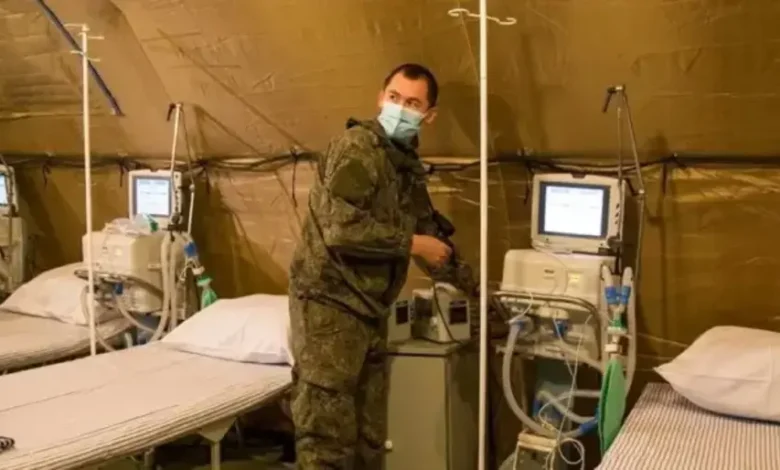
In addition, during the inspection, it turned out that only three doctors worked in one large training center, while other doctors, provided for by the staffing list, were seconded to the military medical commission. With such a personnel imbalance, the medical service lost the opportunity to normally cover all battalions, monitor the condition of new arrivals and respond in a timely manner to deterioration in well-being.
“It turned out there that there are only three doctors for a huge training center. And all the others provided for by the staff are seconded to the military medical commission. These doctors physically do not even have time to go around all the training battalions. And they hospitalize only when there are obvious signs of severe complications,” – Reshetylova noted.
Under such conditions, doctors are actually forced to respond to the severe course of the disease, while early detection, isolation and timely treatment are relegated to the background due to a banal shortage of people. For a large center with a constant movement of personnel, three doctors is a number that does not allow controlling the situation at the proper level.
The ombudsman attributes one of the reasons for this situation to the fact that some of the mobilized people arrive at the training centers already with signs of illness after a long stay in inappropriate conditions in the territorial recruitment centers. That is, the deterioration of the condition begins even before the stage of basic training, and the crowding of people in the training center only accelerates the further spread of the infection.
This detail is important because it shifts the beginning of the problem to an earlier stage, where the person has not yet been included in the full-fledged medical support system, but has already spent a long time in a cramped space, under stress, without proper living conditions and without timely medical examination. If we add to this the cold season, a weakened body and accommodation in large groups, then the disease moves very quickly in such conditions.
In the closed space of a training center, these risks are amplified, because respiratory infections are transmitted from one person to another without much difficulty, and the tight training schedule, physical exertion and fatigue make the course more difficult. Because of this, a cold, which in another situation would be limited to a few days of treatment, in the absence of timely assistance turns into bronchitis or pneumonia.
A separate block of the problem concerns how the decision to send to the hospital is made. After the inspections, the Office of the Military Ombudsman raised the issue of preventive measures, isolation of people with signs of SARS, the procedure for providing medical care and the criteria by which a person should be hospitalized.
At the same time, Reshetylova described another difficulty that affects the behavior of training centers. According to her, hospitalization is sometimes postponed due to fears that after being sent to the hospital, a serviceman may escape.
“In fact, training centers are often afraid to hospitalize, because the largest number of SZCH comes from hospitals. And there were cases when we intervened in this situation, demanded that the man be hospitalized. He was eventually hospitalized, and then he ran away. That is, we took this responsibility upon ourselves. It’s a shame, but there is such a problem,” the ombudsman reported.
In this situation, a conflict of two risks is visible, which overlap each other: on the one hand, delaying hospitalization worsens the patient’s condition, on the other hand, sending him to the hospital for command is associated with the danger of unauthorized abandonment of the unit. As a result, the medical decision is under the pressure of circumstances that should not determine treatment at all, but in practice affect it very noticeably.
Olga Reshetylova separately noted that the tragedy in the 425th regiment was not an exception on the scale of the entire system. According to her, no matter how scary it may sound, the case with “Skelya” is not indicative in the sense that in other places the situation could be no less difficult, and in some places even worse.
The problem in this case arises as a combination of several factors acting simultaneously: people arrive weakened even before the training center, in the center itself they live in large groups, there is a shortage of doctors, and the decision on hospitalization in some cases is delayed. With such a combination, even a few days without proper examination or treatment become critical.
After the death of five servicemen in the 425th assault regiment, a special inspection was appointed, during which the course of events is studied literally minute by minute. According to Reshetilova, they are now checking what happened to each of the deceased, how they were provided with medical care, in what condition they were in when they arrived at the hospitals, and whether any time was lost between the appearance of the first symptoms and hospitalization.
Thus, the situation with mass illnesses of mobilized personnel during basic training shows that it concerns not one single failure, but a wider range of decisions at different stages – from medical examination and gathering of people to the organization of everyday life, treatment and health monitoring in training centers. It is in this sequence, where one problem is superimposed on another, that an environment arises in which severe consequences cease to be an accident.