Milkman and nanny as a linguistic norm: a philologist explains reverse feminines in the Ukrainian language

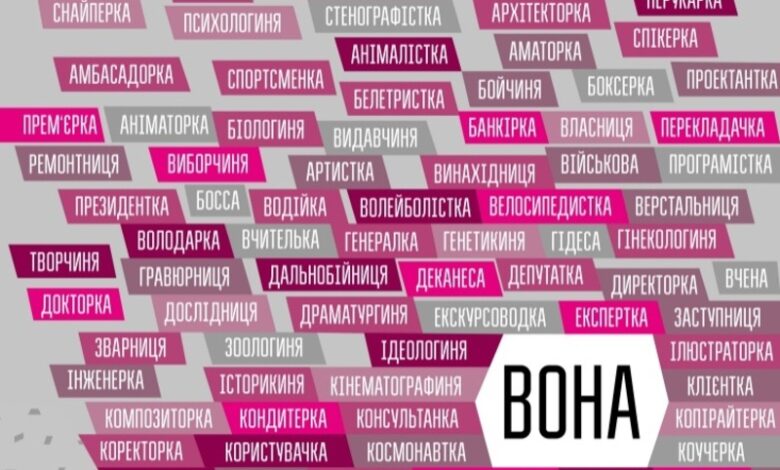
The Ukrainian language is constantly changing along with society, responding to new professions, social roles, and experiences that seemed atypical or even impossible a few decades ago. Therefore, it contains words and forms that often cause surprise, resistance or discussion among Ukrainians, even if these new words fit perfectly into the internal logic of the language system.
The issue of so-called reverse feminines has become the subject of a professional commentary by Olena Synchak, associate professor of the Department of Philology of the Ukrainian Catholic University, compiler of the Web Dictionary of Female Names of the Ukrainian Language.
She draws attention to the fact that the appearance of words like “milkman” or “Nanny” is not a linguistic anomaly or a modern experiment, but has a deep historical and social background related to changes in the structure of work and the roles of men and women. According to her, the discussion of feminatives in the Ukrainian language usually focuses on female names of professions, but the language system is much broader than this optics, and there is a phenomenon in it that rarely comes into public discussion, but has a clear scientific explanation and a long history.
As Olena Synchak explains, language reacts not to ideologies or discussions, but to real changes in society, so word-formation processes occur where there is a need to name a new social role or a new participation of a person in a certain sphere.
According to the philologist, most names of professions in the Ukrainian language do indeed have the masculine form as the base, from which female counterparts were later formed, but this is not a universal rule and does not cover all areas of life. In cases where a certain activity was almost exclusively female for a long time, it was the female name that was fixed in the language as the primary one. When men began to enter this sphere en masse, the language system looked for a way to name them without violating its own grammatical logic.
This is how, according to Olena Synchak, words like “дояр” and “нян” appear, which are formed from the female names “доярка” and “няня” and fully correspond to the word-forming models of the Ukrainian language.
Commenting on the example of “нян”, Olena Synchak emphasizes that the linguistic discomfort that sometimes arises in people is not associated with the incorrectness of the word, but with established social ideas about care work. She explains that the word “nanny” has historically been entrenched as feminine not because the language did not allow for the masculine form, but because the work of caring for children itself has been performed predominantly by women for centuries. When men start working in this field, the language creates the form “nanny” according to existing grammatical rules, rather than inventing something artificial.
According to the philologist, such a word formation model is common for the Ukrainian language, even if the result has not yet become everyday in use.
Olena Synchak applies a similar logic to the word “doyar”, which, as she explains, comes from “doyarka”, because milking cattle was considered women’s work for a long time and it was the female name that took root earlier.
The philologist emphasizes that the masculine form in this case is not secondary in the sense of “inferiority”, but only reflects a change in the social reality in which men began to perform work that was previously associated exclusively with women.
According to Olena Synchak, such examples show that the Ukrainian language does not have a rigid hierarchy of genders in the names of professions, but uses flexible mechanisms that allow people to be accurately named according to their activities.
Experts draw attention to the fact that the rejection of reverse feminines often arises because speakers are used to seeing the process of word formation in only one direction – from masculine to feminine.
She notes that the Ukrainian language is much broader than this scheme, and surprise or irony regarding the words “nanny” or “milkmaid” is more likely a reaction to the violation of stereotypes than to linguistic “non-normativity”.
The philologist emphasizes that dictionaries record what is actually used, not what seems convenient or inconvenient to someone, so the appearance of such forms in language resources is a matter of time and frequency of use.
Commenting on the practical use of reverse feminines, Olena Synchak notes that they are appropriate in situations where it is necessary to accurately name the profession or occupation of a specific person, without resorting to generalizations or “default” masculine forms. Language norms are formed gradually, through habit and repetition, so not all such words immediately become neutral for all speakers, but this is not a reason to consider them incorrect.
According to her, the use of reverse feminines allows language to more accurately reflect the reality in which care, service, or agricultural work ceases to be rigidly tied to gender. A careful attitude to such phenomena helps to move away from emotional disputes and see language as a system capable of adequately responding to real changes in people’s lives, rather than as a set of frozen rules that are not subject to development.