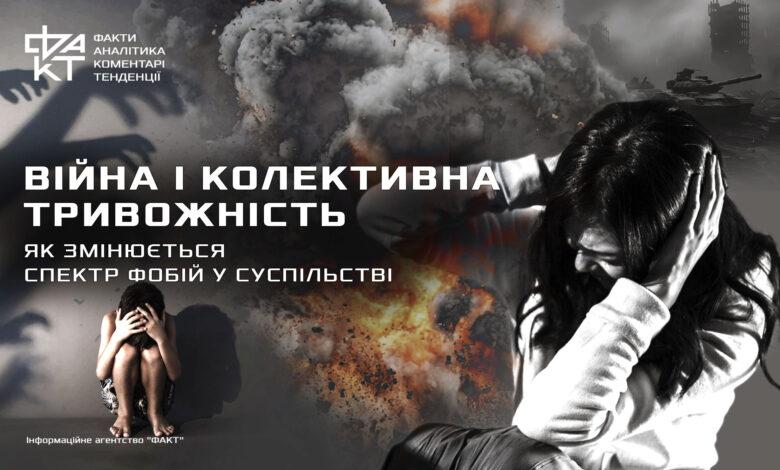
War changes not only cities and borders, but also rewrites the human psyche. What used to seem mundane becomes a source of uncontrollable panic. A loud sound outside the window, the darkness of the entrance, a sudden call – all this can cause not just anxiety, but real terror. New phobias born of war often remain invisible to those around them, but influence behavior, decisions, and even the future of society. They take root so deeply that they cease to seem like deviations, but become constant companions in modern life.
Statistics of fears
Fear is the oldest survival mechanism that accompanies humanity throughout its existence. However, in times of war, this mechanism is activated with particular force, giving rise to new, specific phobias. Ukrainians living in the realities of a full-scale war are forced to constantly face fears that become part of everyday life. According to estimates by the World Health Organization (WHO), 301 million people worldwide suffer from anxiety disorders. As claim experts, 20% of people are prone to phobias. Moreover, these disorders are more common among women than among men.
In Ukraine, the war had a significant impact on the mental health of the population. According to WHO estimates, in 2024, 9.6 million people in Ukraine are at risk of developing mental disorders or already living with them, of which 3.9 million suffer from moderate to severe symptoms. It is clear that hostilities and associated stressors, such as constant air strikes and shelling, can lead to the development of various fears and anxiety disorders among the population.
Data from the Kyiv International Institute of Sociology (KIIS) indicate to the fact that 87% of Ukrainians experienced a stressful situation that affected their health:
- 40% of Ukrainians survived bombing and shelling;
- 18% felt helpless;
- 14% lost their jobs;
- 3% suffered from an attack or robbery;
- 7% experienced other stressful situations.
Of course, all this does not disappear without a trace.
Wartime phobias
In addition to classic fears that have evolutionary roots (fear of death, pain, loss of loved ones), modern warfare creates unique phobias related to technology and the urban environment. Here are some of them:
- dronophobia – fear of drones. In a war zone, the sound of drones causes panic, because they can carry a threat. Even in the back towns, people often shudder when they hear similar sounds;
- sirenophobia – fear of the sound of an air alarm. Studies show that in many people, the sound causes a racing heart, a spike in cortisol, and even panic attacks;
- temnophobia – fear of the dark due to blackouts. Life without light, with a feeling of insecurity, increases anxiety, especially in children and the elderly;
- mapophobia – fear of looking at maps of military operations. Many Ukrainians avoid updates about the front, because news about the loss or capture of territories causes great stress.
War destroys the basic sense of security. When a person cannot control the situation, his brain begins to create traps in the form of irrational fears. Constant stress, hormonal surges and traumatic experiences turn these fears into conditioned reflexes.
For in words According to Anna Likhodeyeva, a psychotherapist at the regional psychiatric hospital, one in five Ukrainians suffered adverse consequences for their mental health due to the war. According to the Ministry of Health, about 15 million Ukrainians will need psychological or psychiatric support, of which 3-4 million will need medical treatment. The doctor also pointed out the fact that Ukrainians are in a state of collective trauma, so the issue of mental health is directly related to psychological and psychiatric well-being.
According to her, after the start of the full-scale invasion, the number of applications to the regional psychiatric hospital increased. If in 2021, 19,000 people sought outpatient help, then in 2022 – 19,500, of which 6,000 needed inpatient treatment. At the same time, in the first nine months of 2023, 7,000 patients were already treated in the hospital. As we can see, the war caused a significant increase in anxiety, depression and panic disorders.
Interestingly, research by scientists from Harvard University confirms that long-term stress changes the work of the amygdala, the part of the brain responsible for fear. War literally resets the psyche, making people fear even those things that previously seemed mundane.
Fear that rules the world
Phobias have accompanied humanity since ancient times. They are deeply rooted in our psyche, emerge from the subconscious and make us tremble at the very idea of the object of fear. They cannot be considered a whim or a figment of our brain. Phobias have deep evolutionary roots. Let’s start with the life of primitive people. Survival depended on the ability to respond quickly to threats. Fear of snakes, spiders or heights was an advantage – those who were afraid died less often. This is called biological training. Our brain imprints those fears that helped our ancestors survive.
Recent research into phobias sheds light on their causes and possible treatments. Scientists have discovered that the brain structure of people with phobias is different from those who suffer from other anxiety disorders. An MRI analysis of more than 1,400 children and adults with specific phobias showed unique changes in the brains of these patients. This discovery may help develop more accurate methods of diagnosing and treating phobias.
Some researchers believe that phobias have an evolutionary basis. Edward O. Wilson suggests that phobias are the result of genetic evolution, because in the early stages of human development they increased the chances of survival. This means that certain fears may have been useful for our ancestors and passed down from generation to generation.
Cognitive behavioral therapy (CBT) is considered one of the most effective methods of treating phobias. The main technique is exposure therapy, which consists in gradually confronting the patient with the object of fear in controlled conditions. This helps reduce anxiety and teach the brain new responses to a stimulus.
Traumatic events, especially in childhood, can contribute to the development of phobias. For example, a negative experience associated with a certain object or situation can lead to the formation of persistent fear. In addition, observing the reactions of other people, especially parents, can influence the development of phobias in children.
There are more than 500 different phobias in the medical directory of the USA and Canada. For the first time, the diagnosis of phobic reaction was described in 1952 in the American Psychiatric Association. At that time, phobias of syphilis, dirt, closed or open places, and animals were common. The modern world has opened access to the most incredible phobias, such as hippopotomonstroseskipedalophobia, which is the fear of long words. There is also omphalophobia – fear of navels. People who have it are afraid to even touch their own navel. Some phobias can be culturally determined. Yes, in Japan there is “taijin kyofusyo” – the fear of offending someone with one’s behavior or appearance. One of the most common is arachnophobia – the fear of spiders, but trypophobia (fear of a cluster of holes – ed.), although popular, is not officially recognized as a phobia.
Over the past decades, the number of phobias has tripled, which is explained by the general development of society, the influence of media content on the human psyche, and other factors. Thus, the appearance of nuclear weapons caused atomasophobia – the fear of a nuclear explosion, scientific progress led to Hellenolophobia – the fear of not understanding scientific terminology, and the rapid development of computer technologies caused cyberphobia – the fear of computers, which is most often found among older people. In addition, idealized images in movies and on television contribute to the spread of obesophobia (fear of gaining extra weight) and gerontophobia (fear of aging).
Experts distinguish three main groups of phobias:
- specific (simple),
- social;
- agoraphobia
Specific phobias usually originate in childhood or early adolescence. By data In the World Mental Health Survey, conducted within the framework of the WHO initiative, the average age of appearance of such phobias among 124,902 participants from 22 countries was 8 years. At the same time, they can occur at any age.
Back in 1987, Lars-Joran Ost, one of the founders of cognitive-behavioral therapy in Sweden, established that the fear of animals most often develops at the age of seven, the phobia of blood – at the age of nine, and claustrophobia – at the age of 20. Childhood fears tend to be fleeting, while those that emerge in adulthood can be persistent and require treatment.
It is interesting that the frequency of new phobias in women decreases until the age of 20, after which it increases again at about 30. An additional peak is observed in old age. The authors of the study published in Lancet Psychiatry, assume, that the most significant demographic risk factor for the development of specific phobias is the female gender. At the same time, everything depends on the type of fear: women are among the people who are afraid of blood, injections and injuries make up from 55% to 70%. Scientists explain this with evolutionary factors: women probably tend to avoid danger, because in the past this could increase the chances of offspring survival.
Social phobias are characterized by the fear of situations in which a person may feel uncomfortable or look insecure in the eyes of others. They can be both specific (for example, fear of public speaking, eating in public), and generalized, when anxiety occurs in various forms of social interaction. The main feature of social phobia is the fear of condemnation or negative evaluation from the environment. It is important to note that these manifestations disappear when a person performs the same actions alone, which confirms their social nature.
Unlike specific phobias, which are usually formed in childhood, social phobias most often appear in adolescence or young adulthood. At the same time, experienced social humiliation does not always lead to the development of this disorder. Yes, agoraphobia is a fear of situations in which a person does not have easy access to a safe place. It can appear both in open and closed spaces. People with agoraphobia often avoid crowded places, such as shopping malls, movie theaters, or stadiums, and may fear travel and avoid public transportation, including buses, trains, airplanes, and the subway.
The world of phobias is not limited to common fears – there are also those that may seem unusual or even paradoxical. For example:
- Pedophobia is the fear of children.
- Coulrophobia is the fear of clowns (this seems to explain a lot of cinematic horror movies).
- Alekterophobia is the fear of chickens (and possibly quail eggs).
- Penteraphobia – fear of mother-in-law.
- Arithmophobia is a panic fear of numbers (mathematics is clearly not an ally here).
- Caligonephobia is the fear of beautiful women. (probably this explains why most men are afraid to meet women).
- Pteronophobia – fear of being tickled by feathers (obviously, intolerance of goose down blankets).
- Macrophobia is the fear of a long wait (queues at the polyclinic can be a real test).
- Phobophobia is the fear of fear itself.
- Cabbage phobia is the fear of vegetables (a great excuse for those who don’t like broccoli).
- Pediophobia is a panic fear of dolls (especially antique ones).
- Ablutophobia – fear of bathing, washing and any cleaning (we hope that such people do not meet often).
- Dendrophobia is the fear of trees (a walk in the park is a real horror).
- Chorophobia is the fear of dancing (for some it is just an excuse not to go to the dance floor).
- Homichlophobia – fear of fog (Sherlock Holmes would not approve).
- Cypridophobia – fear of prostitutes or infection with venereal diseases.
- Nyctophobia – fear of the dark (the most common childhood fear).
- Methiphobia is the fear of alcoholic beverages (it seems to be rare in many countries).
As you can see, phobias are the most unexpected, and although some of them may sound funny, for those who experience them, it is a serious problem that affects the quality of life.
War not only exacerbates existing fears, but creates completely new phobias that were not characteristic of peaceful life before. They are formed as a reaction to real threats, becoming part of the psyche of entire generations. Many of these fears can remain with people even after hostilities are over, developing into post-traumatic stress disorder or changing social norms. At the same time, fear can be not only destructive, but also an adaptive mechanism: it teaches caution, quick decision-making and forms collective responsibility for safety. How society deals with these phobias after the war will determine its future resilience.