Chronic stress of war: mental health of the population and the realities of psychiatric support

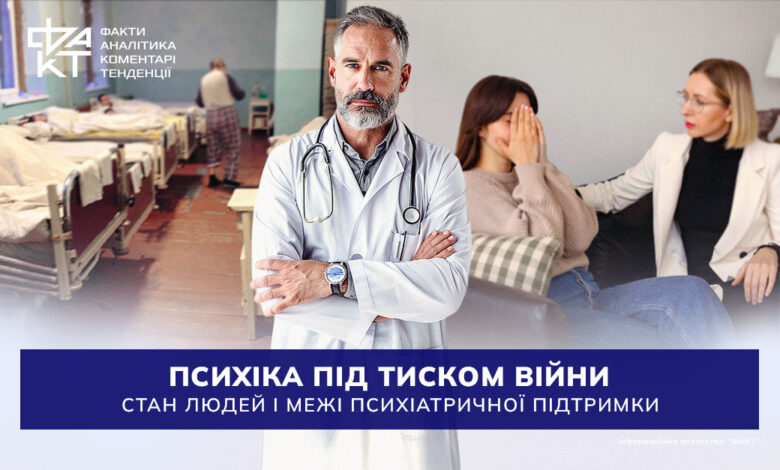
The war in Ukraine has not only destroyed cities and destinies, but also deeply interfered with one of the most vulnerable areas of human life – the mental and psychological state. What 4 years ago remained a private problem or a topic of narrow professional dialogue between a doctor and a patient, in wartime has turned into a question of public security, state responsibility and control over a person.
Mass trauma, loss of loved ones, life under constant threat of shelling, forced displacement, destruction of housing and social ties, economic instability and chronic uncertainty have formed a new reality in which mental disorders have ceased to be an exception and have become a logical reaction of the human psyche to extreme circumstances. According to estimates of the World Health Organization (WHO), in countries at war or in protracted armed conflict, from 25% of the population needs professional psychological or psychiatric help
Separately, UN reports emphasize that armed conflicts sharply increase the level of depressive and anxiety disorders, post-traumatic stress disorder and suicidal risks among the civilian population
The paradox of wartime also lies in the fact that psychiatry simultaneously becomes both a space of salvation and a source of fear. For a certain category of people, it is the only opportunity to maintain mental stability and work capacity. For others, there is a risk of receiving a stigmatizing diagnosis, facing restrictions on rights, problems with employment, or undesirable administrative consequences. In this tension between help and control, a deep distrust of the psychiatric care system is formed.
In addition, the situation is further complicated by the mobilization process of wartime. A psychiatric conclusion in such conditions acquires special importance – sometimes as a substantiated medical document, sometimes as a tool for managerial decisions, and sometimes as the last barrier between a person and the front. This gives rise to two extremes: fear of seeking help and conscious simulation of mental disorders in the hope of avoiding service. Both models of behavior are symptoms of a systemic crisis of trust between citizens and the state.
Journalists from IA “FAKT” decided to analyze which of the population in wartime has access to psychiatric and psychological care, and whether it acts as a real space for support or rather as an instrument of pressure and control. To do this, we spoke with psychologists and psychiatrists, studied available data and cases to find out how the system works in practice and where the line between assistance and administrative influence is drawn.
To understand the real accessibility of psychiatric and psychological assistance, we interviewed a psychiatrist at Kharkiv Regional Clinical Psychiatric Hospital No. 3. According to him, officially assistance is available to many, but in practice the situation is completely different.
“In fact, only those who are in the military structure receive systemic support. They have access to psychologists in hospitals, group consultations and VLK procedures. For civilians, everything is much more complicated: assistance really exists only in large cities and for those who can afford private psychotherapy. The rest are left outside the system,” — explains the doctor.
According to him, the least protected are internally displaced persons, residents of frontline areas, the elderly, and those who do not have access to digital services. A special group is made up of men of military age, for whom any visit to a psychiatrist is automatically perceived as a risk of mobilization.
“We often see that people are simply afraid to seek help, even when their condition requires help. Fear of consequences and social stigmatization makes access to the system nominal, not real.
Ukrainians are enduring extremely difficult circumstances, but the long war affects their mental state. The level of exhaustion, anxiety increases, sleep problems, and symptoms of post-traumatic stress disorder appear. Even psychologically stable people need support, time to recover, and basic self-care – full sleep and regular nutrition.
The experience of other countries shows the long-term consequences of war. For example, in the USA, after the end of hostilities, the number of deaths related to psychological consequences, including suicides among veterans, exceeded the losses during the war itself. This emphasizes that the consequences of traumatic events can manifest and intensify even after the cessation of active hostilities.
Untreated post-traumatic stress disorder can become chronic over time and affect the structure of the personality. That is why timely psychological intervention is important. At the same time, in the current conditions, its full implementation is complicated by the lack of specialists and the reduction of specialized departments, ”says the psychiatrist.
Thus, official declarations about the state’s concern for the mental state of the population and real practice often diverge. Help exists, but it is “elite” and selective, which creates another level of anxiety and distrust among the population.
We also spoke with psychologist Natalia Koval from the Kyiv Regional Psychiatric Hospital and lawyer Oleksandr Honchar, who advises on human rights and social guarantees.
“The full-scale war has significantly affected the mental state of Ukrainians, and these changes are becoming increasingly noticeable. Among young people aged 25-35 in 2025-2026, the level of stress remains extremely high and reaches 91%.
The mental state of older people is increasingly characterized by a feeling of “life on pause”. The long war affects the perception of time and the future: many stop making plans, postpone important decisions and live in a waiting mode. This is accompanied by a loss of the ability to enjoy familiar things and gradual emotional exhaustion. Constant stress, isolation, and accumulated losses deepen feelings of devastation.
In addition, symptoms of post-traumatic stress disorder remain common. These include sleep disturbances, increased irritability, emotional instability, and a tendency to become irritable or angry. According to current trends, such manifestations are recorded in approximately 44-45% of the population, and older people are at increased risk due to their accumulated experience of stressful events and limited access to psychological help.
An additional factor is financial anxiety. More than 40% of people express concern about a lack of funds, which is especially acute among the older generation with fixed incomes. Uncertainty about financial security increases general anxiety, worsens emotional state and complicates the recovery process.
About half of people tell us about constant exhaustion, depressed mood and sleep problems. Prolonged stress creates chronic fatigue, which gradually accumulates and complicates everyday life.
Every day I work with patients, and almost half of them do not seek therapy, but ask the question: “What will happen after the diagnosis?” People are afraid that their psychiatric status will limit their rights, prevent them from finding a job, change their documents or become a problem at the VLK. Many have real stories when former patients fell into bureaucratic traps for years.
Last month I consulted a family of displaced persons from Severodonetsk. The father had severe anxiety, but refused treatment for fear that it would affect his work permit and social benefits. His condition deteriorated so much that a crisis team had to be called in,” says Natalia Koval.
According to unofficial estimates voiced by Natalia Koval, about 60% of patients who need regular psychological support in Kyiv and Lviv do not seek treatment due to fear of the consequences of the diagnosis.
Lawyer Oleksandr Honchar adds:
“I provide consultations in Kyiv and Lviv, and I see one pattern: a record of a psychiatric diagnosis in medical documents is often used as an argument against a person. This can affect obtaining licenses, working in government agencies, and access to some social programs. We even recorded cases where men of draft age who had short-term psychiatric consultations felt compelled to hide their condition for fear of being put on the mobilization list.
On average, out of 10 men of draft age who had occasional psychiatric consultations, 7 avoided re-visiting because they were afraid that it would be used against them.
Even for those who have officially received the status of a psychiatrist’s patient, there is a long-term fixation of records. People often do not realize that this data can appear in bureaucratic checks for several years. Because of this, a culture of silence and self-medication is formed.
As a result, the fear of the consequences of the diagnosis turns psychiatry from a potential resource of support into an additional source of stress, which complicates access to help and deepens the mental problems of society, and this becomes so systemic that even experts admit: without changing the rules for fixing diagnoses and transparency of procedures, most people will remain in the shadows and will not receive the necessary support.
Gradually, society has adapted to the reality of constant danger. Many people have learned to function in conditions of anxiety, loss and uncertainty, but such adaptation has its price. There is emotional blunting, decreased sensitivity to events and an increase in the level of aggressive reactions. What previously caused strong emotions is increasingly perceived as commonplace.
At the same time, the majority of citizens assess their own lives as having a low quality. About 72% of Ukrainians associate this with constant worries about safety and financial situation. Uncertainty about the future and unstable incomes increase anxiety and feelings of instability.
It should be noted that the demand for psychological help is growing. If in 2022 about 7% of citizens turned to specialists, then by the end of 2025 this figure had increased to 17%. At the same time, the need significantly exceeds the capabilities of the system: more than 70% of adults need support, but far from all have access to it.
A separate challenge will be the return to peaceful life of 5-6 million veterans and their family members. Their reintegration will require both professional psychological help and the formation of new models of interaction, mutual understanding and support in society.
It is worth noting that in conditions of general mobilization, psychiatry is faced with a phenomenon that was previously considered isolated: people deliberately imitate or exaggerate the symptoms of mental disorders. The purpose of this simulation is to obtain an official diagnosis as a way to avoid serving at the front. At first glance, this may seem like “mass deception,” but a deeper analysis shows that it is an indicator of the unwillingness to fight, as well as a systemic crisis-induced lack of trust in state procedures and social guarantees. Distrust of procedures and guarantees makes any official assessment risky, so patients try to play by their own rules.
It is important to emphasize that the line between simulation, exaggeration of symptoms, and real wartime mental disorder is often blurred. Chronic stress, trauma, constant threat to life, and economic instability can provoke real symptoms that people can further amplify, intentionally or unconsciously. In such conditions, the traditional categorization of “real” vs. “fake” loses clarity and does not always allow for an adequate assessment of a person’s condition, since the psyche reacts to prolonged stress in a complex and multi-level manner, combining objective manifestations of the disorder with subjective adaptation strategies.
“I see cases where psychiatric reports are used in completely different contexts than treatment. For example, conflicts arise with employers: an employee who has received a diagnosis even as part of temporary observation may be dismissed or have his access to official duties restricted. Sometimes disputes arise with military structures or the VLK, where psychiatric status can be interpreted in favor of or against a person, depending on the circumstances.
In addition, a psychiatric report sometimes becomes an argument in family conflicts or child custody issues, and active citizens or those who demonstrate an uncomfortable public position may face pressure based on the diagnosis.
People do come with mental problems, but they see that the document becomes a tool of control — and this discourages seeking help at all,” says our first interlocutor, a doctor.
The key to this issue is also the lack of transparent procedures and guarantees, which is why a psychiatric diagnosis loses its protective function and becomes a potential risk. In such conditions, the system that should support mental health often only deepens fears and distrust of specialists, forcing people to silence symptoms or seek alternative ways of “protection”.
Thus, a diagnosis can become not the basis for treatment, but a label that formally exists on paper, but socially and administratively works against a person, creating an additional level of pressure in the stressful situation of war.
As we can see, the war revealed weaknesses in the psychiatric system that previously remained hidden. First of all, the country is faced with a shortage of specialists: large cities and front-line regions have too few psychiatrists to cover the needs of the population. At the same time, the load on the available specialists is critical – overload and professional burnout are becoming the norm, which negatively affects the quality of assessment and treatment. In such a system, any consultation is reduced to a minimum, and comprehensive monitoring of the patient is practically impossible.
An additional factor is the lack of unified standards for diagnosis and interaction between psychological and psychiatric care. The patient often moves between different structures, receiving fragmented support or being left without it altogether. Such a gap deepens distrust in the system and stimulates hiding symptoms, self-medication or turning to non-professionals. The lack of long-term support is especially acute: even when the patient receives initial care, the lack of sustainable therapy, support and monitoring programs creates the risk of relapse, exacerbation of symptoms and chronicity of disorders.
The war changed not only the front and the economy, but also the mental health system. Psychiatric and psychological care in Ukraine is currently available only to a part of the population: military personnel through internal structures, residents of large cities and those who have financial means. For the rest — displaced persons, residents of frontline areas, the elderly, and men of military age — the system is formal and fragmented.
This is not a criticism of the profession, but a reality of war. It shows that even medicine, which is designed to save lives, can become an instrument of pressure if transparent procedures, trust, and accessibility of care are lacking.