
Russian attacks on trains have intensified: Ukrzaliznytsia explained to passengers how to act during a threat

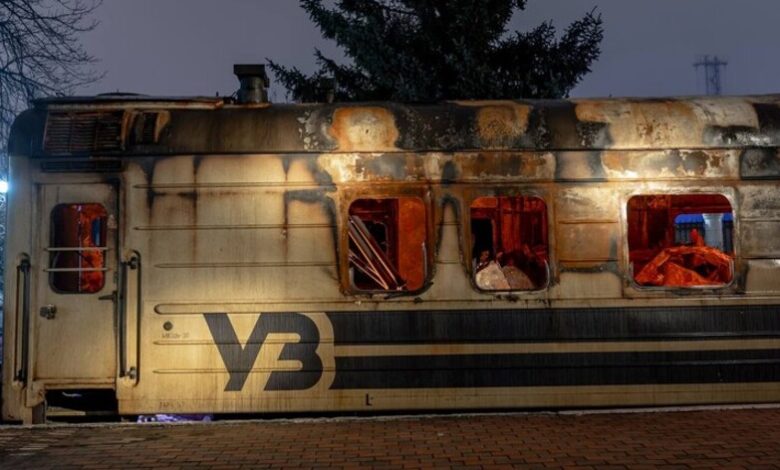
Due to the intensification of Russian attacks on trains and railway infrastructure, it is increasingly important for passengers to know how to act in the event of a threat. Therefore, Ukrzaliznytsia has explained the procedure for action in times of danger: what to do after the conductor’s signal, what things to take during evacuation, and why in such a situation you should not stay in the car.
As reported by Oleksandr Pertsovsky, Chairman of the Board of JSC Ukrzaliznytsia, in several months of 2026, railway infrastructure accounted for a tenth of all attacks recorded since February 2022. The total number of such attacks has already reached 5,000.
The increase in attacks on Ukrzaliznytsia facilities is associated with the fact that in the spring the focus of Russian shelling shifts from energy to transport infrastructure. This change of goals has a completely understandable logic: the railway in wartime plays a much broader role than in peacetime, as it maintains the country’s internal mobility, ensures evacuation, transportation of civilians, delivery of goods and maintains communication between regions where air traffic is absent, and some other routes are vulnerable or limited.
As a result of the shelling, a significant number of locomotives, passenger cars and stations were damaged, which forced the company to change individual routes and revise schedules. Now traveling by rail requires a person to pay more attention to the instructions of Ukrzaliznytsia staff. If earlier the conductor’s instructions mostly concerned everyday things – the place, time of stopping, rules for boarding or disembarking, now they can be directly related to the risk to life.
Oleksandr Pertsovsky emphasizes that in case of increased danger, the passenger should first of all listen to the company’s employees, since they coordinate actions in the car and know when the situation requires urgent evacuation. This is explained by the fact that the modern threat to the train lies not only in the fact of the impact, but also in the fact that a damaged car can turn into a trap in a matter of minutes. Metal structures under the influence of an explosion quickly deform, passages are blocked, a fire can break out inside, and additional danger is created by chemicals released as a result of ignition and destruction of materials. Under such conditions, delaying due to the desire to pick up a suitcase or return for things can be much more dangerous than a person imagines in the first seconds after the impact.
In the event of a signal from the conductor about a threat, a passenger should immediately prepare for evacuation, without wasting time on fuss and arguments about how real the risk is. According to Pertsovsky, large suitcases, bags and other bulky items should be left in place, as they only slow down traffic, block the passage and create chaos in the narrow space of the car. You need to take documents and a phone with you – everything else in such a situation fades into the background.
This rule has a deeply pragmatic basis, because during an emergency exit, the account can run into minutes, and sometimes seconds. A person trying to pull luggage from a shelf, turn a suitcase in the aisle, or collect all personal belongings blocks traffic not only for himself, but also for others. In a car where a fire has started or structural deformation has occurred, such a jam can dramatically complicate evacuation for dozens of people at the same time.
After evacuation, the main task is not to crowd near the train. The company advises to disperse, while keeping in sight the conductor in a signal vest, who coordinates further actions. This recommendation may seem contradictory only at first glance, but its logic is clear: crowds near the cars create a new risk, because people find themselves too close to an object that has already been hit or may be hit again, and at the same time complicate the work of those assessing the situation.
The Chairman of the Board of JSC “Ukrzaliznytsia” emphasizes: if you hear explosions nearby, you should act according to the safety instructions given by railway employees. After that, you need to wait for a signal that the danger has ended – voice, through a megaphone or whistle. In such circumstances, an unauthorized return to the car, an attempt to leave without coordination, or chaotic movement in different directions can only increase the risk, since a passenger without an overall picture is unable to assess where the threat has passed and where it persists.
For “Ukrzaliznytsia” this situation means the need to train personnel in something that in peacetime no one included in regular professional training.
“Unfortunately, no one in the world has been taught how to act when a “shaheed” is flying over you, but life forces us, and colleagues constantly undergo this training and practice to ensure that the evacuation experience is safe,” the specialist noted.
According to Oleksandr Pertsovsky, more than four thousand train crews have already undergone special evacuation training, and such training continues.
Against the backdrop of systemic attacks, the train and the station can no longer be perceived as a space completely separated from the war. Ukrainian railways have long been operating in a mode where a normal flight can at one moment turn into a situation of increased risk, which means that discipline during danger becomes part of the trip itself. A person who knows the basic procedure has a much better chance of not getting lost and not disturbing others than a passenger who, at a critical moment, begins to act intuitively and chaotically.


