Scientists have created microrobots that will replace medical needles for injections

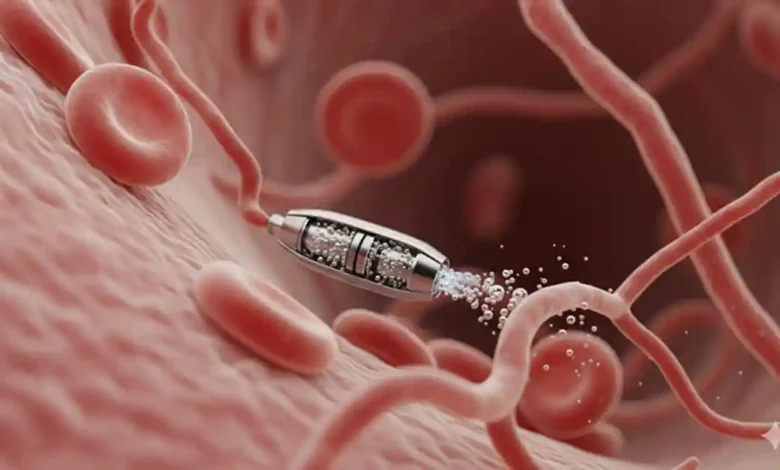
An international team of researchers from the United States and China presented a new technology that uses the phenomenon of cavitation — the process of formation and rapid destruction of bubbles in a liquid — to move microrobots. This development could become the basis for creating methods of drug administration without the use of traditional medical needles, reports Interesting Engineering.
The micro-robots, dubbed “jumpers,” create bubbles thanks to laser heating of a light-absorbing material. When a bubble reaches a critical size, it collapses instantly, releasing mechanical energy in the form of a shock wave. This energy allows millimeter robots to jump to a height of up to 1.5 meters or move in a liquid at a speed of about 12 m/s.
Researchers emphasize that the direction, force and height of the jump can be controlled by changing the intensity, angle and duration of laser exposure. Thanks to this, microrobots are able not only to jump, but also to slide or move in a liquid environment, including microchannels.
In medicine, this technology makes it possible to deliver drugs through the skin or directly to affected areas of the body, such as tumors, without the use of syringes. The system works on the basis of light heating, which allows you to configure it for minimally invasive procedures. An important advantage is the absence of a need for a built-in power source or moving parts, which distinguishes “jumpers” from microrobots that use magnetic fields or chemical fuel and are difficult to control inside the body.
Potential fields of application go beyond medicine. Such microrobots can be used to study hard-to-reach objects, including pipelines, technical mechanisms or biological structures. In biomedical research, they can act as microswimmers in fluids, particularly the bloodstream or intercellular medium. In addition, the technology opens up new perspectives for cell therapy and high-precision surgery, where traditional instruments are too large or inefficient.
Despite great potential, development is currently at the conceptual stage. Among the main challenges are the need to precisely control cavitation in the body without tissue damage, the limited depth of laser penetration, as well as the need to check the biocompatibility of microrobot materials before conducting tests on living organisms.