Scientists have discovered the remains of giant octopuses up to nineteen meters long

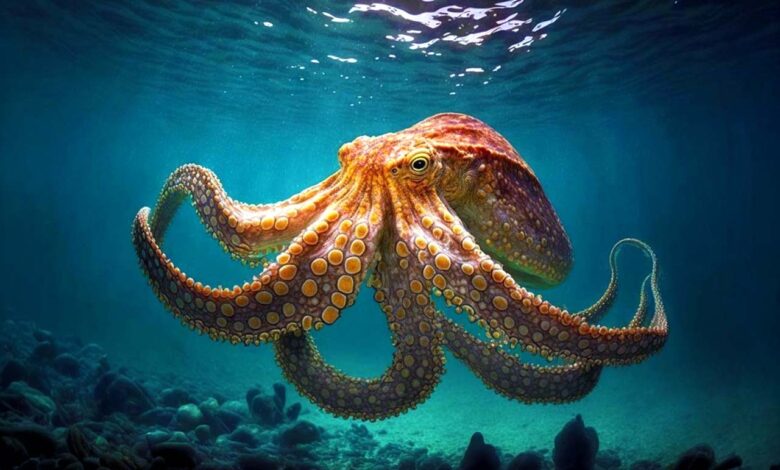
About 100 million years ago, the world’s oceans were inhabited by giant octopuses, whose size and strength were comparable to the mythical kraken. According to a new study published in the journal Science, ancient mollusks of the genus Nanaimoteuthis could reach 19 meters in length. Thanks to the unique structure of their jaws, these creatures were able to crush the shells and even bones of their prey.
Since the soft bodies of octopuses are rarely preserved in the form of fossils, scientists obtained key information by analyzing 15 large “beaks” – the only hard part of the body of these animals.
Using modern digital imaging methods, the researchers discovered additional samples in rocks that are between 72 and 100 million years old. The measurements showed that the Nanaimoteuthis haggarti species had significantly larger jaws than the modern giant squid, which is considered the largest invertebrate of our time.
“N. haggarti probably used its long tentacles to capture prey, and its powerful lower jaw to crush hard structures such as shells and bones,” said study co-author Yasuhiro Iba.
Scientists noticed characteristic chips and scratches on the largest fossils, indicating regular hunting for large prey with strong covers. The victims of these giants were bony fish, crustaceans and even large marine reptiles, including plesiosaurs. The uneven wear of the jaws also suggests the complex behavior of the mollusks, which, like their modern relatives, could have divided functions between the tentacles.
“These animals were not only strong, but also behaviorally sophisticated predators. They were giant predators that occupied the top of the marine food chain of the Cretaceous period,” the scientist emphasized.
The discovery of Japanese paleontologists significantly changes the idea of the marine ecosystem of the Cretaceous period. It turned out that giant octopuses were one of the most dangerous inhabitants of the oceans of that time, successfully competing for resources with marine lizards. This study highlights the importance of studying fragmentary remains in depth to reconstruct the full picture of marine predator evolution.
Previously, German researchers reported the discovery of 183-million-year-old vampire squid fossils, which also confirms the ancient history of cephalopod dominance in the world’s waters. The new data on Nanaimoteuthis adds an important element to understanding how the inhabitants of the deep have changed over millions of years of the planet’s development.