Shooting in Kyiv: a high-profile tragedy as a verdict on the Ministry of Internal Affairs system

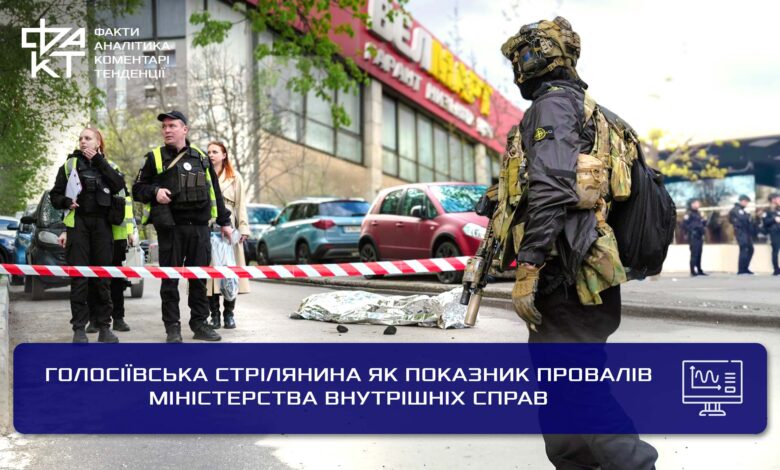
The high-profile shooting in a supermarket in the Holosiivskyi district of Kyiv, which resulted in deaths and injuries, has become one of the most serious crimes of recent times. However, it revealed a much deeper problem than the crime of one armed man. The law enforcement system is tested not by formal reports, slogans and loud statements about reforms, but by its ability to resist crime and stop criminals before they take to the streets. However, now a whole complex of weaknesses that have long been accumulating within the Ministry of Internal Affairs system has come to the surface – personnel weakness and unprofessionalism of the leadership, frank cowardice and unpreparedness of police officers to act in an emergency, as well as the lack of crime prevention and control by the permitting system.
Holosiivskyi shooting: seven dead, hostages in a supermarket and information about the attacker
On April 18, a high-profile incident occurred that shook Ukrainian society. In the Holosiivskyi district of Kyiv, a domestic conflict escalated in a matter of minutes into shooting people on the streets of Demiivka, hostage-taking in a supermarket, and a bloody storming. According to law enforcement, the criminal opened fire on passersby on the street, then burst into the Walmart supermarket and took hostages the people inside. During a special operation, security forces stormed the building where the attacker had barricaded himself and eliminated him.
As a result of this tragedy, 7 people died, including the shooter. Another 14 people were injured, including a 12-year-old boy. As of the latest reports, seven victims remain in the capital’s hospitals: four are in intensive care under intensive care, two are being treated in the trauma department, the child was transferred to a specialized department, her condition is assessed by doctors as stable.
The circumstances of the first minutes of the attack, which were made public by the National Police, indicate that the impetus was a domestic quarrel. The Head of the National Police, Ivan Vyhivskyi, reported at a briefing that the man had a traumatic pistol with him, from which he shot at a neighbor with whom he had a conflict. The neighbor’s wife was nearby at that moment. After that, the shooter ran to the apartment, took another weapon, with which he later went to the supermarket, and also set the apartment on fire, having previously poured liquid on it.
Over time, law enforcement officers made public information about the attacker – according to Vyhivskyi, the shooter was 58-year-old Dmitry Vasylchenkov, a native of Moscow, who had served in Ukraine in the automobile troops since 1992. After retiring in 2005, he periodically traveled to Russia, and in 2017 returned and lived in Bakhmut.
The investigation materials show that Vasylchenkov had previously been held accountable for inflicting minor bodily harm, but that case ended in a court settlement, which meant there were no grounds for depriving him of his right to a weapon. In December 2025, he received a medical certificate required to obtain a permit and officially extended this permit. Now investigators are checking the medical facility and finding out under what circumstances the document was issued. However, it is unclear and the police do not explain on what grounds the criminal was granted a permit to possess weapons.
The head of the National Police also reported that the man’s behavior during the attack gives grounds to assume possible mental disorders at the time of the crime. The investigation is considering this version along with other circumstances that should explain how a domestic conflict escalated into shootings on the streets of Kyiv, hostage-taking in a supermarket, and one of the bloodiest events in recent times in the capital.
Shooting in Kyiv as a verdict on the system: failures in the work of the Ministry of Internal Affairs
The Holosiivka shooting exposed several “diseases” of the Ministry of Internal Affairs system at once, which had been accumulating for years under a layer of reports, reformist rhetoric, and indicative statistics. After the bloody attack, they converged at one point so tightly that it is no longer possible to separate personnel weakness from managerial irresponsibility, training failures from the destruction of prevention, and chaos in the field of gun control from the general decline of the police function.
The first layer of these problems concerns the leadership of the Ministry of Internal Affairs and the National Police, because at a time when the system requires professional and quick actions, a cold assessment of the threat, clear commands, and skills to respond in emergency conditions, people without practical experience in operational units and the public security service find themselves at the top. Minister Ihor Klymenko worked in the psychological and personnel service, served in the personnel inspection of the Ministry of Internal Affairs of Ukraine and the department of vocational training and education. That is, his career was formed outside the environment where decisions had to be made every day during street threats, armed conflicts and emergency events.
Ivan Vyhivskyi’s career path went through investigative bodies and rapid growth from the head of the Ochakiv police department, head of the Main Department in the Poltava region to the head of the National Police. However, even in this movement there is no practice that is tempered in operational activities, public security service and work with rapid response units. With such work experience, one should not expect professional managerial actions from police chiefs, especially in emergency situations.
At the same time, public outrage was caused by the reaction of these leaders after the tragedy, because in a country where the war has long changed the perception of risk, responsibility and duty, society expects the leaders of the security forces not to be a dry distancing, but to take a clear position. After armed police officers left people, including a wounded child, to their fate under the bullets of an attacker, they expected at least an apology and public acceptance of responsibility for the behavior of their subordinates from the minister and the head of the National Police, but such steps did not occur. Abroad, in such cases, the resignation of a leader has long become part of the political culture, because the failure of the security structure with human casualties is considered the failure of the entire vertical, and not just individual officials. However, in Ukraine, it is always convenient to shift the blame to “scapegoats” in grassroots units, leaving the positions at the top untouched and the habit of talking about the mistakes of the executors as if the leadership exists beyond the consequences of its own decisions.
Against this background, the action of the head of the Patrol Police Department, Yevgeny Zhukov, became indicative. On April 19, he resigned after a video of police officers who, upon hearing gunshots and the approach of an attacker, fled, leaving people and a wounded child unprotected, was circulated on social networks. At the same time, his statement about the “unworthy and unprofessional” behavior of his subordinates was important because it acknowledged the obvious: a police officer has no right to run away from a threat when there are people nearby who cannot protect themselves. In such a situation, a law enforcement officer is expected to at least take a defensive position, act against the source of danger, organize shelter for civilians and teams that give people a chance to survive. When this is not the case, society sees not the failure of a separate episode, but a humiliating picture of the entire system’s failure to fulfill its basic function.
At the same time, it would be unfair to generalize the failure of one episode to all patrol officers, because every day many police officers in the rear and near the front perform their service professionally and conscientiously. The problem of this tragedy lies deeper than assessing the entire personnel with one black mark, since it brings to the fore the human factor in a particular patrol and systemic distortions in training, staffing, and understanding of the service. However, in conditions of war, forced mobilization, and participation of police officers in joint activities with territorial recruiting centers, society’s attitude towards law enforcement officers is already extremely negative. The shooting in Kyiv only strengthened it, because Ukrainians react especially sharply to the powerlessness of those who are supposed to be defenders of law and order and at the same time use force against unarmed conscripts, whom the CCK mobilizes.
An important issue after the tragedy in Kyiv is related to the combat experience of police officers, since a country living in war conditions can no longer afford a police force prepared for peacetime with occasional shootings at a shooting range and training disconnected from real threats. A police officer who has never worked in a frontline situation, has no combat experience, has not encountered the use of weapons, panic, sudden injuries to people and the need to act in seconds, may turn out to be psychologically and professionally unprepared for emergency circumstances. In this situation, proposals have repeatedly been made for the constant rotation of police officers from the rear to the front.
The logic of this proposal boils down to the fact that a month of service in the frontline zone, two months in the city at the place of registration would give police officers experience that no training ground can provide. Against this background, the statement of Igor Klymenko that the National Police cannot fight at the front, because they are trained to use weapons against criminals, and not on the battlefield, sounds particularly contradictory. However, the Golosiivka tragedy demonstrated that at a critical moment, law enforcement officers did not cope with the use of weapons against criminals.
Most likely, if war-hardened police officers, for example, fighters from the “Lyut” unit or rifle regiments, had been on patrol during the tragedy in Kyiv, they would not have behaved like the Kyiv police, but would have acted professionally. There is no romanticization of the front here, but there is a sober awareness that the experience of real contact with a deadly threat changes both the skill of assessing the situation, the speed of decision-making, and the ability to keep oneself in check. However, as is known, history does not have the word “if”.
The permit system opens up a separate set of problems, because after the attack a number of questions arise, to which the leadership of the Ministry of Internal Affairs did not give any answers. If the shooter had previous clashes, threats to people and behavior that should have caused alarm, then why did the permit service employees not intervene earlier? Why was the weapon not confiscated from him? Why did not the precinct officers, who should be the first to see antisocial manifestations in their territory, become a source of signal for stricter control? On what basis was the criminal granted and extended a permit to possess weapons?
The permit system exists not for paperwork, but for constant control over those who have weapons, in what conditions they are stored, and whether circumstances arise that make further possession dangerous for the environment. When this function is reduced to formal bureaucracy and corrupt actions, the state loses the chance to stop the threat before the first shot is fired.
The responsibility of precinct officers in this conversation cannot be pushed aside either, because they were traditionally the ones who knew their district best, conflict addresses, dangerous people and situations that have all the signs of future trouble. However, now a significant part of precinct officers are busy on duty at checkpoints, accompanying events with the CCC and other tasks, which is why they cannot perform their tasks qualitatively. The role of “zonal operatives”, whose work in such cases is almost not heard of, is also fading. When services that are supposed to carry out prevention and deter crimes lose daily contact with the everyday environment, violence is increasingly recorded after tragedies, when all that remains is to count the victims, open proceedings and build explanations in retrospect.
Unfortunately, crime prevention in the Ukrainian law enforcement system has gradually come to naught. Once upon a time, the police worked not only with consequences, but also with signs of danger, tracking conflicts, risky behavior, family aggravations, mental breakdowns, problematic environments and addresses where the situation could explode. After the high-profile reforms, this everyday, routine, but extremely important part of the work began to be replaced by spectacular pictures, presentations, rapid recruitment and demonstrative external modernization. At the same time, a large number of professional employees were pushed out of the system, who were forced to retire, although they could continue to work successfully, having invaluable experience, train younger colleagues, and pass on their knowledge to them. Now, the Ministry of Internal Affairs system does not have the mentoring school that operated before, and without which the power structure turns into a set of people in uniform without a living professional memory.
The problem of weapons in a country where the long war has saturated the space with millions of weapons, state bodies have still not created convincing and understandable rules of self-defense, control and responsibility. Millions of illegal weapons circulate outside the bans, and the criminal finds access to them when necessary, and the law-abiding citizen finds himself between the distrust of the state, complicated procedures and the lack of guarantees that, defending his life and property, he will not later get bogged down in the courts or face criminal prosecution.
At the same time, the mass legalization of weapons in itself without strict control over the mental state, asocial behavior according to court decisions and real monitoring of risks also carries an obvious danger. Because the problem arises not only where weapons are illegal, but also where a person with an internal breakdown has them at hand at a critical moment. Hence the proposal of many Ukrainians to simplify the registration system for short-barreled and non-automatic long-barreled weapons as much as possible, leaving strict restrictions and clearly defined rules for their use to protect life, health and property. At the same time, the logic of storing such weapons at home or in the owner’s business premises looks like an attempt to draw a line between private self-defense and the street as the area of police responsibility.
For this very reason, it would be logical to involve voluntary police assistants, because there are only about 15-20 thousand patrolmen in the country, and no squad is physically able to guard every block. The former system of voluntary assistants could take on a different meaning in the new conditions if people with combat experience, a healthy psyche and a willingness to protect civilians in a critical situation were involved in it. However, here too, we will have to raking up the legacy of distortion, since this idea once turned into a tool for obtaining weapons permits, having lost its security meaning. Moreover, even among those who return from war, there is no automatic guarantee of moral integrity, because the front does not cancel the fact that the army and the rear remain a cross-section of society with all its complex human set.
Thus, the Holosiivka shooting posed tough questions to the state about professionalism, responsibility and impunity in the Ministry of Internal Affairs system. When the ministry does not form strong leadership, the police lose prevention skills, the permit system does not track risky gun owners, precinct officers are removed from their direct duties, and some patrol officers turn out to be psychologically unprepared to act under fire, society receives a mixture in which any domestic conflict can in a matter of minutes become the shooting of random people.
The system of training law enforcement officers in Ukraine has undergone significant transformations, but comparing past experience with modern realities is becoming increasingly relevant. Once the foundation of the system were specialized police schools, focused on the high-quality education of practitioners of the “land”. Their program focused on training those who directly interact with citizens: patrol officers, precinct officers, and field officers assigned to specific precincts. This created a flexible career path where a person could either rise to higher officer ranks or remain a highly effective mid-level specialist with real-world experience and knowledge.
A critically important aspect of this was fire and psychological training. The system of regular monthly training sessions during professional training was aimed at ensuring that constant practice in using weapons would build resilience to stress, allowing law enforcement officers to act with balance in extreme circumstances when a mistake could cost a person their life.
Сучасні реалії підготовка патрульних поліцейських зараз займає від трьох до шести місяців, при цьому програма включає 35-45 навчальних предметів, зокрема тактичну підготовку, вогневу підготовку, екстремальне водіння, етику та основи кримінального права. Після цього стислого курсу молоді фахівці отримують право на носіння та застосування бойової зброї. Такий прискорений формат породжує очевидні ризики — дефіцит глибокого професійного досвіду та недостатню психологічну готовність до критичних викликів.
Як наслідок, суспільство отримує правоохоронців, які далеко не завжди здатні оперативно та ефективно впоратися зі складними завданнями в реальних умовах. Ситуація, що склалася, чітко вказує на необхідність перегляду підходів МВС до кадрової політики і навчання поліцейських. На часі — глибокий аналіз і пошук балансу між швидкістю підготовки та якістю професійної підготовки, від якої безпосередньо залежить безпека суспільства. Зараз у населення є велика кількість зброї, число психологічно травмованих людей збільшується, при цьому відсутня профілактика злочинності. За таких умов небезпека українців нікуди не зникне, а лише буде посилюватися.