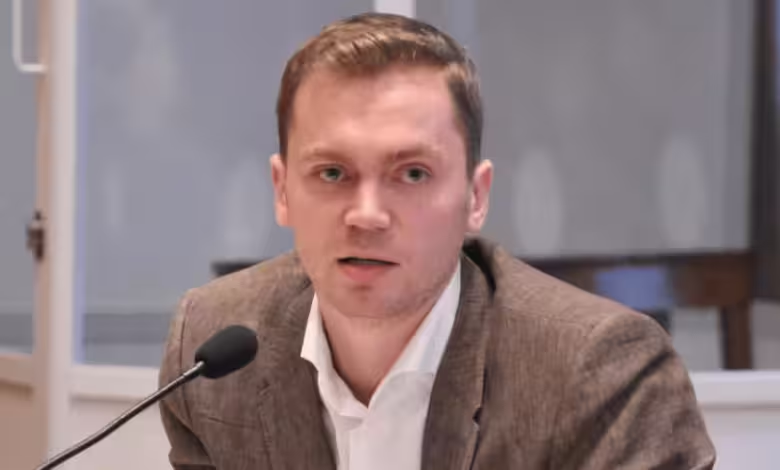
In May 2025, the discussion of judicial reform intensified again in Ukraine, in particular another attempt to reform the Supreme Court. Doctor of Law, Chairman of the Board of the DEJURE Foundation Mykhailo Zhernakov expressed a detailed and critical stance on recent government initiatives.
Mykhailo Zhernakov recalled the government’s draft law No. 13165, which, according to his assessment, was developed “under the guise of European integration and imitates the reform of the Supreme Court.” He drew attention to the fact that instead of the participation of international experts in checking the integrity of judges, the proposed model involves the participation of the Public Integrity Council, which will have only an advisory voice. In addition, he emphasized that facts of dishonesty can be taken into account only within a three-year period. Thus, according to him, the real verification of judges will be blocked by a formal procedure that will not produce results.
As Zhernakov emphasized, the further development of events causes particular concern – on May 27, 2025, the parliamentary Committee on Legal Policy under the chairmanship of Denys Maslov (Servant of the People faction) recommended for the first reading an even more problematic version of the law – alternative bill No. 13165-2, the author of which is People’s Deputy Kalaur, also a representative of the Servant of the People. Zhernakov drew attention to the fact that this alternative document does not provide for a separate procedure for verifying the integrity declarations of Supreme Court judges at all. Instead, as he noted, only a formal change in the form of such declarations is envisaged, without the creation of any mechanism for checking their content.
According to the expert, the adoption of this version of the law will mean a de facto amnesty for unscrupulous judges and even for those who are considered traitors in society. Zhernakov believes that in the absence of real verification, these judges will not only remain in the system, but will also have the opportunity to legalize their status — all this under the guise of allegedly fulfilling obligations within the framework of European integration.
Continuing the topic, he recalled the previous failures in reforming the Supreme Court. In particular, he mentioned the process of 2017-2018, when the reform was carried out without the participation of international experts, despite the recommendations of partners. Then, as Zhernakov noted, “the vast majority of the conclusions of the Public Integrity Council regarding the candidates were simply ignored.” According to him, it was as a result of that reform that people involved in corruption scandals and persons with dual citizenship ended up in the Supreme Court.
Zhernakov also reminded that the head of the Supreme Court is involved in the case of receiving a bribe of 2.7 million dollars, and other judges were found to have Russian passports. At the same time, the Supreme Court itself, as he noted, “stamps in bundles the decision to return to the positions of all the unclean” and slows down any changes in judicial reform. In his opinion, this led to a situation where the institution, which should have been a model of justice and legality, became a symbol of the degradation of the judicial system.
In the context of European integration, Zhernakov emphasized that for the third year in a row, the European Union has demanded real and effective changes in the structure of the Supreme Court from Ukraine. However, as he noted, instead of systemically reforming the judicial system, the government and parliament submit legislative initiatives that only simulate changes.
Zhernakov, in a restrained but eloquent manner, formulated the main question: does Bankova understand what this model of reform leads to? Do they realize that the state will not be able to integrate into the European legal space, keeping in the judicial system persons who discredit it? He refrained from emotional conclusions, noting only that there is no need to comment on the prospects of the state with such a justice system — it is enough to simply look at the content and motives of the alternative draft law.
In this way, Zhernakov outlined not only the critical flaws of project #13165-2, but also the general tendency to sabotage the real reform of the judicial system under the guise of European integration rhetoric.