The award fall as a mirror of historical disputes: what consequences will a diplomatic scandal over the past have for Ukraine and Poland?

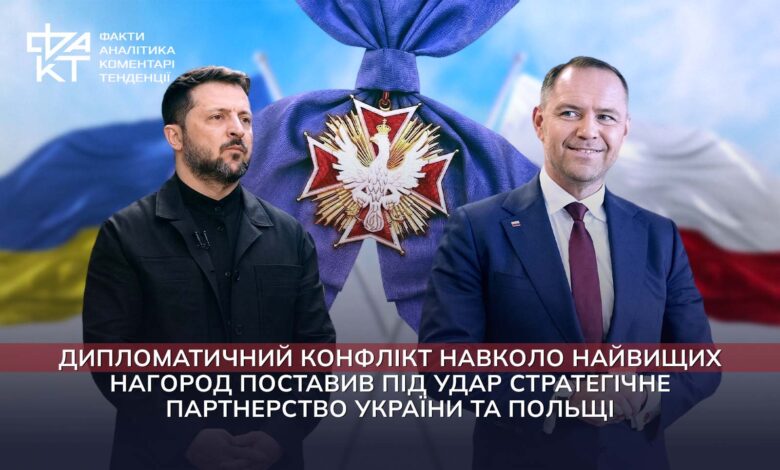
The diplomatic scandal that erupted between Ukraine and Poland over the mutual revocation and return of the highest state awards has exposed a dangerous situation: even in the face of a mortal threat from the Russian Federation, historical ghosts are capable of destroying the strongest alliances. The decision to deprive the President of Ukraine of the Order of the White Eagle due to the renaming of a military unit in honor of the UPA and the immediate solidarity demarche of Ukrainian officials have demonstrated that emotions and domestic political circumstances are beginning to prevail over geopolitical security. This situation goes far beyond protocol disputes, as it jeopardizes the vital support and good-neighborly relations on which the stability of the Ukrainian front directly depends.
Diplomatic rift: how the deprivation of Volodymyr Zelensky’s award led to a solidarity demarche of Ukrainian politicians
On June 19, Polish President Karol Nawrotski made an unprecedented decision that instantly undermined the diplomatic space: the President of Ukraine was deprived of the Order of the White Eagle. This award is the highest state award of Poland, a symbol of absolute recognition, but Nawrotski decided to take it back. The reason for this step, according to the Polish leader, was Volodymyr Zelensky’s consent to assigning one of the units of the Armed Forces of Ukraine the title “Heroes of the UPA”. Nawrotski explained that the order embodies the highest trust and gratitude of the Polish people, and this requires the recipient to show due respect for historical values.
At the same time, the Polish side tried to smooth over sharp edges, assuring that this step did not mean a radical change in Warsaw’s strategy to support Ukrainians in their resistance to Russian aggression. Nawrocki clearly called Russia an aggressor and Putin a criminal who unleashed the largest armed conflict in Europe since World War II. In his address, he emotionally recalled bombed residential areas, divided families and children fleeing, placing all responsibility on the Kremlin. Referring to the difficult past of Poland, which experienced deportations and Soviet control, the leader of the state emphasized the special price of freedom for his nation. Thus, Warsaw declares its readiness to cooperate further, but refuses to close its eyes to historical contradictions. In addition, Nawrocki expressed the position that Poland will not allow the integration into the European Union of those countries that do not realize the need to abandon the cult of totalitarianism and violence.
The response of the Ukrainian side to Nawrocki’s decision was immediate, united and coordinated. On June 20, the head of the Office of the President of Ukraine, Kyrylo Budanov, publicly refused the Golden Officer’s Cross of the Order “For Merit to Poland”, which he was awarded in 2025. He emphasized that Ukraine independently forms its own national memory and does not dictate to anyone how to study the past. Budanov also expressed his deep conviction that Navrotsky’s decision is devoid of justice, because the holder of the Order of the White Eagle is still the Italian fascist dictator and Hitler’s henchman Benito Mussolini. Budanov noted that Kyiv will give a proper assessment of Warsaw’s actions, expressing confidence in the support of its position by the majority of Ukrainians.
Ukrainian Foreign Minister Andriy Sybiga also joined this demarche, declaring his intention to return the Commander’s Cross with the Star of the Order “For Merit to Poland”, which he received in October 2022. The head of the Foreign Ministry called the actions of his Polish colleague a strategic mistake, from which only Moscow will benefit. The minister noted that the Ukrainian side never sought this conflict and has been actively working on depoliticizing complex topics for the past year and a half. According to him, Kyiv has made efforts to restore the scientific work of historians, unblock the search and exhumation processes and reburials at the request of Warsaw, as well as to resume the activities of the Congress of Historians. Such reckless steps by the Polish leadership, according to the diplomat, make it impossible to further preserve the award.
The Ambassador of Ukraine to Poland, Vasyl Bodnar, also did not stay away, announcing the return of the Knight’s Cross of the Order of Merit of the Republic of Poland. He recalled the colossal wave of solidarity at the beginning of the full-scale invasion and the common security interests of both countries. The ambassador emphasized that significant progress has been made in relations over the past year and a half, but Navrotsky’s decree is perceived painfully by Ukrainian society as an attack against the entire people. Bodnar emphasized that he could not accept the deprivation of the award of the leader of a country that courageously withstands the blow of Russian missiles and drones, defending European peace. The ambassador also expressed hope that mutual respect would ultimately overcome the political situation, because the Kremlin always wins from quarrels between neighbors.
In addition, other important political figures intervened in these events. Szybiga’s predecessor as minister, Dmytro Kuleba, added historical context, recalling that not only fascist leader Benito Mussolini, but also Russian Empress Catherine II still retain the status of Knights of the Order of the White Eagle. Amid this diplomatic storm, Polish Prime Minister Donald Tusk expressed deep regret over the escalation of the conflict. The head of the Polish government frankly admitted that the current deepening of disputes shocks Western allies and brings joy only to Putin.
At the same time, the former head of the Polish diplomatic mission in Ukraine, Bartosz Cichocki, called on the parties to exercise restraint amid the scandal surrounding the deprivation of Volodymyr Zelenskyy of the order. The diplomat, who became one of the few foreign ambassadors who remained in Kyiv during the most difficult first weeks of the full-scale Russian invasion, voiced his reservations. On the social network X, he noted that a way out of any crisis situation can be found, and success will be achieved by those who manage to show restraint in time. He also added that every offensive statement made in the heat of emotions will leave a lasting mark in the memory of both peoples.
It is worth noting that in early June, Tsikhotsky also took a symbolic step and returned the Ukrainian Order of Merit received from Zelensky in 2022, thus demonstrating his attitude to Kyiv’s decision to name one of the military units in honor of the UPA.
A threat to the common future: what will be the consequences of the diplomatic conflict between Warsaw and Kyiv
The deep diplomatic rift around the highest Polish award did not arise out of nowhere, because behind this public gesture lies a serious confrontation within Warsaw itself. The acute struggle between the conservative right wing of Polish politics and the current centrist government of the country overlapped with Karol Nawrocki’s personal career aspirations and a long-standing common historical trauma. The official pretext, which was the naming of the Ukrainian military unit “Heroes of the UPA”, turned into an ideal detonator for launching internal processes in Poland. Nawrocki, a professional historian and former head of the Institute of National Remembrance, has built his entire public identity around the Volyn tragedy. His radical decision is aimed at fully mobilizing conservative Polish voters around the defense of his own version of historical truth, which is the main trump card of the right-wing forces in the confrontation with the liberal-centrist coalition government.
This step also became an obvious attempt to weaken Donald Tusk’s position, putting the executive branch in an extremely difficult position. The Prime Minister has already sharply criticized the president’s actions, calling them a play by the Kremlin, but the final legal implementation of this decision requires the signature of the head of government. Thus, Tusk is forced to choose between supporting an openly anti-Ukrainian step and an open conflict with the very sensitive topic of national memory for Poles.
The situation is also complicated by the fact that the demand for so-called hard reciprocity has noticeably increased in Polish society, when further support for Ukraine should directly depend on concessions from its side, in particular on the issue of lifting the moratorium on the exhumation of Volhynia victims. Demonstrating the primacy of the interests of its own state, Nawrocki seeks to show that Warsaw will no longer ignore historical differences for the sake of geopolitical expediency.
The awards scandal exposed a fundamental problem: Ukraine and Poland speak different languages of memory. What for Kyiv is a symbol of the struggle for freedom is for Warsaw an unhealed historical wound. For Volodymyr Zelensky and the command of the Special Operations Forces, the UPA symbolism is exclusively the embodiment of fierce resistance to Soviet and Russian totalitarianism, and therefore this decision was made to raise the morale of the military, without any intention of hurting the feelings of its neighbors. On the other hand, for Polish conservatives, any official legitimization of this structure is a direct glorification of the organizers of the mass murders of the Polish civilian population in 1943–1944.
In view of this, the decision of the President of Poland to deprive Volodymyr Zelensky of the White Eagle award looks irresponsible, as it demonstrates contempt not only for the person of the head of state, but also for all of Ukraine, which is currently holding back the invasion, covering the same Poland. This award was once presented by the previous Polish President Andrzej Duda precisely as a symbol of deep respect for the heroic resistance of the Ukrainian people.
At the same time, Ukraine could have avoided this scandal if it had calculated Warsaw’s reaction. Ukrainian diplomacy and analysts ignored the fact that the political landscape in Poland had changed and conservatives, for whom the abbreviation “UPA” is an absolute red light, came to power. In Ukraine, they acted on the principle of “our army is our heroes,” without considering the political consequences. The unit could have received the name of outstanding historical figures common to Ukraine and Poland, then Karol Navrotsky would not have had a legal and moral reason to launch the procedure for depriving the President of Ukraine of the order.
The prospect of this scandal developing may turn so that current events will later turn against Navrotsky, and the order will sooner or later return to the president. However, the short-term effect of these actions is extremely threatening, because the quarrel between the closest allies directly strengthens the positions of the Russian Federation and weakens the united European front. At the same time, the reaction of Ukrainian high-ranking officials, who began to massively refuse Polish awards, although understandable from the point of view of national dignity, carries an escalation of the conflict and significant risks for the future. It would be a logical step to ignore the new awards from the current Polish leader, but the demonstrative return of former orders awarded on behalf of the Polish people during past terms only adds destructive emotions to the crisis.
Such an exchange of diplomatic blows threatens to escalate into an uncontrolled reaction that will quickly move from political offices to the public sphere, provoking new waves of destruction of monuments or repeated blocking of strategic border crossings. For Ukraine, which is waging a grueling war for survival, such a scenario is critical, because Poland remains one of the key logistical, military and humanitarian donors, whose reliable shoulder ensures the stability of the Ukrainian rear and front.
Despite the sovereign right of each nation to honor its own historical figures, neighbors need to realize that they are in the same geopolitical boat in the face of a common enemy. Political figures will change over time, while maintaining a strategic partnership, mutual respect, and unwavering assistance from Warsaw is a fundamental issue of regional security for years to come. The real diplomatic wisdom of Ukrainian and Polish officials now will lie in the ability to immediately stop this destructive chain reaction, to separate historical discussions about the past from modern cooperation and good neighborly relations, without which the future of both nations may be at risk.