Outlines of possible elections in Ukraine: what changes and restrictions are being prepared in parliament

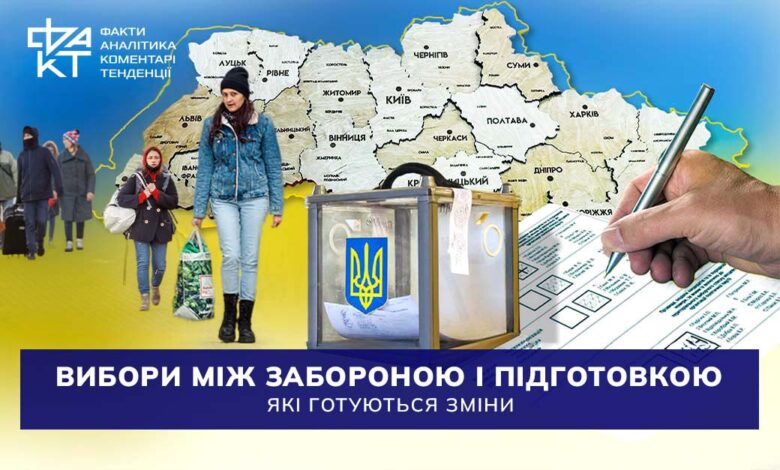
Ukraine has found itself in a situation where the issue of elections is no longer hypothetical, but also has no clear answer. Despite the long war, the topic of a possible presidential election is increasingly being raised in the political environment. If earlier this idea was rejected for both practical and legal reasons, now it has become the subject of public statements and legislative developments. Now the focus is not on the date of the elections, but on their content, which rests on a number of complex and as yet unresolved issues. Candidates may be required to declare any ties to Russia, and for concealed information – be removed from registration through the court. At the same time, for internally displaced persons, there are plans to unify voting rules and abandon alternative formats. In fact, we are talking about constructing a new electoral reality under the pressure of war.
Presidential elections: between legal restrictions and political reality
To hold the elections, first of all, it is necessary to stop or significantly reduce the intensity of hostilities, which will allow the abolition or change of martial law. In addition, updating the legislation to ensure democratic standards and guarantee the safety of citizens is key. It is also extremely important to ensure the participation in the vote of those categories of citizens who, due to the war, found themselves in special circumstances. These are millions of military personnel on the front lines, internally displaced persons, a significant part of whom do not have current registration, Ukrainians in temporarily occupied territories, as well as refugees abroad. It is worth understanding that the network of polling stations will not fully cover these groups.
No less acute is the issue of the information environment: how to guarantee equal access of candidates to the media and freedom of speech if some opposition channels have ceased operation, and key television platforms operate in the format of a telethon with centralized content? It should also not be forgotten that opposition politicians are currently being severely persecuted by the authorities. A separate dimension of the problem concerns international standards of transparency and legitimacy of elections, which must be combined with the restrictions provided for by martial law.
At the same time, the main legal barrier is that although the Constitution does not directly prohibit holding elections during martial law, the special Law “On the Legal Regime of Martial Law” in Article 19 establishes a ban on holding elections of the President, the Verkhovna Rada and local self-government bodies, motivating this by the impossibility of guaranteeing security and the exercise of electoral rights in conditions of hostilities.
Despite this, recent statements by the President of Ukraine indicate his readiness for the electoral process under certain conditions and instructed the parliament to begin preparations by developing a corresponding draft law. On February 20, Volodymyr Zelensky in an interview with AFP stated that he had not yet made a final decision on his participation in the upcoming presidential elections, but categorically emphasized that any vote in the country would take place only after the end of hostilities.
It should be noted that the president’s position on the elections has recently undergone changes and at the same time remains controversial. Previously, he repeatedly emphasized the legal impossibility of organizing the electoral process during martial law. Now he allows them to be held. Such rhetoric opens up space for discussion, but does not contain clearly defined procedures or deadlines, which gives rise to different interpretations of his intentions.
An important factor in this discussion was the statements of Donald Trump, who linked the topic of the elections in Ukraine to the issue of the democratic status of the state and the prospects for a peace agreement. In an interview with Politico, the US President called on Ukraine to hold presidential elections and suggested that Zelensky could win. At the same time, public comments often emphasize the role of international support as a prerequisite for the legitimacy of the process, which actually takes some of the responsibility outside the framework of domestic politics. At the same time, the Russian Federation has declared its readiness to ensure silence on the day of a possible vote in Ukraine if Kyiv decides to hold elections.
In an interview with British journalist Piers Morgan, Volodymyr Zelensky stressed that he is ready to hold elections if there is at least a two-month truce.
“I think our partners have to answer one question: what do they want? Do they want elections or do they just want to replace me? Because I think the Russians just want to replace me. And then they use what you talked about earlier – physical removal or other steps,” the president said.
Zelensky also emphasized that he would not refuse US proposals if they could contribute to achieving peace. According to him, even a two-month ceasefire would be a basis for consultations with parliament and attempts to convince deputies to support a decision that currently does not have a majority.
Thus, the president’s statements combine references to existing legal norms and a response to external political signals. On the one hand, a legal restriction is recognized, on the other hand, the possibility of its revision under certain circumstances is allowed. This position leaves open the question of the practical implementation of the electoral process.
What decisions are being prepared in parliament
On February 25, 2025, the Verkhovna Rada adopted a resolution on supporting democracy in Ukraine, which states that elections cannot be held until the end of the war. At the same time, in fulfillment of the president’s instructions, the parliament began preparatory actions. The Chairman of the Verkhovna Rada, Ruslan Stefanchuk, signed an order to create a working group under the leadership of First Deputy Speaker Oleksandr Kornienko. It includes representatives of all parliamentary factions, public sector experts, and electoral law specialists. The group must prepare a draft law that simultaneously takes into account security requirements and the principles of democratic expression. It is assumed that if adopted, this law will be applied once.
The creation of the working group indicates the desire of the legislative branch of government to develop a special mechanism capable of functioning under martial law. The idea of adopting a separate law with simplified voting procedures that would allow the military, citizens abroad, and residents of temporarily occupied territories to participate prevails in parliamentary discussions. At the same time, it is considered inexpedient to change the Electoral Code, since a one-time regulatory act would allow elections to be held without a large-scale reform of the entire electoral legislation.
In Ukrainian practice, there have already been cases of adopting special laws for conducting unique election campaigns, but the current situation is unprecedented, since we are talking about a format of “post-regular” elections, which is not directly provided for by either the Constitution or the Electoral Code. According to the deputies, the creation of a separate legal mechanism is necessary for one-time use in wartime.
A separate stage of preparation was the resumption of the State Register of Voters on December 23. This decision is of key importance given the large-scale migration processes and demographic changes caused by the war. Updating data on citizens creates a technical basis for possible voting and is an important condition for the transparency of the process.
Parliamentary initiative on mandatory declaration by candidates of any cooperation with the Russian Federation
The Verkhovna Rada is currently discussing one of the toughest initiatives in the field of future post-war elections – the introduction of mandatory declaration by candidates of any cooperation with the Russian Federation from March 2014. It is about creating a systemic safeguard that should prevent people associated with the aggressor state from coming to power. The preparation of such changes was announced by Tamila Tasheva, the head of the subgroup on IDPs, temporarily occupied and frontline territories, during a meeting of the Verkhovna Rada working group. According to her, legislators are working on a mechanism that would prevent the return to politics of people who directly or indirectly helped the aggressor.
The essence of the proposal is that each candidate in the post-war elections will be obliged to officially declare the facts of interaction with Russia or structures controlled by it since 2014. Without such a declaration, registration with the CEC will become impossible. In fact, we are talking about a new type of political responsibility – not only for today’s actions, but also for behavior throughout the entire period of the war.
The declaration should cover various areas, including receiving funds for the election campaign from Russian sources or through affiliated structures. Business in Russia or cooperation with occupation administrations is also highlighted separately. It also includes work in the bodies of the occupiers, participation in paramilitary formations or assistance to enemy forces. At the same time, the list includes activities in the Russian media, public support for the legitimization of the occupation, as well as a political career from parties banned in Ukraine.
Thus, legislators propose to cover not only obvious cases of state treason, but also a wider range of political, economic and informational interaction with Russia. This indicates the desire to form a comprehensive approach to cleaning up the political field after the war.
At the same time, the initiative provides for a mechanism for verification and liability for false information. If a candidate conceals the facts of cooperation, the Ministry of Justice, through a special interdepartmental commission, will be able to go to court. If the violation is confirmed, the Central Election Commission will have to cancel the registration of such a candidate. That is, the issue is not limited to a moral assessment – it is transferred to the plane of judicial review.
Separately, clear grounds for refusal of registration are proposed: the presence of a conviction for intentional or international crimes, the status of a suspect in cases of genocide or war crimes, as well as proven campaign financing from Russia. This creates an additional barrier for individuals who may pose a threat to national security.
However, such an initiative inevitably raises the difficult issue of the balance between protecting the state and respecting the constitutional rights of citizens. Restricting the right to be elected is one of the most sensitive aspects of a democratic system. Excessively broad or vaguely formulated criteria for “cooperation” may create a risk of political abuse or instrumentalization of the law in inter-party struggle.
To prevent this from happening, legal precision of legislative formulations is extremely necessary. The key task is to clearly distinguish those who, under the conditions of occupation, were forced to work to ensure basic survival from those who consciously acted in favor of the Russian Federation and contributed to the undermining of Ukrainian statehood. This is of principle, because millions of citizens lived or live in the occupied territories, and the formal presence of certain ties does not always mean voluntary cooperation.
The changes proposed by the parliament can be seen as an attempt to lay the foundation for a post-war political system in which the issue of loyalty to the state will become the basic criterion for participation in power. At the same time, not only its effectiveness, but also public trust in the electoral process itself depends on how clearly and impartially the verification mechanism is written.
Unification of rules for IDPs by the parliament and refusal of alternative voting
The parliamentary working group on the preparation of elections in a special period outlined another principle block of future changes – an approach to ensuring the electoral rights of internally displaced persons and citizens from temporarily occupied and frontline territories. The key idea is to unify the voting rules for IDPs and reject alternative methods of expressing their will.
As reported by Tamila Tasheva, the subgroup focused on analyzing the guarantee of the electoral rights of IDPs, developing mechanisms for the participation of citizens from the TOT and frontline areas, assessing possible restrictions on their rights, and also considering the idea of introducing alternative voting formats. As a result of the discussions, several conceptual positions were agreed upon. Firstly, there are no plans to create polling stations in Russia and Belarus, as well as in the temporarily occupied territories. Secondly, legislators do not support the idea of alternative voting methods – in particular, remote or special procedures that could differ from the general procedure.
This approach demonstrates the desire to maintain uniform standards of the electoral process in modern conditions. The rejection of alternative voting methods can be seen as an attempt to avoid technical, security and legal risks associated with new mechanisms. At the same time, this means that the state is betting on the classic model of organizing elections, adapting it to military realities, rather than radically reforming it. However, there is no answer in parliament about how Ukrainians who currently live in Russia and other countries, as well as in temporarily occupied territory, will vote.
In addition, the Verkhovna Rada determined that the voting rules for internally displaced persons should be the same regardless of the date of their movement to the territory controlled by Ukraine. Such unification is designed to eliminate possible discrimination between those who left in 2014 and those who left the occupied regions after 2022. In the political dimension, this is an important signal about the equality of rights of all citizens, regardless of the time and circumstances of their resettlement.
Among the proposed mechanisms for ensuring the electoral rights of IDPs, it is proposed to provide the Central Election Commission with access to the Unified Database of Internally Displaced Persons, which is administered by the Ministry of Social Policy. It is assumed that the CEC will verify the identity of the IDP, in particular using the registration number of the taxpayer’s registration card, and will also check the actual place of residence based on the declared address in the IDP’s certificate.
If the data is confirmed, the Central Election Commission will temporarily change the IDP’s voting place within ten days after the start of the electoral process, while the electoral address will not change. IDPs will be informed about the new polling place, and they will retain the right to change the voting place or electoral address on their own initiative. This process assumes an application principle: displaced persons will be able to submit an application to change their electoral address or voting place in paper or electronic form no later than thirty days before election day. Such an algorithm intends to combine automated verification with the possibility of personal expression of will regarding electoral binding.
At the same time, some deputies emphasized the need to maintain the requirement for IDPs to submit documents regarding their place of residence to change their electoral address. This position reflects the desire to avoid abuse and manipulation, especially in conditions of large-scale internal population displacement. At the same time, the voting procedure for persons who have returned from the occupied territories is being discussed separately. For them, the basis for receiving a ballot should be a certificate of return to Ukraine, which confirms their identity and citizenship. Thus, legislators are trying to take into account the specifics of the status of these citizens, without depriving them of the right to participate in the elections.
In general, the proposed model indicates an attempt to combine two tasks: to guarantee equality of electoral rights and at the same time minimize the risks of abuse and external interference. The rejection of alternative voting methods simplifies control over the procedure, but places the state’s responsibility to ensure the physical accessibility of polling stations and effective logistics for millions of displaced people.
As we can see, at present we are talking about changing the parameters of the electoral process under the pressure of war. The state is trying to lay down safeguards against revenge and external influence, but each of them inevitably affects basic rights – the right to be elected and the right to vote without additional barriers.
The extent to which these restrictions will be justified and proportionate will depend on the clarity of the criteria and the ability of the authorities to avoid selective application of the norms of the law. Ця напруга ‒ між безпекою і свободою, між оновленням політикуму і ризиком зловживань та надмірних обмежень ‒ визначатиме, якими стануть можливі вибори. Від того, як влада впорається з цією напругою та забезпечить рівність правил для всіх, залежить результат ‒ або вибори стануть чесним і прозорим механізмом волевиявлення громадян, або перетворяться на зрежисований спектакль із заздалегідь розписаними ролями.