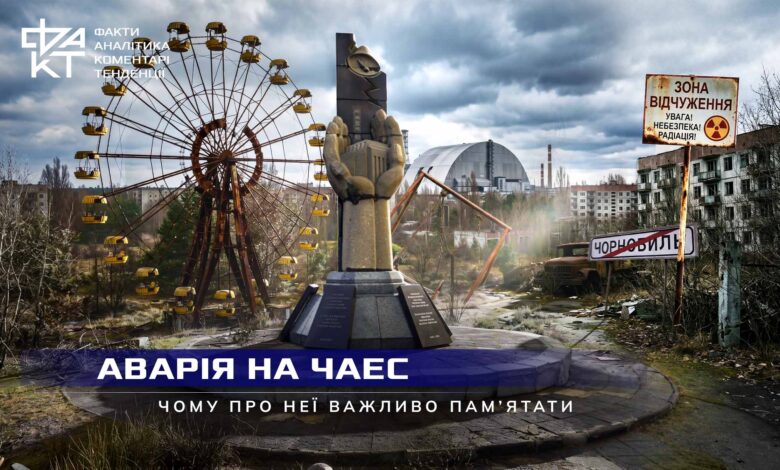
Forty years after the 1986 accident, the Chernobyl nuclear power plant remains not only a site of historical tragedy, but also a complex man-made facility that now requires constant monitoring. Fuel-containing materials still remain under the protective structures of the fourth power unit, the exclusion zone retains a radiation trace, and a full-scale war has added new threats to this legacy. Strikes on infrastructure, power outages, and damage to protective structures can disrupt the fragile safety system that has been built over decades. In addition, the Chernobyl accident still affects the health of Ukrainians and shows that its consequences last for decades.
Chernobyl Tragedy: What Happened in 1986
The tragedy that occurred on a spring night in 1986 at the industrial site of the Chernobyl Nuclear Power Plant 12 kilometers from the city of Chernobyl went down in world history, becoming a stern warning about the fragility of civilization. When the clock struck 01:23 at night, the fourth power unit of the Chernobyl Nuclear Power Plant became the epicenter of a large-scale disaster provoked by a fatal coincidence of circumstances during safety system tests. Two consecutive explosions of incredible force instantly tore apart the reactor shell and thereby opened “Pandora’s box”, releasing a deadly stream of isotopes into the sky over Polissya, which in terms of their total activity exceeded the consequences of the Hiroshima bombing hundreds of times.
The destroyed unit, engulfed in flames, turned into a giant hearth, spreading radioactive aerosols for thousands of kilometers, while the first liquidators, without proper protection, tried to control the elements. Within a few hours, more than a hundred people with severe radiation burns and signs of acute radiation sickness were taken to medical facilities, where doctors first encountered lesions of this scale in peacetime. While the fire was devouring the graphite masonry, an invisible cloud had already crossed the borders of Europe, reaching the shores of Scandinavia and covering Finland and Sweden, where radiation monitoring sensors recorded an abnormal jump in indicators.
When the Chernobyl reactor exploded, the most terrible thing was the silence of the authorities, who knew about the danger, but did not immediately mobilize resources to save the population and left people to live ordinary lives under an invisible rain of radiation. Children went to May Day demonstrations, families opened windows, drank water, stood in the streets, not realizing that the air had already become poisoned. This silence cost the health of thousands: receiving critical doses of radiation, some burned out from radiation sickness almost immediately, while others carried the consequences of that lie for years – oncology, leukemia, thyroid diseases, a mutilated life that was slowly taken away by the catastrophe that people were not given the right to know about in time.
There is no single final figure for the victims of Chernobyl, and this is what makes the catastrophe even more terrible. Some could be counted immediately: those who died in the explosion, firefighters and station workers who died from acute radiation sickness in the first weeks and months. However, most of the consequences did not have a clear date of death in the medical record with the inscription “Chernobyl”, so different numbers appear in different calculations – from dozens of officially confirmed deaths to tens and even hundreds of thousands of probable victims.
This discrepancy in numbers shows the true scale of the tragedy: Chernobyl was not an event that can be summarized with a single list of the dead. More than a million people in Ukraine had the status of victims, hundreds of thousands of liquidators went through dangerous work, and some of them then struggled with illness and disability for years.
The political echo of the explosion turned out to be no less powerful than the physical one, since Chernobyl exposed all the internal defects of the totalitarian mechanism, becoming a catalyst for irreversible transformations. The state’s failure to protect its citizens at a critical moment undermined trust in the regime, which ultimately accelerated the collapse of the Soviet Union, demonstrating the inability of the command-and-administrative model to withstand the challenges of the technogenic era. Today, these lessons of the past are especially acute, as nuclear blackmail has once again become an instrument of political global destabilization in the world.
Chernobyl in 2026: Controlled Stability on the Verge of Disruption
The current threats associated with the military seizure of the Chernobyl nuclear power plant, the occupation of the Zaporizhzhia nuclear power plant, and the audacious drone attacks on the protective structures of the fourth power unit are making the world shudder with awareness of the reality of a new apocalypse. Each entry into the new confinement area is a challenge to the collective security of humanity, reminding us of how easily technological progress combined with aggressive policies can turn into weapons of mass destruction. The issues of preserving peace and controlling the atom today must become an urgent requirement of the time, on which the survival of future generations depends.
Now the exclusion zone around the Chernobyl NPP remains a territory where people can no longer live a normal life, but nature, as if in spite of the catastrophe, is gradually reclaiming its space. Where there were once roads, villages, and human noise, the Chernobyl Radiation and Ecological Biosphere Reserve now operates: scientists observe how radiation changes ecosystems, and wild animals occupy places abandoned by humans. There is a terrible paradox in this: the zone created by one of the greatest man-made tragedies of the 20th century has become a refuge for wolves, lynxes, elks, Przewalski’s horses and other species, which have often been harmed by human presence no less than by invisible pollution.
The Russian Federation’s long-standing disregard for safety protocols has led to the New Safe Confinement (NSC), this grandiose technological shield worth over 2 billion euros, no longer being an impenetrable monolith. On February 14, 2025, a Russian strike drone hit the arch of the New Safe Confinement — the structure that covers the destroyed fourth power unit and is supposed to contain the radiation hazard. The fire was extinguished, the radiation background did not increase, but the event itself exposed the terrible vulnerability of a place that has required constant monitoring for decades. The arch, designed for 100 years, has lost some of its tightness and anti-corrosion protection, and its full restoration may take until 2030 and cost hundreds of millions of euros – that is, the consequences of one blow can stretch for years, like everything related to Chernobyl.
The current state of the Chernobyl nuclear power plant in April 2026 resembles balancing on a razor’s edge, where the destructive energy of war is added to the natural aging of the metal. The latest IAEA reports and monitoring data from the ChNPP indicate that the facility has become a unique platform on a global scale, where the statics of concrete structures are tested daily by the dynamics of modern threats.
The operation of the ChNPP in 2026 critically depends on uninterrupted power supply, but the January attacks on substations in the Kyiv region forced the facility to switch to a critical mode of operation from diesel generators. This is not just a matter of lighting the corridors, but a matter of supporting the complex ventilation systems that create the necessary rarefaction of the air inside the confinement to contain dust. When the station switches to backup power, monitoring of the “controlled self-heating” of nuclear fuel becomes selective, and neutron flux control systems work at the limit of their capabilities. Generators, not designed for a multi-week marathon, wear out many times faster than prescribed by regulations, and fuel logistics through mined territories of the exclusion zone turns into a dangerous special operation.
The war has effectively stopped the grand plan to transform the Chernobyl NPP into an environmentally safe system, since dismantling unstable structures and extracting nuclear fuel is now technically impossible. Military activity around the station, including more than nine dozen drone flights in the immediate vicinity, creates a constant threat of forest fires. Such fires in the exclusion zone act like giant aerosol sprayers, lifting settled cesium and strontium from the soil and carrying them by wind for hundreds of kilometers.
Even if the Kinzhal missiles fly 20 kilometers from the station, they create seismic vibrations that act on the old concrete like a microscopic jackhammer. The risk of the collapse of the western buttress wall threatens to raise a huge cloud of finely dispersed radioactive dust. In conditions of broken tightness of the outer “Arch”, these fuel-containing masses can freely go beyond the facility, turning a local problem into a transboundary environmental threat.
Today, the radiation background remains within normal limits thanks to the professionalism of the personnel and the presence of the IAEA mission, but this stability is illusory. The restoration work, which the EBRD plans to complete by the end of the year, directly depends on the intensity of hostilities. The main challenge of our time is that Chernobyl has ceased to be just a monument to a past disaster, turning into a hostage of modern war, where each approach brings closer the moment of mechanical fatigue of the structures that humanity has built for decades.
Today’s Chernobyl NPP paradoxically combines the status of an exclusion zone with the ambitions of an energy hub. In 2026, the Ukrainian government, together with international partners, in particular the company Holtec, finalized the selection of sites near the abandoned villages of Kopachi and Leliv for the potential placement of small modular reactors (SMRs). This strategy turns the territory, which once produced only fear and isolation, into a platform for testing next-generation nuclear technologies. At the same time, the exclusion zone continues to integrate into the unified energy system of Ukraine, no longer as a generator, but as a powerful distribution node, which is confirmed by the recent restoration of power lines after massive attacks.
The safety of the Chernobyl zone in 2026 is based on the synergy of international supervision and modern conservation technologies. Currently, about 2,200 people work at the SSE Chornobyl NPP, most of whom are residents of the city of Slavutych. In addition, employees of related structures, such as the Atomremontservis branch (about 1,000 people), are involved in the industrial site, which creates a total workforce of over 3,000 specialists within the zone.
Unlike previous decades, which were devoted to the localization of consequences, this year has become a starting point for the creation of a deep geological repository. Ongoing research focuses on finding stable crystalline rocks for the final disposal of high-level waste. This turns the exclusion zone into a global laboratory, where humanity learns both to isolate radiation and to fit complex man-made objects into an ecosystem that, in the absence of humans, demonstrates impressive rates of flora and fauna regeneration.
How the Chernobyl footprint still affects the health of Ukrainians
The Chernobyl tragedy, despite its remoteness in time, remains a dynamic medical and social challenge that continues to transform the fate of generations. The most painful vector of this legacy is the vulnerability of human biology, which, under the pressure of radiation, has revealed anomalous disease development scenarios. A collective study by Ukrainian and American specialists confirmed the critical figure, as about 13.5 thousand people who were children at the time of the explosion were exposed to intense radiation of the thyroid gland. This category has become the epicenter of long-term observation, since doctors still record the consequences of the exposure at that time today, decades after the event.
Analyzing the specifics of pathologies, scientists faced the destruction of classical medical ideas about the latent periods of oncological processes. If earlier world practice defined a period of 4-6 years as the minimum necessary for tumor formation, then the Chernobyl scenario shortened this path, detecting thyroid cancer in children under 4 years of age. Such aggressiveness of oncogenesis was a direct consequence of the immaturity of children’s tissues, which absorbed radionuclides much more intensively than adult counterparts.
The demographic picture of the affected population as of early 2026 demonstrates the inexorable dynamics of natural and pathological decline. Currently, more than 1.46 million citizens in Ukraine retain the official status of victims, including more than 1.5 thousand children whose condition requires constant state attention. Comparing the figures for 2008, it turned out that during this period of time the number of adults with the status of victims has decreased by almost a third, and the ranks of liquidators, which now number about 135 thousand, have thinned by a catastrophic 52%.
The alarming continuity of radiation exposure is manifested not only in those who survived 1986, but also in the current generation through mechanisms of biological transmission. Data obtained in early 2026 on the detection of dangerous radionuclides in the placenta of pregnant women indicate that environmental risks have been integrated into intrauterine development. Such findings pose a direct threat to the health of future children, emphasizing that the “soil-food-human” chain remains active. Cesium-137 and strontium-90 continue their invisible circulation in food cycles, entering the bodies of residents of contaminated areas along with mushrooms, wild berries, or locally produced milk.
The spectrum of medical problems of the victims has long gone beyond exclusively endocrine disorders, covering broader layers of physiology and psychology. Doctors observe a steady trend towards an increase in cases of leukemia and breast cancer, while among the direct liquidators of the accident, severe pathologies of the cardiovascular system and metabolic disorders dominate. Along with physical exhaustion, chronic psychological stress plays a destructive role, as the anxiety caused by life in controlled territories and the social stigma of a “victim” forms complex psychosomatic disorders that turn radiation trauma into a lifelong psychological burden.
Forty years later, it is important to remember Chernobyl not as an event whose consequences still affect people, territories, and perceptions of safety. This disaster showed that the danger becomes greater when it is hidden: people received doses of radiation not only because of the accident, but also because they were not told the truth in time. The memory of Chernobyl is also necessary because its history did not end with the evacuation of Pripyat or the construction of a new shelter. The exclusion zone still exists, people still live with the consequences of radiation, and the station itself remains an object that requires constant control. Chernobyl reminds us that man-made disasters do not pass quickly; they leave a long-lasting mark on human health and the ecological situation.