Ukraine’s 111th place in the world ranking of youth happiness and mood: what new research shows

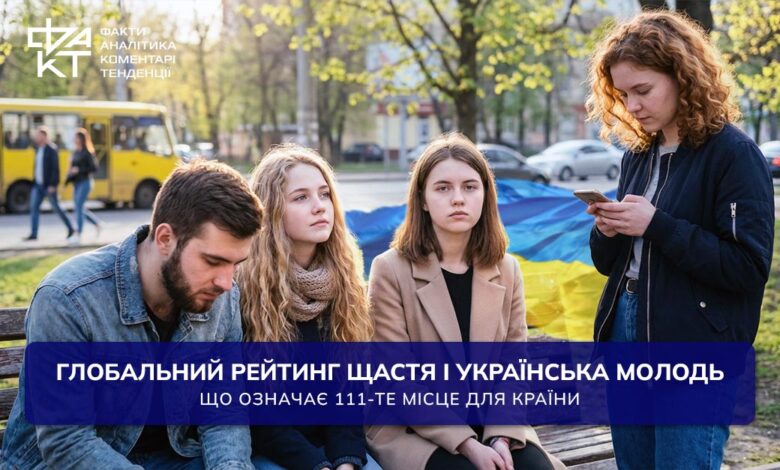
Ukraine has entered a dangerous period, when the main loss is not only territories, resources or destroyed infrastructure, but also young people, without whom the country’s recovery and future are impossible. Against this background, in the global ranking of the “happiest countries” by the World Happiness Report, Ukraine took only 111th place, falling between Kenya and Morocco. This study measures how people assess the quality of their own lives, the level of security, social support, freedom of choice and trust in the environment in which they live. Therefore, the result of the rating should be understood as an alarming indicator of the mood of young people, who are either getting used to living in conditions of a long war in the country, or are increasingly considering the possibility of building their future outside its borders.
Ukraine’s Place in the World Happiness Ranking
The annual report World Happiness Report, published for the International Day of Happiness on March 20, this time again recorded the familiar top of the world happiness ranking. Ukraine received 4,658 points in the quality of life assessment, taking 111th place, and found itself between Kenya, which is in 110th place, and Morocco, which took 112th. There is no sensation in these figures, but there is a telling detail about the state of society: a country that lives in conditions of constant danger, loss and exhaustion, does not demonstrate a further collapse of internal well-being.
At the same time, at the other pole of the ranking is again Finland, which remains first for the ninth year in a row. It is followed by Iceland, Denmark, Costa Rica, Sweden, Norway, the Netherlands, Israel, Luxembourg and Switzerland. This list traditionally consists of countries where stability, security and quality of daily life have long been the norm.
This year’s study was broader than the usual ranking of countries by level of life satisfaction, as its authors focused not only on general indicators of quality of life, but also on the influence of social networks on young people. Such an emphasis seems indicative, because in the era of constant digital presence, the question of happiness increasingly goes beyond the boundaries of economics or social policy and affects the way a person perceives himself, others and his own future. The study, prepared by the Oxford Center for Well-being in collaboration with Gallup and the United Nations, covered more than 100,000 respondents, and therefore made it possible to see not random moods, but stable trends.
The happiness index, as in previous years, was calculated based on the averages of several key factors that together give an idea of daily life in a particular country. These include gross domestic product per capita, life expectancy, social support, freedom of life choices, generosity and perception of corruption. What is important in this list is not which indicator looks the most impressive in economic tables, but how these parameters fit into the overall picture of the human experience, where well-being is measured not only by money, but also by a sense of security, the ability to count on others and trust in social institutions.
Finland topped the rating with a score of 7.764 out of 10, leaving behind Iceland, which scored 7.54, Denmark with a score of 7.539 and Costa Rica, which rose to fourth place with a score of 7.439. Costa Rica is particularly noteworthy in this list, whose jump up the authors attribute to strong family ties, as this indicates an important thing: high positions in the ranking are not always the result of the financial capacity of the state alone; sometimes the decisive factor is the social fabric that holds society together much more reliably than dry macroeconomic indicators.
Against the background of these results, Finland looks particularly interesting, since even with rising unemployment and reduced social benefits, the country’s citizens still consider themselves the happiest nation. Such stability is explained not by situational comfort, but by deeper mechanisms of the social system, among which researchers single out a high level of trust in the government, social equality and a developed system of social protection. At the same time, Finland emphasizes that the key to a feeling of happiness is not limited to state policy.
Against this background, Ukraine’s result looks particularly alarming, as the country, ranked 111th, showed the lowest indicator among all European states. Such a result does not require a complicated interpretation, since it concentrates the consequences of a protracted war and instability, which directly affect the sense of security, life expectations, as well as the daily emotional endurance of people.
Despite this result, the survey data recorded an important feature, without which the picture in our country would be presented incompletely and one-dimensionally – a significant part of young people still retain faith in the future. According to the results of the study, almost 78% of young people in Ukraine and 59% of Ukrainians abroad believe in the future. These figures reveal a complex combination of two realities that coexist simultaneously: on the one hand, an objectively low assessment of the quality of life, and on the other, an internal reserve of expectations that prevents society from completely slipping into despair.
A separate section of the study devoted to youth adds another disturbing touch to this picture, as the report’s authors point to the negative impact of active use of social networks on the psychological state of young people. This observation is important not as a moral warning against the digital world, but as a fixation of a new dependence between the method of communication and inner well-being. If earlier the level of happiness was primarily associated with income, health or social support, now another dimension is increasingly evident – the information environment, which can fuel anxiety, exhaustion and a feeling of constant comparison with others.
Thus, this year’s World Happiness Report showed that the highest positions are occupied by countries where people have not only an acceptable material level, but also trust, connections and a sense of support, while states exhausted by crises, war or systemic instability inevitably slide down. Ukraine was very low in this coordinate system, but even against the background of this result, the study recorded a feature that does not fit into the simple logic of the rating: a low score does not cancel hope, and statistics of general well-being are not able to fully measure the strength of a society that, despite fatigue and instability, is still looking forward.
Ukrainian youth between risks and adaptation: what other studies show
The fourth wave of monitoring by UNDP and the Ministry of Youth and Sports makes it possible to clearly trace the emergence of a renewed system of interaction and mutual expectations that young Ukrainians are building with state institutions and their own life path in the current realities. Instead of the expected depressive apathy, the numbers capture a complex dynamic of “adaptive optimism,” where high levels of psychological stress coexist with an unprecedented rise in civic subjectivity.
The psychoemotional landscape of today’s young generation resembles a zone of high turbulence, where the absence of anxiety has gone from being the statistical norm to a rare exception. Only 35% of respondents within the country and a critically small 18% among those who have gone abroad claim not to have experienced panic attacks or excessive anxiety, indicating a deep traumatization of those who are in a relatively safe environment but feel a disconnect with their roots. 62% of young people recognize “doomscrolling” news as the main trigger for their anxiety, but only 12% find the strength to limit their content consumption.
The problem is exacerbated by systemic distrust of psychological support institutions or financial inability, as every third person does not know where to turn for help, and 21% of respondents do not believe at all that talking to a specialist can alleviate their condition. At the same time, 15% of respondents still feel the pressure of social stigma, fearing that a visit to a psychologist may harm their future career or reputation.
It should be noted that the migratory resilience of those who remain in Ukraine looks paradoxical against the background of daily security challenges, but 68% of young people clearly articulate their reluctance to leave the country. This figure is a powerful anchor for the state, although it borders on the pragmatic 29% of potential emigrants, for whom the main trigger for leaving is not so much the fear of shelling, but the lack of material prospects and professional lift. For young people already abroad, returning home has ceased to be a matter of purely patriotic impulse, transforming into a specific list of requirements for the labor market and housing policy, without which the emotional connection with Ukraine will lose to the stability of European life.
The modern requirements of young people for the labor market have undergone significant changes, because for 74% of specialists, the possibility of remote work or a hybrid schedule is a decisive condition for employment. In conditions where a physical office has ceased to be a guarantee of stability, and has become a point of risk, young people choose the model of “digital nomadism” as the only way to maintain economic viability. The mass movement into self-employment and access to global platforms has become a form of “economic emigration without moving” for Ukrainian youth. This is a strategy of risk diversification, where income in foreign currency and an extensive network of foreign customers act as more reliable protection than state social guarantees.
This autonomy is shaping a new type of citizen, the so-called “taxpayers with a request”. Young people, who independently ensure their own security and income, demonstrate zero tolerance for bureaucratic obstacles and demand from the state a service model of interaction based on the speed and transparency of digital solutions.
The classic five-year academic model is finally losing to the dynamics of war and market demands, as young people increasingly view education not as a “social elevator” in the future, but as a tool for survival “here and now”, putting forward the following demands:
- demand for microskills: instead of fundamental theories, priority is given to intensive courses, certifications and highly specialized workshops that allow you to monetize knowledge in 3–6 months.
- education as adaptation: “dual-purpose” skills are gaining popularity — from crisis management to operational management of unmanned systems;
- flexibility as opposed to a diploma: for students behind the code, the issue of “dual loyalty” is particularly acute, as 56% of them try to combine studies in foreign and Ukrainian universities. This poses a critical risk, because if the state does not offer inclusive integration programs, Ukraine risks losing over 40% of these students immediately after receiving a European diploma.
As we can see, the transition from “accumulation of knowledge” to “rapid mastery of tools” is creating a generation of extremely pragmatic professionals. They do not wait for the end of the war to get a profession, but adapt their intellectual capital to the constantly changing market, betting on their own mobility and independence from state institutions.
The transformation of risk perception indicates that young people have passed the stage of acute shock and have moved to the phase of long-term survival, where fear for physical life gives way to anxiety for social realization. Compared to 2024, concern about one’s own safety has fallen from 26% to 18%, and fear for one’s health has fallen from 42% to 30%, indicating not a real improvement in the situation, but a fatal habituation to the threat as a constant background noise. At the same time, 78% of respondents still look to their own future with hope, which creates the foundation for “strategic optimism” that allows them to plan their lives in conditions where the horizon of events is limited to a few weeks.
At the same time, civic activism has transformed from an optional activity into the foundation of national identity, which is confirmed by the increase in willingness to participate in the country’s reconstruction to 77% against last year’s 59%. Particularly significant is the strengthening of faith in one’s own ability to influence local processes: 44% of young people feel like active participants in their communities, which is a third more than in previous research periods. If in 2022–2025 the “spontaneous firefighting” model dominated, where adrenaline and empathy were the main resources, then in 2026 young people finally turned volunteering into a high-tech industry with their own standards of efficiency.
Today, a young volunteer is not just a “humanitarian courier”, but a subject who fills institutional spaces where the state apparatus turns out to be too sluggish. We are currently observing three key vectors of this evolution:
- professionalization and micro-specialization: the generations of buzzers and alphas integrate their professional skills directly into activism. Instead of physical labor, active youth choose intellectual contribution: from complex OSINT analysis and cyber defense to the development of AI-based logistics algorithms and the design of autonomous energy systems for frontline communities;
- the creation of “parallel institutions”: a high level of trust in horizontal connections has led to the emergence of network organizations that operate according to the principles of modern IT corporations. For many young Ukrainians, working in their own foundation or public initiative has become a full-fledged alternative to a classic career, where KPIs (performance indicators) are measured not by profit, but by the number of lives saved or the pace of infrastructure reconstruction;
- fundraising culture as a new religion: the ability to accumulate resources has become a basic social skill. Since 82% of young people donate regularly, the fundraising process itself has evolved into a complex system of gamification and creative content. Donation ceased to be an act of sacrifice, becoming a daily ritual that maintains a sense of control over one’s own destiny in conditions of chaos.
The transition from the role of a passive observer to an active architect of change is also supported by institutional trust, where the Armed Forces of Ukraine (92%) and the State Emergency Service (86%) are perceived as the only guarantors of stability, on which not only the front line but also social peace rests.
However, it is extremely worrying that Ukraine is rapidly losing youth in its demographic structure: the share of people aged 15 to 24 is steadily decreasing, and if this trend continues, the country may become the oldest in the world by mid-century. The United Nations Global Demographics Report states that in 2000, youth in this age group made up 14.8% of Ukraine’s population; in 2025, its share is estimated to have decreased to 9.0%, and by 2050, according to the forecast, it may fall to 6.6%.
As of March 2026, sociological research has recorded one of the most difficult wartime trends for Ukraine: more and more young people who have gone abroad do not associate their future with returning home. This is primarily about Ukrainians aged 18 to 34, who, after several years of living in European countries, have managed to integrate into a new reality, find a job, enter universities or simply get used to an environment where security has ceased to be a daily issue of survival.
According to various estimates, about 35–45% of young Ukrainians abroad now express their intention to stay there permanently. This figure varies depending on the survey methodology, but the general trend is obvious: the longer the war lasts, the weaker the connection with the prospect of return. Against this background, the broader picture among all refugees looks even more alarming, because in 2026, according to the data provided, about 70% may not return to Ukraine due to the protracted war, the destruction of infrastructure and the lack of a sense of stability. This development of events is about the future change of the demographic structure of the country itself, since the loss of a large part of the young generation does not mean a temporary population reduction, but a long-term gap that will affect the labor market, the education system, and the birth rate in the coming decades.
The reasons for the mood of young people are quite understandable and at the same time difficult for Ukraine itself. A significant part of young people have already integrated into new societies, where they have education, work, a circle of friends and a sense of predictability of tomorrow. In contrast, in Ukraine, the main barriers to return remain security instability, constant shelling, uncertainty about the end of hostilities, as well as the economic gap between Ukrainian opportunities and what young people see in the countries of the European Union. Under such conditions, the decision not to return often looks not like an emotional gesture, but a sober choice in favor of a promising future.
Якщо держава вже зараз не перейде від декларацій до системних розумних рішень — від програм повернення молоді з-за кордону до зрозумілих умов життя, роботи і навчання — вона втратить свій кадровий, економічний і демографічний фундамент, тобто своє майбутнє.