The issue of closing the largest center for helping Ukrainians in Belgium has gone far beyond a single local news story, as we are talking about a space that over the years has become for thousands of people the first point of contact with a new country, a place of daily survival and an environment where a living connection with the Ukrainian language, culture and sense of community was maintained. The Brussels center “Ukrainian Voices” concentrates so many functions that its closure would mean the loss of a holistic support model where a person could receive legal advice, psychological assistance, language courses, support in finding a job or housing in one place, and for children – clubs, classes and a space for regular communication.
The situation has become particularly acute due to the fact that the center operates in a country where up to one hundred thousand Ukrainians are under temporary protection, while the burden on the support system is not decreasing. Against this background, the news of the termination of funding from April 1 is perceived as a blow to the infrastructure that has long gone beyond volunteer enthusiasm and has become an important public mechanism for the large diaspora.
What is happening to the center in Brussels
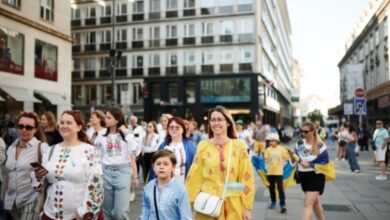
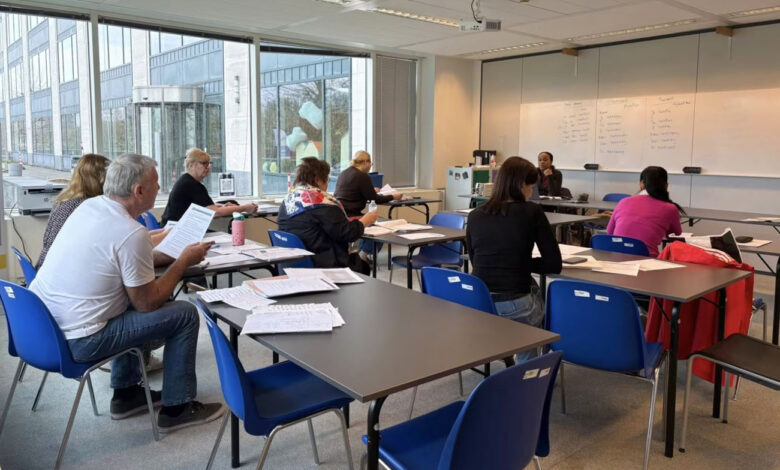
In the center of Brussels, a few minutes’ walk from the key institutions of the European Union, there is an eight-story space called “Ukrainian Voices”, which is visited by about a thousand Ukrainians every month. Its work is supported by approximately three hundred volunteers, and the list of free activities covers thirty-five areas for adults and children. These include language courses, legal consultations, psychological support, assistance with document processing, recognition of diplomas, finding a school for a child, a doctor, a job, housing, and support in difficult administrative situations.
The financial model of this center was built with the participation of the city of Brussels, which in 2022 allocated money for a project to support the integration of Ukrainians. Thanks to this, part of the team, which previously worked on a volunteer basis, received paid positions. Now, against the backdrop of reduced social spending, the city authorities are cutting the budget, and from April 1, funds for construction and support of volunteer work will no longer be allocated. For the center, this means the loss of a foundation, without which it is no longer possible to maintain the current scale of activity.
For a large number of Ukrainians, “Ukrainian Voices” became a place where they came in the first days after their arrival, even before understanding the Belgian system, local rules and their own further steps. One of the visitors recalls how she arrived there on the third day of her stay in Belgium, confused and exhausted, and a volunteer was next to her, who simply took her hand and helped her get through that state. This detail reveals the true role of the center: it worked not as an ordinary service point, but as an environment where a person was met even before they could clearly formulate a request.
The everyday usefulness of this place was combined with a feeling of psychological support. People came here for legal advice after being denied temporary protection, for help with an appeal, for explanations about documents, for a speech therapist for a child, for an interpreter, or for advice at a time when it seemed that no government office would give a clear answer. For many families, the cultural component was also important, as children attended dances, drawing, clubs, and theater classes, and adults got a chance to maintain a connection with the language and community without feeling like they were dissolving in a foreign environment.
How volunteers and visitors perceived the news
The news of the center’s closure caused a sharp and very emotional reaction, which is understandable given the scale of its presence in the life of the community. During a meeting with volunteers, of whom there are about three hundred at the center, people cried, because for them this space had long become a second home. One thought is constantly repeated in the words of the coordinators and the visitors themselves: this is not about the loss of another office or a separate project, but about the destruction of a place where a vibrant Ukrainian community was kept in a foreign country.
Visitors also speak of shock, since many have used the center’s support for years to solve very different problems. For some, it was children’s classes and the opportunity to give their child a familiar rhythm of life, for others, psychological assistance after losing their home and moving, for others, consultations on temporary protection or legal status. All these stories add up to one picture: the center performed so many functions that its closure inevitably creates a gap that is difficult to fill with random alternatives.
The situation is made even more acute by the change in the general context in Belgium. If in 2022, only two percent of Ukrainians were denied temporary protection, according to the Belgian migration service, now this figure reaches about forty percent. This means that the number of people who need help with appeals, documents, finding temporary housing, and explanations of how to act after a negative decision is growing. In such a situation, the center also plays the role of a crisis mediator between a person and a complex administrative system.
Separately, we should take into account the new wave of people who left Ukraine after a particularly difficult winter with shelling of infrastructure. The center’s coordinators emphasize that many of these people have stayed in Ukraine for four years, survived several winters without electricity, and arrived in Europe already exhausted. For them, the need for support is often even more acute than it was at the beginning of the great exodus, because the resources for adaptation have been exhausted more, and the rules for admission have become stricter.
The employed administrative team is not being fired: people are being offered to continue working in shelters on the outskirts of Brussels. However, this scheme does not preserve what made Ukrainian Voices unique. The only center in an accessible part of the city is being lost, where a person could find all the help in one place, without being scattered between different addresses, without complicated logistics, and without constantly switching between separate services.
At the same time, the volunteer environment that supported a large layer of cultural and public work is disappearing. A shelter on the outskirts can partially replace the administrative presence, but it does not recreate the model of a living community in which consultations, children’s classes, a choir, a theater, clubs and dozens of horizontal connections between people existed side by side. Because of this, we are not talking about a simple change of address, but about the loss of an entire way of organizing Ukrainian life in Brussels.
Why the center is called a ready-made model of a “Hub of Unity”
The leaders of “Ukrainian Voices” draw attention to another important aspect: in terms of the content of its work, this center actually already performs the functions of what Ukraine and the EU have announced as “Hubs of Unity”. The idea of such hubs is to help Ukrainians integrate in EU countries, maintain contact with Ukraine and advise those who are considering returning home. According to representatives of the center, delegations from the Ukrainian Ministry of Social Policy who came to Brussels saw in this space a model of such a hub that has already been implemented.
The problem is that Belgium is not yet on the list of countries where such hubs are being launched as a priority. Against this background, the closure of an already existing, vibrant and effective center looks particularly controversial, because it loses a ready-made structure that does not need to be created from scratch. For the community, this sounds like a manifestation of strategic incoherence: the importance of maintaining contact with Ukrainians abroad is officially discussed, but one of the most successful examples of such work may disappear in Brussels.
The center team is trying to preserve the space through petitions to the Belgian authorities, appeals to government officials, and finding other ways to maintain work at least in key areas. The possibility of raising funds is also being discussed, although this idea is difficult within the team, because for many Ukrainians, donating to the needs of the troops in Ukraine remains a natural priority. This makes the task even more difficult: the center is important for a large community, but the moral logic of wartime does not make it easy to accept the idea that the money collected in emigration should be directed to rent or maintain the building.
The real way out of the situation depends on a political initiative at the level of interstate dialogue. The coordinators of the center openly say that a country-to-country conversation is needed here, because the volunteer team cannot resolve the issue related to the city budget, state integration policy, and agreements between Ukraine and Belgium on its own. Until such a solution is found, the center is in a state of limbo, where the team’s dedication and community support collide with the limits of financial and administrative reality.
What European Commission officials say
The European Commission explains that the Unity Hubs should be financed under a mixed scheme involving Ukraine, the host countries, and EU funds. At the same time, member states received additional funds in 2025 to launch such hubs, but could also direct this money to other projects supporting Ukrainians. In a broader sense, the EU is gradually reducing the amount of assistance to countries hosting Ukrainians as 2027, the end date of the current temporary protection regime, approaches. For local initiatives, this means increased competition for resources and increasingly strict selection of priorities.
The Ukrainian Ministry of Social Policy, Family and Unity recognizes the important role of the “Ukrainian Voices” for the community in Belgium and for maintaining contact with Ukraine, but makes it clear that the financing of such centers is the responsibility of the EU states that host them. It is separately indicated that the launch of the “Unity Centers” requires the signing of joint declarations between Ukraine and the relevant countries, while there is no such document with Belgium yet. This is where the main knot of the problem arises: everyone recognizes the usefulness of the center, but no party has yet taken on the role of initiator of a solution that could save it in its current form.
What the closure will mean for the Ukrainian community in Belgium
If Ukrainian Voices ceases to operate, Belgium will lose a large Ukrainian center that combined daily assistance, cultural life, a volunteer environment, and a sense of belonging to its community. For people who have lived in Brussels for a long time, this will mean the disappearance of a space where they have been together for years and found answers to problems that cannot be solved with a single phone call or a one-time consultation. For newly arrived Ukrainians, this will mean even worse: instead of a clear support center, they will receive a more fragmented and cold system in which each issue will have to be solved separately, spending much more effort.
The history of Ukrainian Voices shows that the Ukrainian community abroad clings to specific places where a person can receive help, be heard, and not fall out of their own cultural environment. The Brussels center has become one of these places, so its possible closure is already perceived as the loss of an infrastructure of trust that has been created over the years. In this situation, the question is: either a new support model will be found for such a space, or one of the most successful Ukrainian initiatives in Belgium will disappear at a time when the need for it still remains very high.