The Prosecutor General’s Office presented the scale of the Russian Federation’s crimes against Ukraine to the UN Independent Commission

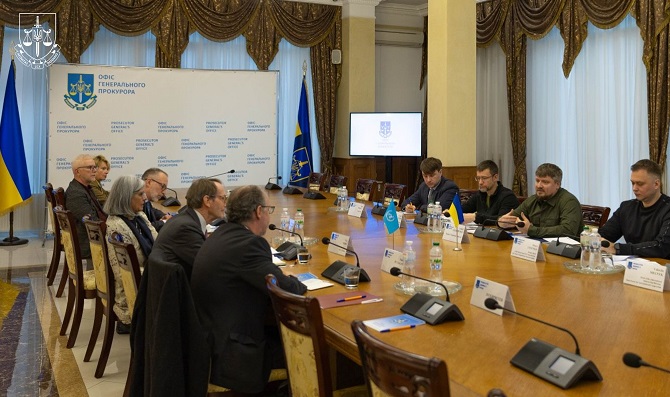
Deputy Prosecutor General Andriy Leshchenko held a meeting with representatives of the UN Independent International Commission of Inquiry into the Events in Ukraine, headed by Eric Mose. During the meeting, the parties discussed the documentation and investigation of war crimes and crimes against humanity committed by the aggressor state, as well as further coordination of actions and exchange of information between Ukrainian and international institutions.
The Ukrainian side informed the Commission delegation about the results of the prosecutors’ work. Since the beginning of the full-scale invasion, more than 190 thousand war crimes committed by representatives of the aggressor state have been registered. 1,029 Russian servicemen have been reported for suspicion, 747 indictments have been sent to court, and 206 people have already been convicted.
Andriy Leshchenko emphasized that the scale and systematic nature of the crimes of the Russian Federation allow us to consider them as part of a targeted genocidal policy against the Ukrainian people:
“What we see is a planned state policy of destroying the Ukrainian nation. That is why our investigations are focused not only on the perpetrators, but primarily on the political and military leadership of the aggressor state.
The Head of the Department for Countering Crimes Committed in Armed Conflict, Yuriy Rud, informed about the increase in the number of attacks on the civilian population:
“In just nine months of this year, more than 5.1 thousand attacks using drones against civilians were recorded, which is twice as many as in the entire year 2024. Such actions bear the hallmarks of crimes against humanity.
Separately, during the meeting, they discussed the latest report of the UN Independent International Commission of Inquiry into the Events in Ukraine, which documented numerous cases of the use of force against the civilian population in occupied and frontline territories, including systematic drone attacks on civilian objects, as well as the forced deportation of people from temporarily occupied regions.
The parties emphasized the importance of continuing close cooperation and data exchange for the full and objective documentation of war crimes.