“There are too many of them”: Parents in Poland ask to limit the number of Ukrainian children in school classes

When parents took their children abroad, they were guided by the goal of saving life. After the beginning of the full-scale invasion, Ukraine turned into a zone of constant threat: shelling, destruction, alarms. Millions of women with children left the country, hoping to find temporary protection, and now – stable education, peace and a safe childhood. However, over time it turned out that outside of Ukraine, security is not always a guarantee of acceptance. Ukrainian children in European schools are increasingly faced with indirect and sometimes open pressure: from a difficult transition to education to accusations of “disruption in the classroom”. In countries that have demonstrated solidarity from the first days, the demands to limit the presence of Ukrainians in schools, to reduce their number in classes or to transfer them to separate groups are becoming louder and louder. Most of these signals come from Poland, which has accepted the most refugees from Ukraine. But now Polish parents are openly declaring that there are too many Ukrainian children in schools, and they are a nuisance.
The case in Siedlce: from complaints to petition
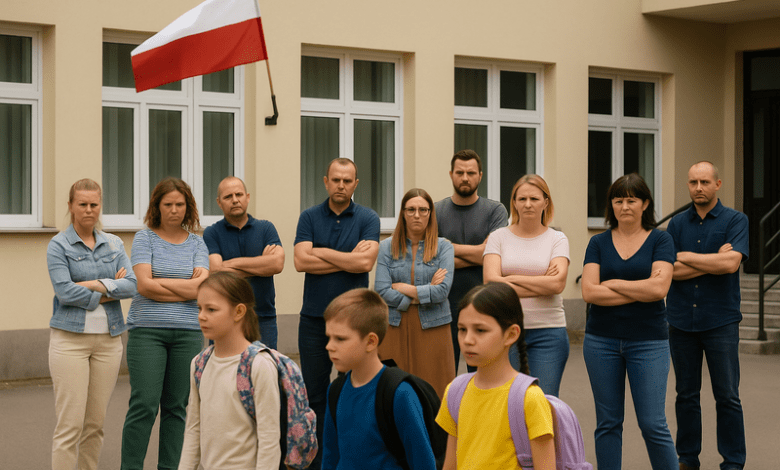
In June 2025, in the city of Siedlce (in Polish – Siedlce), the parents’ committee of primary school No. 1 submitted an official appeal to the local authorities. The essence of the petition is a request to limit the enrollment of Ukrainian children in school. At the time of the application, 65 students from Ukraine were studying there – about one seventh of the entire school contingent. It is reported Siedlce Weekly.
The authors of the petition complain that Ukrainian schoolchildren do not know the Polish language, do not want to learn it, and allegedly make the normal educational process impossible. The statement states that in some classes the number of Ukrainian children is close to half. In the 7th and 8th grades, according to the representative of the parents’ committee, most of them do not speak, write or read Polish. And therefore, according to parents, their presence makes a full-fledged education impossible for Polish children.
This appeal contains not only criticism of the organization of the educational process — in fact, it demonstrates the rejection of Ukrainian children as an equal part of the school community. At the same time, instead of requiring adaptation support or language assistance, a proposal to limit the number of students based on nationality was voiced.
Similar sentiments in different cities
Similar episodes have happened before – and not only in Poland. In Krakow in the spring of 2024, parents of several schools demanded that Ukrainian students study separately. Conflicts between local teachers and parents were recorded in Warsaw due to the alleged reluctance of Ukrainian children to participate in extracurricular activities. In Poznan last year, the local mass media reported on cases when children from Ukraine were reluctantly accepted into groups, and teachers did not have any methodical support for working with students who do not speak Polish.
In the Czech Republic, Germany, and Slovakia, situations also arise from time to time when school administrations fail to cope with the integration of a large number of Ukrainian students. But it was in Poland, due to the scale and duration of the stay, that open demands to reduce the presence of Ukrainian children in educational institutions began to be heard.
As early as 2022, Polish trade unions of educators warned that the system is not ready for a sudden increase in workload without changes in funding and staffing. But instead of adapting educational programs or creating a language support system, a part of society began to blame Ukrainian children themselves for “inconveniences”.
Language problem or reluctance to accept another?
One of the main arguments of petitions and complaints is “reluctance to learn the Polish language”. This wording is repeated in different variations — allegedly Ukrainian children do not seek adaptation, refuse language courses, do not try to integrate. But it is worth distinguishing between two different situations: lack of opportunity and real ignoring.
Most schools do not have individual teachers who speak Ukrainian. Polish language lessons are often replaced by regular subjects. There is no transition period in high school — the child must immediately write works, solve problems, and read historical sources in a foreign language. For a teenager who was hiding in a shelter a year ago, and today has to reproduce the functions of chemical elements in Polish, it is not just difficult, it is humiliating and frustrating.
It should also be remembered that not all children came to Poland with a zero level of Polish. Some of them study in parallel at a Ukrainian distance school. And even if the child did not master Polish in one year, this does not mean that he “doesn’t want to”.
In petitions like the one received in Siedlce, another strategy is unwittingly revealed – assimilation. This is not about helping Ukrainian children to adapt, but about the demand for complete integration into the Polish linguistic and cultural environment. Regardless of age, previous experience, trauma and the right to identity.
Instead of creating special classes with enhanced Polish learning, giving teachers methodical support, providing language assistants or at least translation assistance, children are actually forced to make a choice: either you become completely “yours” or you are a burden. This is not integration. This is displacement by soft methods.
What parents and schools can do
Parents whose children study abroad need to have realistic expectations—and not be silent at the same time. If the school does not create conditions for adaptation, the child has the right to receive advice, support and assistance. It is important not to allow the pressure in the team to remain unanswered. In many cities of Poland, there are organizations that protect the rights of Ukrainian children, provide legal advice, and record cases of discrimination. Do not be afraid to apply.
Schools should realize that Ukrainian students are not a temporary phenomenon. Even if the war ends tomorrow, many families will remain – and the task of the education system is not to exclude, but to include. This is possible only when an institutional approach is created: language preparation classes, bilingual assistants, normalized workload for teachers and support for children with psychological difficulties.
Ukrainian children who left the war are not responsible for the system they fall into. It’s not their fault that the language barrier gets in the way, that classrooms are overcrowded, that teachers lack resources. They cannot be made a convenient target for irritation, because a child who hears today: “you are unnecessary here” will not believe any promise about European values, solidarity and security tomorrow.