This week, for the first time in 1,000 years, two comets will be at their brightest in the night sky

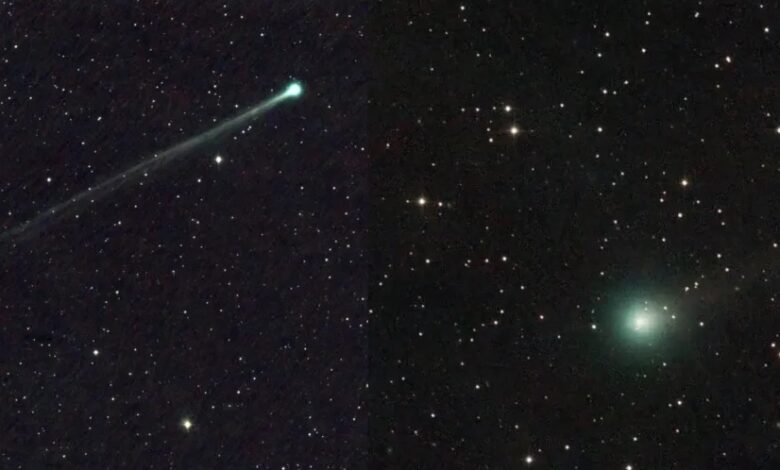
Comet C/2025 R2 (SWAN) will make its closest approach to Earth on the evening of October 20, followed by brighter comet C/2025 A6 (Lemmon) the following day. Both are among the brightest comets of the year, and will be visible to the naked eye this week for the first time in 1,000 years. However, binoculars will be needed for a better view, Live Science reports.
Comet C/2025 R2 (SWAN) was discovered in September of this year, and its orbital period is about 1,400 years. It will come within 24 million miles (39 million km) of Earth on Monday, October 20. It will be visible approximately one and a half hours after sunset. According to calculations, the object’s magnitude will be +5.9.
Since the human eye is able to detect light from objects up to +6 under dark skies, this comet can be seen without instruments, but for clarity it is better to use binoculars. To find it, you should focus on the Summer-Autumn Triangle (formed by the stars Vega, Deneb and Altair) in the southwestern part of the sky. The comet will be located approximately halfway between Altair and the horizon.
Comet C/2025 A6 (Lemmon) was discovered in January of this year, its orbital period is about 1350 years. It will come closest to Earth — at a distance of 89 million km — on Tuesday, October 21. It will also be visible approximately one and a half hours after sunset. It will be brighter than SWAN, with a magnitude of +4.5. Although there is a chance of seeing it with the naked eye, binoculars are also recommended for better clarity.
The comet will be visible in the northwest, near the Big Dipper (an asterism in the constellation Ursa Major) and the bright star Arcturus. After approaching the Sun, both comets will leave the inner part of the Solar System. The next opportunity to see them will arise only in more than a thousand years.