Ukraine is on stage: how theater in Romania helps children preserve their national identity (video)

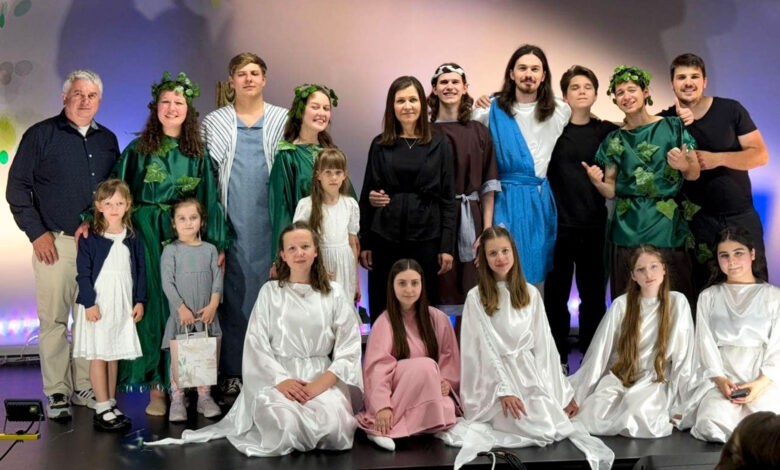
The war forced thousands of Ukrainian families to leave their homes, going into the unknown in search of safety for themselves and their children. Romania became one of the countries that extended a helping hand to Ukrainian refugees. Here, amid new circumstances, Ukrainian communities not only find shelter, but also actively work to preserve their national identity. They pay special attention to children, who are the future of Ukraine. They are taught, entertained, involved in creative initiatives so that they not only do not forget their native culture, but also carry it to the world.
IA “FAKT” visited one of these communities and spoke with Natalia Lupashtyan, the wife of a pastor from Russia, who took a firm position in support of Ukraine from the first days of the war. In the Romanian city of Oradea, she became a volunteer and head of a Ukrainian theater group operating on the basis of the Ukrainian Christian Church BCUO. Its goal is to give children a piece of home, to create a space where they can not only learn the art of theater, but also feel part of Ukrainian culture.
Natalia, how did you end up in Romania? What events or circumstances made you leave Siberia after the start of the war?
I am originally from Ukraine, and so is my husband. I was born and grew up in the city of Rivne. At the age of 19, she went on a short-term mission to Siberia, to the city of Chita. It was there that I met my future husband, who, like me, comes from Ukraine, from the city of Chernivtsi. Soon we got married and devoted our lives to missionary work in Siberia.
We lived in Russia for 33 years — mostly in Siberia, and then in the northwest, in the Pskov region. During the years of our life together, God gave us seven children – two boys and five girls. My husband is a pastor, and I have always supported him in his ministry. At the same time, I studied directing, created a Christian theater, where I worked with young people. Later, I received education as a caregiver and counselor. Both of these things became an important part of my vocation.
When the war started, it was a huge emotional upheaval and a personal tragedy for us, as we were closely connected to the two countries. We couldn’t just cut those ties, but we realized that we had to make a decision.
We tried to help Ukrainians who were in trouble. In Pskov, near the border with Estonia, there were many refugees who needed food and warm clothes, because they had been there for several days. We did everything possible to support them.
At the same time, we understood that everything was becoming more dangerous in Russia. The situation was changing rapidly, the propaganda was intensifying, and the attitude of the people was also becoming more and more rigid. It was very difficult to go through. We were afraid for our children and just wanted to get them out of there.
We decided to move to Romania because my husband is Romanian by nationality. He knows the language, was born in a Romanian family in a Romanian village in Ukraine, in the Chernivtsi region. It seemed to us the most realistic way – to move to Romania and get citizenship there.
We left all the property we acquired and left because we could no longer see a future for ourselves and our children in Russia. The question of identification arose. We understand that first of all we are God’s children, Christians, but at the same time we expressed our attitude to this war in this way.
Photo: IA “FACT”
Why did you decide to devote your time and effort to working with Ukrainian children?
I put on plays for families with children. It was logical to dedicate our time and efforts to Ukrainians, because that is what we came for – to be with Ukrainians, to feel part of their community and to serve and help in whatever way we can.
Photo: IA “FACT”
How did your theater background influence the choice of this field of activity? Was it a spontaneous idea?
Like many people, I remained silent for a long time after the start of the war. It was difficult to think of any creativity. When we came here, I did not initially plan to do any productions. But after seeing the children and young people, I realized that there was someone to work with, and, approaching Easter last year, I thought for the first time that it might be worth putting something together with them. Of course, I already had experience in this kind of activity, this is what I was doing before. This is my element, what I’m interested in, what I’m good at, and I know how it can serve for the benefit of others. That’s how everything came together perfectly.
https://youtu.be/0SLAspnnjbw
Was it difficult to integrate into the Ukrainian community in Romania? How were you received?
There were fears, especially for the children, because they were born in Russia, always spoke Russian and do not know the Ukrainian language. But we saw that God had indeed prepared this way for us. We quickly integrated into the community, we were received very warmly, and we felt like a family, which was a great joy for us. My children found friends, joined the youth, began to participate in various activities, sing and recite poems, including in Ukrainian.
Why did you decide to stage the play in Ukrainian?
At first it was in Russian, and I ordered a translation from my friend, who speaks Ukrainian well. I made two performances: one in Russian (for the sake of all Russian speakers), and the other in Ukrainian.
Many people told me why make two plays, two casts, why make it so complicated. But it was very important for me. When I was a child growing up in Ukraine, our language was very mixed with Russian, we all know that. But now the language has blossomed and is becoming more and more refined.
Does your work help children keep in touch with their native culture and traditions? How does it manifest itself?
Of course, I cannot give up Russian, because it is the language I know best and the language in which I think. But Ukrainian is something special for me. I believe that Ukrainians in Europe must preserve the language and learn it. And, of course, now I’m thinking about doing more creative work in the Ukrainian language.
Photo: IA “FACT”
What guided you when you decided to put on plays specifically for Ukrainian children? Why is this important to you?
In childhood or adolescence, the best help is when adults are nearby, calm and leading their normal lives, fulfilling their duties. When there is work, study, some responsibility, when there is free time, and you can afford some entertainment… And when a child sees that life goes on and adults live normally, it calms him down and gives him a sense of confidence and hope.
Do you believe that art can heal souls? If so, how exactly does this manifest in your work?
Of course, art plays a special role here. The theater has always been famous for its healing properties, in particular, the ability to give a person a chance to experience emotions. These are emotions not from real life, but those that happen on stage, here and now. And this process has a therapeutic effect. Aristotle also said that thanks to sympathy for the characters on stage, the audience experiences catharsis – psychological cleansing and emotional restoration.
In real life, we often do not allow ourselves to experience emotions. We do not know how to express them, we restrain them, and because of this they can eat away at us from the inside, giving rise to fears and anxiety. But when we experience these emotions through creativity, it is completely different. We give them an outlet and allow ourselves to be cleansed.
This, of course, poses a great challenge to creativity. I want to add that I am often disappointed in modern theater because, in my opinion, it is not always aimed at the development of a person, at his inner enrichment, unfortunately. That’s why I put resolutions only on evangelical topics. For me, this is the greatest authority. Each of my performances is, in fact, a performance-sermon. This is something that is definitely enriching.
https://youtu.be/yycq4nQscLc
What does it mean to you personally to put on plays on such important holidays as Christmas or Easter?
The most difficult thing these days in our busy lives is to find time to gather all the necessary people for a rehearsal. There is a desire, but opportunities do not always allow to gather. Therefore, the biggest difficulty is time itself. However, Christmas and Easter are major Christian holidays for which people are used to spending time preparing. That is why we usually prepare a festive program for these holidays.
How do you cope with being the wife of a priest from Russia? Have you faced prejudice because of your background?
In the first months after our arrival in Romania, we tried not to say that we were from Russia, as we did not know how we would be treated. But over time, we realized that most of the refugees from the East of Ukraine have relatives in Russia, close people, and this does not surprise anyone. Therefore, we stopped feeling negativity or fear.
I want to say that I know many people in Russia who help Ukrainians risking their health, freedom, and life. And, in the end, it is not so important who you are by origin. The most important thing is what you have inside, what you live by, and what your value system is.
I believe that when a person needs help, it does not matter much who provides it. It is more important that there is this person who is ready to help, regardless of their background.
Do you feel supported by the local community in Romania? How does it manifest itself?
We have found a Christian family here, and it is a huge support for us. The Ukrainian community is very united, and our church has become a real place of strength for us. Although there are not many of us, God arranged everything in such a way that our team has all the necessary talents and gifts for effective service. I even received support in the theater direction — we have a costume designer, decorator, and director. It is an incredible blessing to see everyone find their place in ministry.
What attitudes do you see among Ukrainian children and their families? Do they feel any hope of returning home?
Today, many people live without thinking far ahead, because circumstances change very quickly. Even the Bible says: “Don’t worry about tomorrow, because tomorrow will worry about itself. Today is enough to worry about itself” (Matthew 6:34, Modern translation of the Ukrainian Bible Society). This divine principle helps to maintain inner peace, protecting us from unnecessary worries. This is a kind of intuitive self-defense.
When we talk to people, many people remember home, pull back. My mother cries every day and wants to go home. Some, if possible, go to Ukraine. But everyone understands that some people have lost their homes, property or it is simply impossible to return. This creates additional instability and anxiety.
However, there is hope. Humans by nature always live in hope, and it is actually wonderful to have inner strength and faith in the best. At the same time, many have already managed to adapt to a new place: make acquaintances, create connections and feel part of the community. For us, Romania has become a certain support, because Romanians are mentally very close to Ukrainians.
So while there are still many unknowns, people continue to find a balance between the past and the new reality, relying on each other’s hope and support.