Ukrainian diplomacy and non-professional ambassadors: the risk of strategic and reputational losses for the state

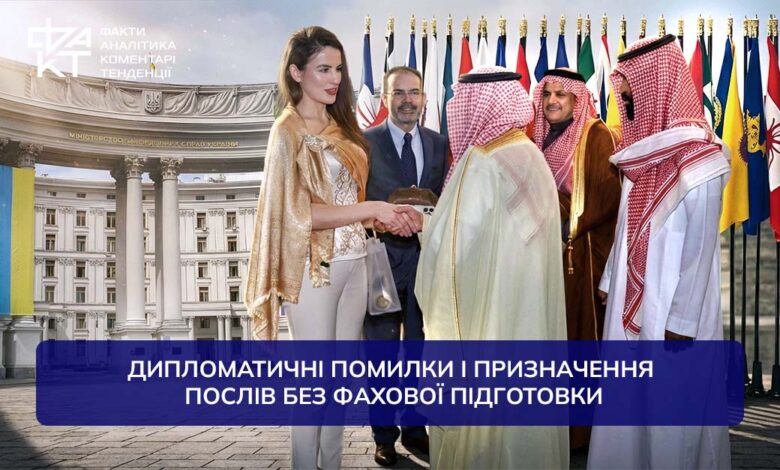
In the Sultanate of Oman, the celebration of iftar during Ramadan is attended by high-ranking officials, including members of the Sultan’s family, diplomats and local community leaders. This makes each element of the protocol an important signal of state representation in an eastern country where traditions deeply rooted in Islam and culture are of fundamental importance. Among the guests was the Ambassador Extraordinary and Plenipotentiary of Ukraine Olga Selykh, whose choice of attire caused shock and lively discussions among both local participants and Ukrainians.
At the same time, the key problem goes far beyond this case, because the appointment of people without classical diplomatic training to strategically important positions is a systemic problem for Ukrainian diplomacy. Bad personnel decisions turn into a risk that can cost the state much more than one reputational mistake at an official reception. In times of war and international crises, diplomacy becomes a critically important tool for protecting national interests, Ukraine, and each ambassador actually simultaneously plays the role of a negotiator, analyst, and crisis manager. The lack of systematic training, knowledge of protocol, cultural norms, and rules of negotiation turns the representation of the state into a potentially dangerous experiment, where mistakes can have long-term consequences.
Iftar in the Sultanate of Oman: Diplomacy and Public Reaction to Olga Selykh’s Dress Code
The celebration of Iftar in the Sultanate of Oman during Ramadan always combines religious, state, and social aspects. This period, which falls between mid-February and mid-March, is a time of spiritual fasting, as well as a time of public demonstration of the values of unity, generosity, and mutual respect among citizens and guests of the state. Iftar is held immediately after sunset and marks the end of the day’s fast (uraza), during which believers abstain from all food and water. This rite is accompanied by a traditional feast, which includes meat dishes, rice, spices and coffee, which creates an atmosphere of solemnity and mutual attention.
High-ranking officials, including members of the Sultan’s family, diplomats and local community leaders, always participate in state and public events in the country. At the same time, iftar receptions traditionally require foreign women to adhere to a strict dress code that must comply with Oman’s cultural and religious traditions, and any careless step can turn into a diplomatic scandal. Women at official events, particularly when meeting with high-ranking officials, usually choose clothing that covers their arms and legs, avoids flashy or provocative details, and reflects a restrained elegance that combines respect for religious norms with diplomatic etiquette. These rules have been formed over the centuries, maintaining a balance between privacy, public perception, and political symbolism.
The Ambassador Extraordinary and Plenipotentiary of Ukraine to the Sultanate of Oman, Olga Selykh, was present at the iftar reception. However, her choice of attire — a white blouse with gold patterns, a gold cape, and tight white pants — attracted considerable attention from both local and Ukrainian observers, causing genuine shock and indignation. Such a style, in particular the tight pants, is perceived as a gross violation of the traditions of female modesty adopted in Oman, which looks dissonant at an official diplomatic event.
This situation demonstrates how thin the boundaries are between diplomatic presentation and local cultural norms. The choice of clothing for a female ambassador in a public event in a Muslim country is not limited to aesthetic criteria, but becomes part of symbolic communication, a signal of respect or, conversely, a possible cultural misunderstanding.
As we can see, iftar in the Sultanate of Oman is not just a religious or gastronomic ritual, but a complex political and cultural phenomenon, combining tradition, etiquette, state interests and public perception. An analysis of reactions to the choice of clothing of the Ukrainian ambassador emphasizes the importance of a sensitive balance between personal style and the expectations of the host country. He demonstrates that appearance at official events is an integral part of diplomatic discourse.
Without experience, but with millions: the dubious appointment of Olga Selykh as ambassador
However, the surprise at the ambassador’s behavior disappears if you carefully examine her reasons. The appointment of Olga Selykh as Ambassador Extraordinary and Plenipotentiary of Ukraine to the Sultanate of Oman in July 2025 immediately caused an ambiguous public assessment. President Volodymyr Zelenskyy chose the first female ambassador of Ukraine for the strategic region of the Middle East, a business leader and lawyer without specialized diplomatic experience. This appointment became historic for Ukraine, since women had not previously held similar positions in the region.
It should be noted that the appointment of a woman as ambassador to Oman, as well as to any other eastern country, is not officially prohibited, but it directly clashes with the realities of a conservative society. Islamic social norms and traditional culture can affect the effectiveness of business contacts and require additional attention to the format of meetings and communication. At the same time, the experience of other Muslim countries shows that a competent female diplomat is able to build stable relationships if she takes into account local rules of etiquette and the peculiarities of social interactions.
Before her diplomatic career, Olga Selykh gained experience in business and management of large companies in the construction sector. She worked as a lawyer, managed foreign economic activities and headed several enterprises: Kyiv Invest-Bud, Global Bud-Project and International Trading Company. During her work, these companies won dozens of government tenders, the total value of which exceeded 35 million hryvnias, and some deals had signs of anti-competitive collusion. However, these business victories were criticized due to potential conflicts of interest and opaque procedures, especially in connection with family ties. Meanwhile, Olga’s sister, Lyudmila Dyakova, previously served as deputy head of the local organization of the Opposition Platform – For Life party.
Selykh’s biography demonstrates a wide range of educational achievements in management, law, and economics, including numerous private courses and certificates, including foreign ones. However, her preparation for diplomatic activity was limited to a short-term program at the Diplomatic Academy of Ukraine in 2025, a few months before taking office, which makes her official rank of Ambassador Extraordinary and Plenipotentiary extremely accelerated compared to the classic career trajectory of the Ministry of Foreign Affairs.
In addition, Olga Selykh’s lifestyle and public activity contrast with the traditional image of a diplomatic worker. She owns property worth over 5.5 million hryvnias, including a 96.9 m² apartment in Kyiv, a 78.8 m² non-residential premises, land plots in Volyn region and Kyiv region, as well as a 2017 Toyota Camry and luxury furniture from the Italian brand Giorgio Collection Luxury Experience. However, her official income for 2023 was only 150 thousand hryvnias, which contrasts sharply with the declared assets and raises questions about the correspondence of her lifestyle to the declared income. Added to this is her activity on social networks: constant travel, social events and photo shoots, which in public discourse reinforce the dissonance between the image of a businesswoman with a luxurious lifestyle and the requirements of diplomatic work in a country where respect for cultural traditions is of critical importance.
Despite the lack of classical diplomatic experience, the appointment of Olga Selykh was a symbolic step for Ukraine: she took up the position after an open competition among more than 1,170 applicants. However, Selykh’s career and behavior continue to generate discussions about the transparency of personnel decisions, the balance between business acumen and diplomatic delicacy, as well as the compliance of lifestyle and activity with the expectations that the state places on a representative of national interests in a strategic region.
Diplomat Training: Ukrainian Traditions and International Standards
The traditional system of training Ukrainian diplomats has always been formed taking into account the classical principles of the Ministry of Foreign Affairs and international experience. Applicants for positions in foreign missions usually underwent multi-level education: first, they received fundamental knowledge in international relations, political science, economics and law, often at specialized universities, such as the Taras Shevchenko National University of Kyiv or the National Academy of Public Administration under the President of Ukraine. In addition to basic education, specialists were trained for practical work in diplomatic conditions through the training programs of the Diplomatic Academy of Ukraine, where they carefully studied diplomatic protocol, negotiation techniques, cultural features of the host countries, international law and economic diplomacy.
During the training, special attention was paid to language competence, in particular knowledge of English, French, Arabic and other languages necessary for conducting negotiations and diplomatic documentation. Future diplomats and ambassadors were taught the intricacies of conducting negotiations in complex political situations, conducting analytical assessments and forming diplomatic reports. Additionally, they underwent internships in embassies abroad, where, under the supervision of experienced employees, they learned practical work with protocol, organizing high-level meetings and maintaining bilateral relations. Such comprehensive training provided systematic preparation for complex tasks in strategically important countries.
In the history of Ukraine, there have been cases of appointing individuals without specialized training to the position of ambassador, but they have always been exceptional and were determined either by special merits in the civil service or by strategic political agreements. Such a practice was not the rule, since the risks in the diplomatic sphere, especially in countries with clear cultural and religious traditions, are extremely high. The lack of professional training jeopardized the effectiveness of the mission and could lead to cultural or political misunderstandings.
The appointment of ambassadors in Ukraine has historically combined professional and political criteria, and the practice of the competition has changed depending on the period and political context. In the first years after independence, in the early 1990s, most diplomatic positions were held by people with experience in government agencies or political loyalty, and formal competitions were rather declarative in nature. The decision on the appointment was made by the president on the proposal of the Ministry of Foreign Affairs, and the actual assessment of the candidate’s professional training often gave way to political agreements.
Since the mid-2000s, Ukraine has begun to formalize selection procedures: for key and strategically important positions, competitive commissions were introduced that assessed knowledge of international relations, language skills, and work experience. Applicants had to submit detailed dossiers, undergo interviews, and demonstrate practical negotiation skills. However, in practice, the final appointment remained dependent on political factors, and the competition often serves to legitimize an already adopted decision. At the same time, the leadership of the Ministry of Foreign Affairs emphasizes that the appointment of individuals outside of career diplomacy to ambassadorial positions is a common international practice. In Ukraine, over the past two years, such non-cadre diplomats have demonstrated decent results, and the effectiveness of their work should be assessed by real achievements, rather than assumptions or stereotypes.
It should be noted that abroad, the training of diplomats is traditionally even more rigorous and systematic. In the United States, Great Britain, and France, candidates for positions in the Foreign Ministry undergo years of training, which includes not only academic studies and practical internships, but also work in think tanks and the study of the cultural and social norms of the host countries. In many countries, international positions are often held by people with specialized education in international relations or related fields, and only after several years of training do they get the opportunity to head embassies. In addition, candidates are selected for ambassadorial positions who have proven their ability to think strategically, negotiate in conflict situations, and effectively manage diplomatic teams. This approach reduces the risks of reputational and political crises for the state and ensures the stability of foreign policy activities.
Diplomacy without school: personnel experiments and the price of protocol errors
The discussion around the appointment of non-professional diplomats is not limited to just one case with Olga Selykh and is not reduced to disputes about her person alone. In recent years, many personnel decisions have appeared in Ukrainian diplomacy that have caused a sharp reaction from society due to the lack of classical training in people who received ambassadorial positions in strategically important states. Such appointments look especially contrasting against the background of the traditional system of diplomatic service, where a career is formed over years, and sometimes decades.
One of the most discussed examples was the appointment of Olga Stefanishyna as Ukraine’s ambassador to the United States in August 2025. She began her diplomatic mission in Washington in September of the same year, replacing the scandalously known Oksana Markarova. Stefanishyna’s public biography looks rich: work in the Ministry of Justice, participation in the work of the government office, activity in the Secretariat of the Cabinet of Ministers, the position of Deputy Prime Minister for European and Euro-Atlantic Integration, membership in the National Security and Defense Council. Her education also gives the impression of academic solidity – a diploma in international law, specialization in the field of finance and credit. However, alongside this, there is a long list of public scandals and journalistic investigations that accompanied her political career.
The most high-profile episode was the story of the tender for the preparation of comparative analyses of Ukrainian and European legislation during her work in the Ministry of Justice. Journalists reported that in 2015, the cost of one page of such an analysis ranged from 1.4 to 4.5 thousand hryvnias. Complaints were raised not only about the high price, but also about the quality of the prepared materials. In 2019, Stefanishyna received suspicion from law enforcement in this case, but later she insisted that the charges were politically motivated.
In 2025, another story emerged – her mother’s purchase of an elite apartment almost four times cheaper than the market value. This property was not declared, although the declaration included another apartment of her mother. A separate wave of criticism was caused by reports of ties to the agency that manages seized assets and the role of her ex-husband in schemes to transfer property to close companies. However, after a series of scandals, criminal proceedings, and dismissal from her previous position, Stefanishyna was appointed ambassador.
Even earlier, society had already experienced a similar personnel experiment – the appointment of Olesya Ilashchuk as the Ambassador of Ukraine to Bulgaria. Before receiving a diplomatic post in December 2022, she had no experience in civil service and did not work in diplomatic structures. Her professional biography consists of various and loosely connected stages. In the 1990s, she worked as a teacher’s assistant and taught English at school, later became a journalist in the regional editorial office of a television channel. In the early 2000s, she held the position of director of international development in a private company. In 2005, she graduated from Chernivtsi National University with a degree in regional studies.
Her subsequent career was related to business: managing a jewelry company, managing a packaging materials production enterprise, and working in the field of computer technology trade. For some time she worked in the publishing department of the company in Baku, and from 2018 to 2022 she was engaged in private practice of Gestalt therapy in Kyiv. It is noteworthy that before her diplomatic career, Ilashchuk publicly positioned herself as a psychotherapist and sexologist. It was this circumstance that caused a sharp reaction from some experts, who called her appointment a “strategic failure” for Ukrainian diplomacy in Bulgaria.
These and other personnel decisions in Ukrainian diplomacy look especially risky given that during war their activities are critically important, because the word of a diplomat can save more lives than thousands of guns. As is known, not only guns win wars, but also negotiations. The seventh UN Secretary-General, Nobel Peace Prize laureate Kofi Annan said: “Good diplomacy can save the world; bad diplomacy can drag you into war.” At the same time, the world-famous leader of the Indian national liberation movement, the ideologist of the movement for independence from Great Britain, Mahatma Gandhi, emphasized: “The mightiest sword has power only when diplomacy allows you to preserve peace.” In political philosophy, diplomats are sometimes called “doctors of the state,” whose task is to maintain the health of international relations and prevent “surgical intervention,” that is, military action.
Therefore, during war, diplomacy becomes a tool on which a country’s access to weapons, allies, financial support, and political solidarity of the world depends, so mistakes or unprofessionalism of those who represent the state abroad can cost much more than just reputational losses.
People who find themselves in the position of ambassadors, having no experience in diplomacy, public administration, security or international politics, actually enter the complex system of foreign relations without understanding its mechanisms. They have not undergone professional diplomatic training, have not worked in state structures and have not encountered crisis situations in which decisions have to be made quickly, relying on knowledge of protocol, international law and political context. At a time when a country is at war and diplomacy is becoming one of the key tools for protecting national interests, such a lack of professional experience turns from a personnel feature into a serious risk: a representative of a state may simply not have the professional tools necessary to act confidently and effectively in critical circumstances for the country.
Diplomatic history knows many cases when one ill-considered remark, gesture or violation of protocol caused international conflicts, sometimes much more serious than it seems at first glance. In diplomacy, symbols carry the same weight as official documents, and the behavior of a state representative is often perceived as the behavior of the state itself.
In 2009, during an official meeting at Buckingham Palace, US First Lady Michelle Obama placed her hand on the shoulder of Queen Elizabeth II of Great Britain while talking to her. In British monarchical tradition, physically touching the queen during an official meeting is considered a violation of etiquette. A photo of this moment instantly flew around the world media, and the British press discussed for several days whether a diplomatic insult had occurred. Although the incident was quickly smoothed over, it demonstrated how closely symbolic details of behavior are monitored in international relations.
Another incident occurred in 2018 during the G7 summit in Canada, when presidents and prime ministers traditionally took photos together. At the same time, US President Donald Trump sat demonstratively, while other leaders stood nearby. In images that later became symbolic of the tension at that summit, German Chancellor Angela Merkel leaned over the table to talk to Trump, while he remained in a pose that many diplomats interpreted as disrespectful to partners and women. The photo became one of the most famous images of the diplomatic conflict in recent years and only intensified the sense of division between the allies.
Another telling incident occurred in 2021 in Ankara during a meeting between Turkish President Recep Tayyip Erdogan and European Union leaders. Two chairs were prepared in the meeting room for the Turkish president and European Council President Charles Michel, while European Commission President Ursula von der Leyen was forced to sit on a sofa to the side. Video of her exclaiming, “Uh…” in confusion, was circulated around the world’s media. In Europe, the incident even got its own name: “sofagate.” In Brussels, it was perceived as a violation of diplomatic protocol and a sign of disrespect, after which the EU and Turkey continued for several weeks with heated public discussions about the humiliation of a European representative.
Such situations arise not only due to protocol trifles, but also due to careless statements. In 2018, the British ambassador to the United States, Kim Darroch, resigned after his diplomatic cables with critical assessments of the US presidential administration were leaked to the press. In diplomatic practice, such assessments are the norm of internal correspondence, but after publication they were perceived as an insult. The US president refused to work with the ambassador, and London effectively lost its key diplomatic representative in Washington.
These examples show that diplomacy often works on the border between symbols and politics. What to an outside observer looks like a minor mistake or an awkward gesture can be perceived in the international environment as a signal of disrespect, political pressure or a demonstration of superiority. Diplomacy consists not only of official documents and negotiations, it is based on symbols, gestures, intonations and cultural rules that professional diplomats have studied for years. Therefore, the diplomatic service in most countries involves long-term training and a gradual career, where a person goes through dozens of stages before receiving the right to represent the country at the highest level.
Against this background, the appointment of people in Ukraine without systematic training looks like a risky experiment, and in this case, each official reception turns into a potential risk. A mistake may not look like a disaster at the moment of its appearance, but it gradually undermines trust in the state, which is represented by an unprepared representative. When a country delegates the representation of its interests to non-professionals, in peacetime such experiments cannot take place, but during wartime any mistake in the international arena can cost the state much more than one reputational mistake at an official reception.