
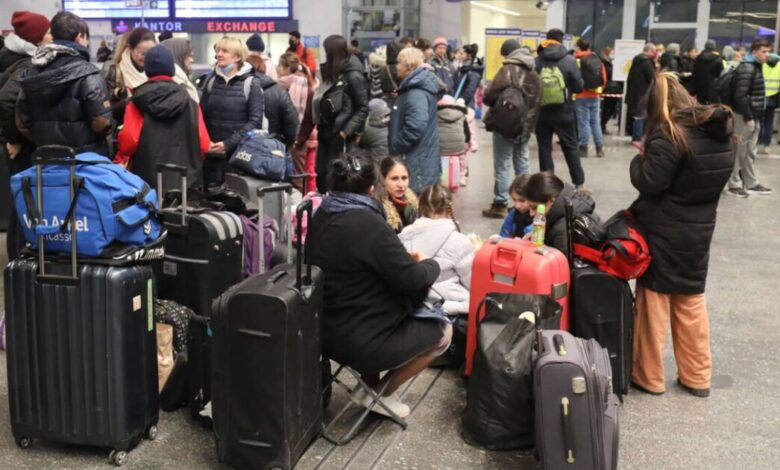
The full-scale war caused one of the largest waves of forced migration in modern Ukrainian history, as millions of people left their homes due to danger, destruction, job loss, the need to protect children, and the inability to plan their lives in conditions of constant threat. After several years of being abroad, some Ukrainians had already established themselves in new communities. Adults found jobs, children began studying, families arranged housing, and household and social ties gradually made temporary departures much longer. What is the current situation with Ukrainians abroad?
How many Ukrainians are abroad
According to estimates of the Center for Economic Strategy, as of the beginning of 2026, about 5.6 million Ukrainians who left due to the full-scale war are abroad. The majority of these people left the country through the western borders, while individual groups entered Europe in transit through Russia or Belarus.
From the beginning of the full-scale invasion until the end of 2025, the Ukrainian border was crossed over 60.4 million times for exit, and 56.3 million times for entry. The difference between these figures shows the scale of non-return, although such data does not include those who left Ukraine through the territory of Russia or Belarus.
Separately, analysts estimate that about 277 thousand Ukrainians left for European countries through Russia or Belarus. According to UN estimates, approximately 1.3 million Ukrainians received refugee status in Russia or Belarus.
Dynamics of departure and return
303 thousand more citizens left through the western and southwestern borders than returned to Ukraine. Compared to 2024, this gap has decreased, as the difference was 459 thousand people.
These figures indicate a change in migration behavior. Younger Ukrainians are more likely to continue to leave, as they are looking for education, work or more stable living conditions, while older age groups are more likely to return home, where they have left their housing, family ties or familiar environment.
Adult women make up the largest share of Ukrainian refugees — about 40%. The share of men increased from 27% to 29% over the year, which may be due to different channels of departure, family circumstances and changes in migration plans.
Children under 18 make up 31% of Ukrainians abroad. At the same time, the share of people over 45 years of age has decreased, which is consistent with the trend of more active return of older groups to Ukraine.
In total, 66% of refugees are of working age from 18 to 65 years. Young people under 35 years old make up more than half of the entire group of Ukrainian refugees — approximately 56%, so the issue of the return of this category will be of great importance for the labor market, demography and post-war recovery.
From which regions did they leave most often
The largest share of refugees before leaving lived in Kyiv and Kyiv region — 24%. Another 52% were residents of the eastern and southern regions, which most felt the consequences of hostilities, occupation, shelling and destruction of infrastructure.
The vast majority of Ukrainians abroad left cities. Only every tenth refugee comes from rural areas, which is explained by different population mobility, access to transport routes, financial capabilities and the level of risk in specific settlements.
Where do most Ukrainians live
The largest number of Ukrainian refugees live in Germany — 23%. Poland ranks second with 19.5%.
Germany is more likely to attract younger Ukrainians, as 28% of refugees under 35 are there. Poland is more connected to the 35–49 age group, among which the share of Ukrainians in this country is 24%.
The choice of country often depended on proximity to Ukraine, the presence of relatives or acquaintances, conditions of temporary protection, access to work, housing, education for children and social support. Because of this, some Ukrainians perceive their stay abroad as a forced pause, while others gradually move on to long-term planning of life in a new country.
Scenarios for returning after the war
According to the calculations of the Center for Economic Strategy, the number of Ukrainians who will return after the war will depend on security, the state of the economy, the availability of housing, work, education and a general sense of stability in Ukraine.
Under the baseline scenario, about 1.6 million people could return home, while about 2.7 million would remain abroad. The pessimistic scenario assumes the return of only 1.3 million Ukrainians and the residence of about 3 million people outside the country. Under the optimistic scenario, the return could reach 2.2 million people, while about 2.1 million would remain abroad.
These estimates are based on surveys of return intentions, but people’s real decisions will depend on whether Ukraine can offer safe conditions, work, restored housing, and clear prospects for families with children.
The main challenge for Ukraine will be the return of people of working age and young people, as this will affect the labor market, demographics, and the pace of post-war recovery. Research data shows that the decision to return is increasingly linked not only to the end of hostilities, but also to how quickly the country can restore conditions for a safe and stable life.


