
Ukrainians in Europe after the end of temporary protection: in which countries is the greatest risk of deportation?

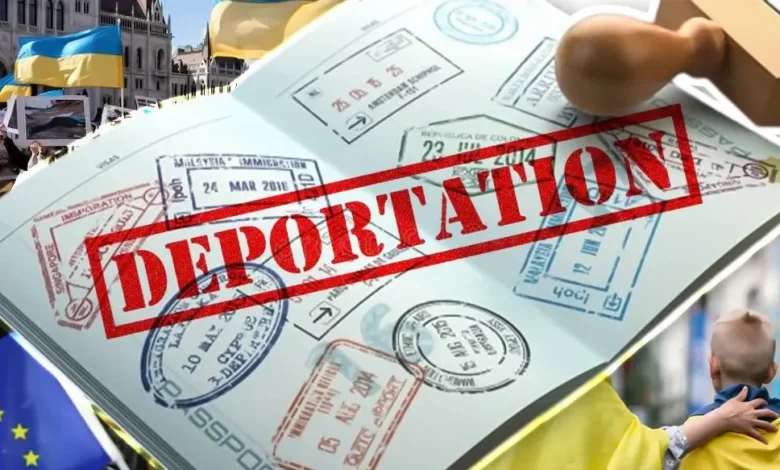
The Temporary Protection Mechanism, introduced by the European Union in March 2022, became a key tool to help Ukrainians who were forced to leave their homeland due to a full-scale invasion. At that time, the main task was to ensure the safety and vital needs of the displaced, and the issue of long-term legalization and prospects after 2027 remained out of focus. However, millions of people are now wondering about their further rights to stay abroad, the risks of losing legal status, and the potential consequences of not processing documents on time.
Countries with a high risk of deportation of Ukrainians
Although the EU does not plan mass deportations due to the high cost and complexity of such operations, individual states are already forming rules that provide for forced or voluntary departure.
The standard measures remain fines and a ban on entry to the Schengen area for a period of three to five years for those who are illegally present, and physical deportation is used as an exception, but it is real in five or six countries.
Norway, although not a member of the EU, functions in the common European space and with On September 28, 2024, it stopped providing collective temporary protection for residents of “safe” regions of Ukraine, such as Lviv, Volyn, and others. Men aged 18–60 are on an individual procedure. Although the official government rhetoric emphasizes voluntary return, emphasizing the humanitarian aspect, the actual policy provides that those who do not integrate into the system or do not meet the established criteria must leave the country.
Denmark demonstrates the most consistent approach to controlling the stay of Ukrainians after 2027. Thanks to the opt-out from the EU’s common migration policy, the state is able to make independent decisions on the legalization and return of displaced persons. The legislation, which is in effect until March 17, 2027, provides for a strict integration check. Persons from regions where there is no hostilities, in particular from the western regions of Ukraine, are considered through individual procedures. These procedures are more complex and have a higher rejection rate than collective protection. Those who do not speak the language of the country or have no formal employment are particularly vulnerable; for them, forced departure after the end of temporary protection is quite real.
The Baltic states — Latvia, Lithuania, and Estonia — have limited temporary protection for people from regions where there is no fighting and have introduced strict travel controls. Any documented travel to Russia or the occupied territories automatically becomes a reason for checking legal status and potential cancellation. Permits are issued for three years and after this period they provide for either extension on the basis of employment and integration, or departure from the country.
Slovakia and the Czech Republic are also preparing for potential returns. Slovakia is showing strictness towards persons who have a parallel status in another EU country or have not fulfilled the integration requirements. It supports the possibility of deportation to “safe third countries”. The Czech Republic, using the Lex Ukraine mechanism, cancels the status in case of detection of parallel registration, and the government is part of a coalition of states that are ready to return Ukrainians from regions without active hostilities.
Poland and Germany are showing a more moderate position, although certain risks exist. In Poland, PESEL UKR is valid until 2027, after which the transition to a standard permit will become mandatory. Although mass deportations are not announced, forced departure is possible in cases of illegal stay. Poland is part of a coalition of thirteen countries that support the return to regions of Ukraine where there is no fighting.
In Germany, paragraph 24 is automatically extended until 2027. After the end of the temporary protection, standard checks will become a reality, and deportation is possible only in the presence of criminal offenses or systematic evasion of integration. This provides greater predictability for most Ukrainians and allows planning for legal stay.
At the same time, Spain, Italy and France offer the smoothest transition for Ukrainians. These countries provide for automatic extension of permits and simplified access to the labor market, which reduces administrative barriers. Forced return is used only in exceptional cases, which makes the stay safer and more predictable for displaced persons.
Logistics and economics of forced deportations
It should be noted that forced deportation is an extremely expensive operation. According to the European Commission, the return of one person costs approximately 5 thousand euros.
This amount includes the costs of transport, convoy, legal support and administrative paperwork. That is why most states encourage voluntary return through special consultation centers that help organize departure independently. This approach is cheaper, less politically resonant, and more lenient for refugees.
However, in high-risk countries such as Denmark and Norway, the bureaucratic system is already set up for checks and refusals, and it is impossible to avoid control without obtaining legal status.
Practical advice for Ukrainians
To minimize the risks of losing legal status in any country, it is important to obtain legal status in advance:
-
Official employment and an employment contract are key arguments when applying for a permit extension.
-
In Denmark and Norway, men aged 18–60 must obtain certificates of deferment or unfitness for service.
-
In the Baltic countries, trips to Russia or occupied territories should be avoided, as this automatically provokes a status check.
-
In Lithuania, it is recommended to replace the card by December 31, 2026, in order to avoid problems with the extension of the permit.
-
The transition to a national permit should begin no later than mid-2026, as the queues for processing documents are constantly growing.
-
Consultations with UNHCR or local NGOs provide free support and assistance in preparing the necessary documents.
Following these recommendations provides reliable protection against any potential risks associated with the end of temporary protection and the transition to national legalization programs.


