
Uncelebratory thoughts on Constitution Day: what’s wrong with the Constitutional Court of Ukraine

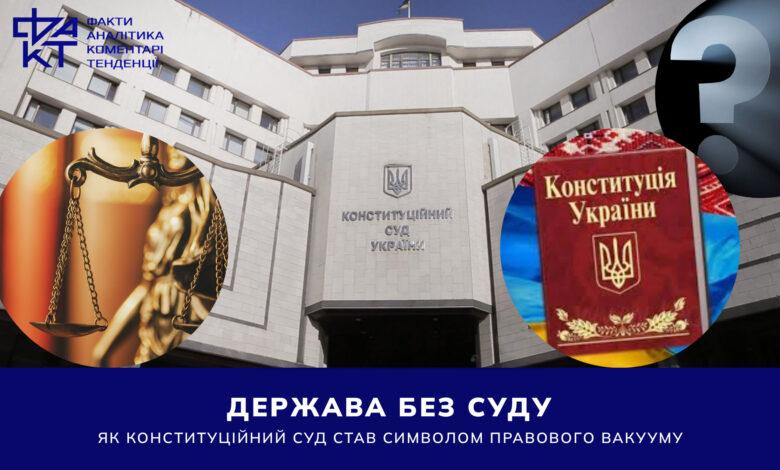
On June 28, Ukraine celebrated Constitution Day – a holiday formally designed to remind society and political elites of fundamental values: democracy, the rule of law, human rights and freedoms. But this year, the celebrations had a bitter aftertaste. In social networks and among the expert community, not joy, but anxiety dominated: “There is a constitution, but who protects it?”
The key guarantor of the constitutional order – the Constitutional Court of Ukraine – for a long time did not have even the basic technical ability to administer justice. The shortage of judges, the absence of a chairman, the inhibition of appointments – all this turned the KSU into an almost decorative institution. And on Constitution Day, the question “When will the Constitutional Court start working in the country?” became almost rhetorical.
Chronicle of decline: quorum “on the edge”
For more than half a year, the KSU was without authority. The reason is banal and at the same time shocking: 11 judges remained in the composition, against the minimum required 12. Under such conditions, the Grand Chamber of the Court – a collegial body that decides cases based on the submissions of the president, people’s deputies, the ombudsman, etc. – could not make a single decision. Similarly, one of the Senates – a structural unit of the KSU that considers individual complaints of citizens – “fell out”.
This state of paralysis lasted until June 27, when President Volodymyr Zelenskyy appointed a new judge – Oleksandr Vodyannikov. The appointment was made following a competitive procedure recommended by the Venice Commission, with the participation of international experts, and became only the third example of the application of the new approach.
On the one hand, this is a reason for cautious optimism: there is finally a quorum. But on the other hand, the situation remains shaky. Six judges are currently not appointed (two – by the president’s quota, three – by the parliament, one – by the congress of judges). In addition, in the near future, several current judges will lose their mandate due to the end of their nine-year terms, which will once again put the court at risk of gridlock.
No head, no explanations, no answers
The Constitutional Court has been functioning for the fifth year (!) without a permanent chairman – since 2020, its duties have been performed by various judges. And this is not just a formality. The absence of the chairman makes it impossible, for example, to elect his deputy, which means full management and coordination of the institution’s work.
At a time when the country lives in conditions of war, the Constitutional Court is entrusted with solving fundamental issues. In particular:
– whether the new law or presidential decree complies with the Basic Law;
– is it admissible to submit a certain question to an all-Ukrainian referendum;
– whether the procedure of impeachment of the president has been followed;
– whether constitutional international treaties ratified or proposed for ratification;
– what is the official interpretation of this or that provision of the Constitution.
As of June 2025, the Constitutional Court cannot resolve any of these issues. And not only for technical reasons. Even before the loss of the quorum, the KSU was characterized by extremely low efficiency: important submissions have not been considered for years, including the interpretation of the provision on unified citizenship, assessment of decentralization reform, changes to land legislation, etc.
President at PACE: the constitution is out of date?
In June, President Zelensky spoke at PACE, where he answered questions from European parliamentarians. After an emotional speech, in particular about the war and the unity of the West, one of the deputies drew attention to… the lack of a quorum in the Constitutional Court of Ukraine. “How are you going to protect the rights of every Ukrainian?” she asked.
The president responded in his characteristic manner: first he emphasized the price that Ukraine pays for freedom, spoke about the need to maintain European unity, and then added: “I understand that you are worried about the Ukrainian Constitutional Court? Don’t worry, we will somehow solve this problem.”
And indeed, in a few days the appointment was made, which formally unblocked the work of the KSU. However, the question remained: why is the decision made only after external pressure or on the occasion of high-profile dates? And how long and permanent will this unlocking be?
A government that is in no hurry
Formally, candidates for the post of judge of the KSU have already been selected and recommended, including with the participation of international experts. But neither the president nor the parliament is in a hurry with the appointment. And this is not an accident, but a political calculation. After all, the Constitutional Court is not just an arbiter, but a potential restrainer of the ambitions of any government. An uncontrolled branch of government is probably more comfortable that way.
What’s more, the public speakers of the ruling team repeatedly expressed themselves in the spirit: “Well, what if there is no court? So far, the war is not critical.” There were even opinions that the law on the legal regime of martial law is more important than the Constitution. The odious People’s Deputy Maryana Bezugla spoke most harshly on this matter, calling the Ukrainian Constitution a cage and a prison that should be gotten rid of as soon as possible.
“Single” or “multiple”? And the Constitutional Court is silent
The problem with the Constitutional Court is not only about the “personnel gap” and loss of quorum. It is also about the consequences of his systemic inaction regarding the key demands of society. One of the most revealing examples is the issue of multiple citizenship.
After the president signed the law legalizing multiple citizenship (in a limited form, with an emphasis on the diaspora), the authorities hastened to declare “victory”. Indeed, Ukrainians abroad, who lived in a legal vacuum for decades, now have the opportunity to formalize their connection with the Motherland.
But inside the country there is a completely different background: confusion, mistrust, and in many people, indignation. The law actually recognizes the existence of multiple citizenships, without changing Article 4 of the Constitution, which unequivocally states: “There is a single citizenship in Ukraine.”
This provision has long caused controversy among lawyers, diplomats and politicians. Different state institutions interpret it differently. And where is the referee? The Constitutional Court, which since December 2021 has under consideration the corresponding parliamentary submission on the official interpretation of this article, is simply silent.
Emptiness that breeds legal schizophrenia
As a result, Ukraine finds itself in a situation of legal cognitive dissonance:
The principle of single citizenship is formally in force.
A law has been legally adopted that opens the door to multiple citizenship.
Rhetorically – officials talk about “exceptions”, “not for everyone”, “within the framework of diplomacy”.
In fact, there is no agreed interpretation.
This gives rise to inequality in law enforcement (for some, dual citizenship is loyalty, for someone it is a reason for depriving the status) and risks of discrimination – depending on origin, territory of residence or political situation.
And all this is only because the body, the only one authorized to give a binding official interpretation of the Constitution, is inactive.
Political consequences of judicial silence
The price of such inaction is not abstract. In the political dimension, it is:
- New lines of division in society – between “internal” and “external” Ukrainians, between frontline communities and “passport patriots”;
- The threat of discrediting Ukrainian law at the international level, because the question: “What kind of citizenship do you have – single or multiple?” officials do not have a clear answer;
- Weakening of state legitimacy, when the basic norms of the Basic Law cease to be a guide, but become an optional set of phrases.
While the authorities promise reforms, a European future and legal certainty, the highest institution of constitutional control either does not work or is in no hurry to work. And without her voice, any new law is not a guarantee of justice, but a potential source of chaos. And then the answer to the question “What is the citizenship in Ukraine?” does not sound like a legal fact, but like an ironic aphorism: “The plural – but the one, no one canceled either.”
The inaction of the Constitutional Court is not a technical defect, but a deep systemic crisis that calls into question the state’s ability to be governed by its own Constitution.
Not the only court
It is worth pointing out one more dissonance: in 2025, more than 332 million hryvnias are planned for the financing of the Constitutional Court. At the same time, the institution, which does not consider cases, does not interpret laws and does not have a head, exists only as a symbol, and not as a real tool for monitoring compliance with the Basic Law.
Symbolic violations are added to this. For example, the president’s greeting on Constitution Day was accompanied by the slogan “Ukraine above all”, which caused criticism from lawyers. After all, the Constitution indicates: “A person, his life and health, honor and dignity, inviolability and security are recognized as the highest social value in Ukraine” (Article 3).
It works when it is followed and respected
The Constitutional Court not only ceased to be an arbiter, it became a victim of political indifference. The silence of the court against the background of serious social transformations is a dangerous lacuna in the system of checks and balances. And the government, which ignores its own Constitution, will sooner or later itself become a hostage of legal anarchy.
If we really respect the Constitution, respect should start not with greetings, but with actions. And first of all, to restore the full-fledged, independent, efficient work of the Constitutional Court. Because if it does not work, no one protects the main law of the country. And, accordingly, nothing protects our rights.


