Underground — but with education: how Zaporizhzhia prepares underground schools for children during the war

In times of war, learning becomes not just a problem, but a form of survival. For thousands of Ukrainian children, the school desk has long ceased to be associated with children’s noise and interruptions in the corridors. Instead, there are sirens, shelters, unstable internet and lessons in the mode of “make time before the shelling”. With Russia regularly attacking civilian infrastructure, even being in school can cost lives. Therefore, the issue of safe access to education has become one of the most acute in frontline regions, such as the Zaporizhia region. It is here, in the region that is constantly subjected to rocket and drone attacks, that the regional authorities have taken a course on a radically new format of school infrastructure — the construction of underground educational institutions. We are not talking about temporary shelters or classrooms in the basement. These are full-fledged schools, specially designed as safe, autonomous spaces for learning.
Six underground schools are already working, ten will open by autumn
As reported head of the Zaporizhia Regional Military Administration, Ivan Fedorov, six underground schools are already operating in the region. They accept children who have studied remotely for years or in conditions of constant anxiety. Five more such facilities are under construction. And by September 1, 2025, it is planned to open another ten new underground schools, designed for a total of 10,000 students.
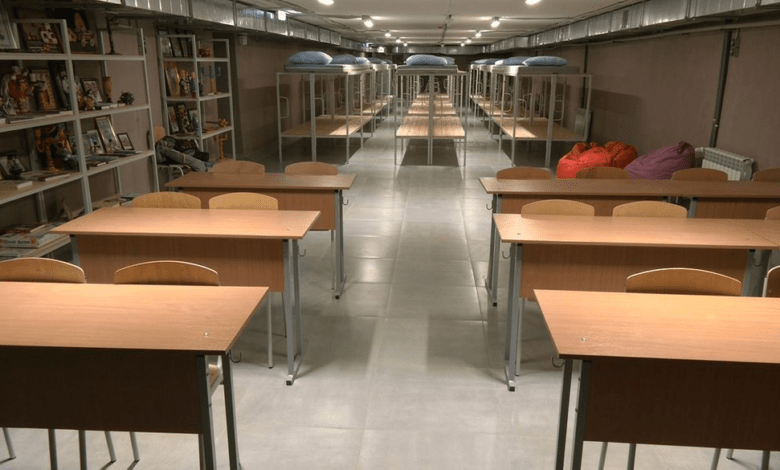
According to Fedorov, it is not just about building shelters with boards, but about creating full-fledged schools with offices, laboratories, canteens and space for development. In such conditions, children will be able to prepare for the national multi-subject test (NMT), work with teachers offline and not be afraid that the next siren will interrupt the lesson in the middle of a word.
“These schools are an investment so that children don’t live in constant fear. So that they don’t lose a chance for a future just because they live in a region closer to the front line.” – emphasized the head of OVA.
Learning conditions: autonomy, shelter and modernity
Underground schools are designed not as a temporary solution, but as an infrastructure with long-term potential. They are built according to all safety standards: taking into account blast wave protection, ventilation systems, bathrooms, autonomous power supply. Classrooms for classes, places for rest, medical centers, even rooms for group work are provided.
The educational process in such schools is no different from the usual one: children have the opportunity to attend classes according to the schedule, pass knowledge tests, and communicate with teachers. But the main difference is the continuity of training even in the case of shelling, which is critically important in the conditions of the Zaporizhzhia region.
According to the Ministry of Reintegration, more than 25% of children in Ukraine are unable to attend school due to military operations. Most of such students either study remotely or drop out of the system altogether. In the frontline regions, this share is even higher. That is why underground schools are not only about safety, they are about returning to normality in abnormal conditions.
The construction project of such institutions is financed from the state budget. According to Fedorov, the construction of 11 schools has been financed at the moment. Another 12 are at the approval stage. In general, by September 2025, it is planned to build 139 underground schools throughout Ukraine.
This scale suggests that the state considers safe education not as a secondary field, but as part of a sustainability strategy. Because a country that thinks about schools even underground is definitely not capitulating.