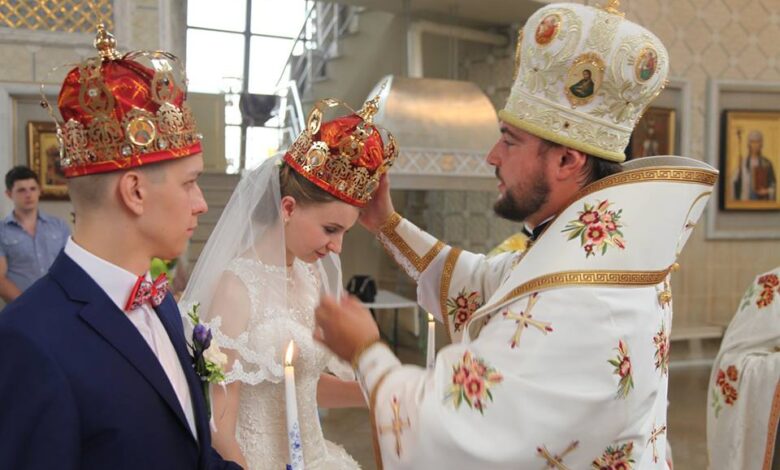
The discussion of the new Civil Code of Ukraine touched not only property and family relations, but also the procedure for concluding a marriage. Among the ideas that are being heard during discussions in society, the possibility of official registration of marriage through a religious community has emerged. This approach would provide that a couple could undergo a wedding ceremony in a church, and the marriage would at the same time receive legal force without a separate application to the state registration authorities.
The idea is that a clergyman who conducts a religious ceremony could simultaneously register the marriage on behalf of the state. After such a marriage, information about the spouses would be entered into the Register of Civil Status Acts, as after the usual procedure in the State Civil Registry Office. Such a mechanism would not mean the abolition of state registration of marriage. This is an additional method in which the state would grant appropriate powers to individual clergymen, and the religious ceremony would be combined with the legal registration of marriage.
The head of the State Service for Ethnopolitics and Freedom of Conscience, Viktor Yelensky, stated that if such a proposal were made, his department could support it. According to him, the model under which a priest has state powers to register a marriage has long been working in many countries.
At the same time, Yelensky doubts that such an initiative would become widely popular. He recalled that in recent years, Ukraine has already simplified the procedures for concluding a marriage, so for many couples the current procedure is fast and convenient. At the same time, the official admitted that a religious form of registration could be appropriate in some cases, in particular in communities where the church remains an important center of support for people.
“In principle, it is possible. People come to a church where a certain person is authorized by the state to perform such a function. That is, in addition to the sacred sanction, this person must receive the appropriate powers from the state. In many countries, this is exactly the case. But I am not sure that such an initiative is the most popular, because over the past 10 years, much has been done to make marriages faster and easier than before. At the same time, obviously, there are cases when such a form may also be appropriate.
In this context, it should be borne in mind that today there are settlements, especially in front-line areas, where the church is, if not the only, then the main institution that supports the life of the community,” – believes Viktor Yelensky.
The proposal regarding the possibility of registering marriage by clergy was previously voiced by representatives of the All-Ukrainian Council of Churches and Religious Organizations. During the discussion of the norms of the draft new Civil Code, they also supported the provision according to which marriage is defined as the union of a woman and a man.
Religious organizations have proposed combining the wedding with state registration so that the couple does not have to separately apply to the DRACS after the church ceremony. To implement such a model, clear rules are needed: who exactly can receive authorization, how data will be transferred to the registry, who will be responsible for checking documents, and how the state will monitor the legality of the procedure.
“Actually, one could ask the Constitutional Court how it understands the principle of separation of state and Church. It is clear that in the 21st century this principle means something different than in the 13th or 15th centuries. Once upon a time, religion was everything to everyone. Over the centuries, art, politics, science, medicine, etc. were separated from it. Religious institutions also changed accordingly.
Nowadays, they do not dictate to the prince when to go on a campaign, do not claim to have recipes for monetary policy or restructuring the state debt. They focus on their deeply inherent mission – to separate good from evil, to lead a person to salvation, to elevate his morality, to help him overcome earthly vanity. And this requires a rethinking of the principle of separation.
Once upon a time, this principle was supposed to prevent the Church from interfering in the internal affairs of the state, namely in France at the beginning of the 20th century. This line, ultimately, led to the antagonistic separation of Church and State, namely, for example, in the USSR or in a distilled form in Albania during the time of Enver Hoxha. Even now, some understand the separation of Church and State as a state in which these two institutions have nothing in common, but such a state does not exist in modern democracies. Even in the USA, where the so-called “Great Wall of Separation” has been built, – emphasized the Head of the State Service for Ethnopolitics and Freedom of Conscience.
The draft of the new Civil Code of Ukraine has already been supported in the first reading. The document is to update a significant part of private law, including norms on family, property and civil relations. Particular attention was drawn to the provisions related to marriage, divorce, alimony and property disputes between spouses. One of the most discussed norms was the possibility of marriage from the age of 14 by court decision, but this provision has already been excluded from the draft.
At the moment, religious registration of marriage has not been introduced in Ukraine. The idea is being discussed as a possible additional form, but the corresponding legislative amendments have not yet been adopted.
If such a norm is nevertheless included in the updated legislation, the wedding will be able to gain legal force only under the condition of state control and entry of data into the official register. Without this, the church rite will continue to have religious significance, but will not replace the state registration of marriage.