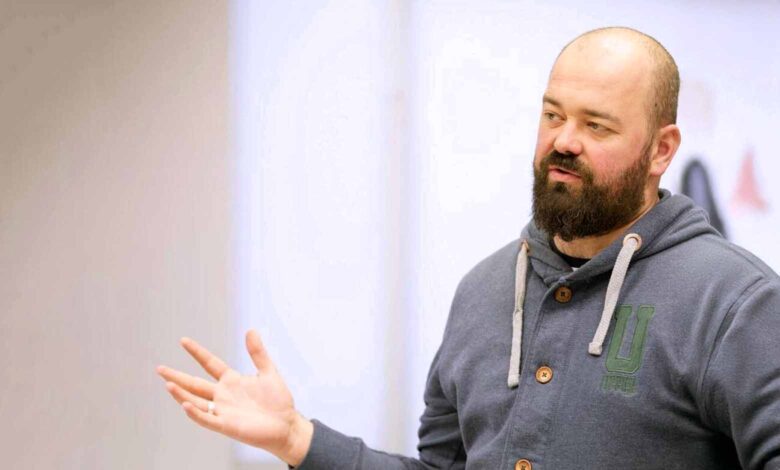
The issue of disunity in Ukrainian society has always remained acute, but the full-scale war made it particularly noticeable. What previously appeared to be latent differences have manifested in 2022-2025 as structural social fissures that affect the country’s ability to mobilize and maintain unity in a protracted conflict. Volunteer, musician and public figure Denys Bloshchynsky not only states the existence of these faults, but also tries to carefully study their nature. In his reflections, he singles out twelve types of social divisions, which, in his opinion, form the modern map of internal tension in Ukraine.
Denys Bloshchynskyi emphasizes, that Ukrainian society has never been monolithic, and this is not a tragedy, but a fact that should be consciously dealt with. Every break, he notes, carries risk, but also potential for future growth. With honest diagnosis and strategic intervention, the fault can become a point of strengthening, not destruction.
- Geographic fault (tectonic)
Bloshchynskyi believes that the first big gap in Ukrainian society has historical roots and is connected with differences in experience, formed under the influence of different imperial traditions – Austria-Hungary and Russia. He reminds that the opposition between the East and the West of Ukraine has been one of the favorite tools of political manipulation for many years. However, the full-scale war shifted these “tectonic plates”: it was the East and the South that became the epicenter of resistance, and millions of displaced people from the frontline regions became part of the life of Western Ukrainian towns and villages. This led to a rethinking of established ideas.
- Language gap (open wound)
Bloshchynsky sees a second vulnerable point in the language issue. He notes that, despite the growing support for the Ukrainian language, there are still tensions that arise at the everyday level: in transport, shops, and educational institutions. For many Ukrainian-speakers, this is a question of identity, and for some Russian-speakers, it is a painful demand to change their usual way of life. Ukrainization after 2022 has gained new strength, but it is already facing a counter wave of fatigue, irritation or silent resistance.
- Religious schism (struggle for faith)
Bloshchynsky calls the religious sphere the third source of division. The conflict shifted from confrontation between confessions in general to tension within Orthodoxy. The struggle is now raging between those who support the Orthodox Church of Ukraine and those who remain loyal to the Moscow Patriarchate. He draws attention to the fact that real interfaith unity is most often manifested not in peaceful conditions, but at the front – in the trenches, where priests of different faiths serve the same soldiers, and where disputes lose their meaning.
- Between military and civilians (two realities)
Bloshchynsky singles out a separate dividing line between those who have experience of war and those who live in peaceful cities. This chasm is only beginning to form, but it is already generating silent, internal conflicts. He calls the moment when the question arises in people’s minds – “why not me?” especially painful. or “why me?”. This issue can cause long-term moral tension in society.
- Bureaucracy vs. experience (veterans and the system)
The fifth rift, according to Bloshchynskyi, is the conflict between veterans and state structures. The Ukrainian bureaucratic system is not ready to work with military personnel returning from the front. He emphasizes that officials think in different categories than those who are used to quick decisions and specific actions in a combat zone. For many veterans, it is contact with the state that becomes a source of new trauma, as it is accompanied by indifference, procrastination, or a formal approach.
- Economic gap (gap of opportunities)
The sixth point he calls economic inequality, which has been going on since the 1990s. Bloshchynsky notes that the formation of the oligarchic system and the environment that serves it has created a permanent division in the country between those who have access to resources and those who are forced to fight for basic opportunities. The war only deepened this inequality – through shadowy mobilization schemes, unequal access to health services and demonstrative consumption by a part of the elites.
- Local and immigrants (own among strangers)
Bloshchynsky believes that another source of social tension is the relationship between internally displaced persons and local communities. More than 3.7 million Ukrainians have become forced migrants, competing for the same resources: housing, jobs, educational services. Even with humanitarian support, psychologically displaced people often do not feel part of the host community.
- Generational conflict (conflict of experiences)
Bloshchynsky reminds that the gap between generations is not a new phenomenon, but the war gave it a new sound. Restrictions on leaving for men, especially young men, only exacerbated the tension. He explains that alienation is formed between generations not only because of different values, but also because of different visions of the war itself, its meaning and the limits of what is acceptable.
- Center and periphery (urban divide)
In the ninth point, Bloshchynsky talks about the imbalance between big cities and rural areas. He points out that the war has greatly exacerbated these differences: cities are overflowing with displaced people, villages have been emptied by mobilization, and the quality of services, especially medicine and education, is radically different. These gaps prevent the formation of a common political and cultural agenda.
- Passionists and paternalists (mental breakdown)
Bloshchynsky also highlights the gap between active citizens and those who hope for external solutions to problems. The war made this division more obvious: some volunteer, serve, create initiatives, others maintain the position of an outside observer, expecting someone to take care of them. This conflict, in his opinion, has a deep psychological nature.
- Internal division between those who left and those who stayed (survivor’s guilt)
One of the deepest and most complex rifts, according to Bloshchynskyi, is the tension between those who went abroad and those who stayed. He emphasizes that the basis of this division is not a political or social difference, but an existential experience. Survivors begin to feel guilty or pressured by survivors. This forms a deep psychological barrier.
- Psychological limit (various wars)
Bloshchynsky calls the last gap the difference between those who were directly traumatized by the war and those who try to live “as before.” He notes that trauma, particularly PTSD, can affect up to 30% of military and IDPs, and that trauma becomes a societal problem rather than a private one. People live next to each other, but in different realities.
In conclusion, Bloshchynsky emphasizes that all the faults in question are not permanent or fatal. They are dynamic. War, he notes, acts as an amplifier: it deepens old cracks and also creates new ones. But at the same time, it can have a positive effect on some of them. According to Bloshchynskyi, in the demographic sense, war is a catastrophe. In the social aspect, it is a chance.
He reminds that in each of the listed fractures, despite the pain, despair and destruction, there is also hidden a colossal potential for growth. According to him, the bone growing after a fracture becomes much stronger at the point of fusion. But this is possible only if the fracture itself was correctly diagnosed and treated professionally. If surgery is necessary instead, it should be performed so that the person is not left with a disability.
He is convinced that each of these divisions can and should develop its own programs and strategies. However, he emphasizes, these strategies should not be born spontaneously. They must be the result of deep, honest work on overcoming ideas, on understanding not only the causes, but also the causes of the causes—what gave rise to these rifts. It should be a conscious, purposeful work: with analysis, reflection, careful attitude to the consequences and attempts to influence them.
Bloshchynsky concludes that this is exactly the choice Ukrainian society is currently facing. We can become stronger by healing our brokenness. Or turn into a chronically injured system that has lost vital functions for a long time. Everything depends on our attention, our will and our work. After all, it is not just future development that is at stake. At stake is the ability not to lose humanity.