Zelenskyy said that manufacturers of interceptor drones were built behind the back of the state: how do parliamentarians assess this situation?

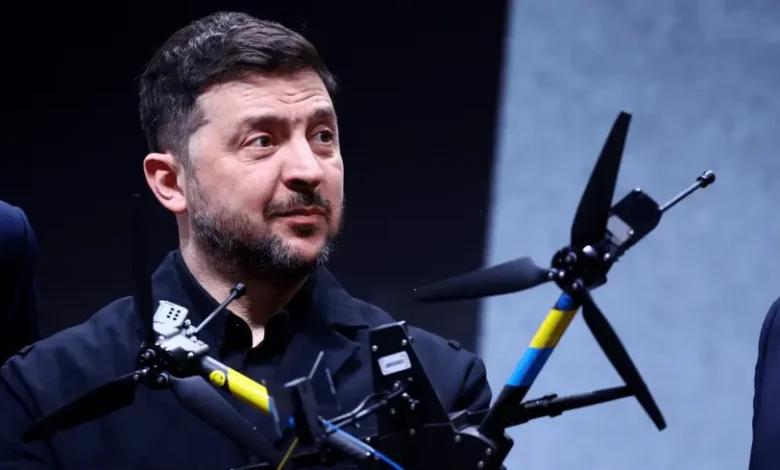
The production of drone interceptors has long gone beyond a purely technological topic, since in this area the country’s defense needs, state control, export restrictions and commercial interests of manufacturers intersect. Because of this, any public conversation about selling such developments abroad or transferring production to other jurisdictions immediately opens up a wider conflict of views: the authorities insist on security logic, part of the market talks about the loss of opportunities, and deputies have different assessments of where the line is drawn between protecting state interests and excessive regulation.
What Volodymyr Zelenskyy said
President of Ukraine Volodymyr Zelenskyy during a video conference with journalists reported that he was aware of a dozen factories for the production of interceptors that were being built in different parts of the world behind the back of the state.
“I know somewhere, I’ll tell you honestly, about 10 factories that were built behind the back of the state in different parts of the world just so that, God forbid, they wouldn’t lose anything. I think they will lose,” the president noted.
Separately, Zelensky gave an example of selling a batch of interceptors to another country. According to him, one company supplied a thousand such drones for $3.5 million, although, according to the president, Ukraine could have transferred such products to a partner without a commercial scheme.
“Dollars, so that it would be clear which country and where these interceptors ended up. That’s no problem. We could have just given these interceptors to this partner,” he emphasized.
In the president’s assessment, the problem goes far beyond a single deal, since companies that complain about the loss of export opportunities, in his opinion, are undermining Ukrainian exports with their own actions.
Zelensky also said that the country that purchased the interceptors later turned to Ukraine due to the lack of combat units in the delivered drones. He described a similar story after a visit to one of the European countries, which also received some of the interceptors without explosive components and asked to send operators, but Ukraine refused such assistance.
“I was also in another European country. I was here recently on an official visit. They were also sold some of the interceptors. Again without explosives. And they ask me, can we send more operators? I say no,” Zelensky emphasized.
The president placed additional emphasis on the ratio of private sales and government orders. According to him, the company that sold drones for $3.5 million at the same time received a government contract for 300 million euros, and he called such a situation “rather frivolous.”
How Serhiy Rakhmanin explains the situation
People’s Deputy Serhiy Rakhmanin proposed a different framework for assessing the situation, shifting attention from claims of a complete ban to the actual regime of restrictions. According to him, there is no total ban, but a “limited regime” with permits through the commission and licenses from the State Export Control Service is in force.
In this position, not only the list of bureaucratic procedures is important, but also doubts about their effectiveness, since, according to the deputy, the MKVTS has just resumed work, and the effectiveness of this mechanism remains an open question.
The key idea in Rakhmanin’s approach seems to be that the manufacturer is looking for a way out where the system allows it to move faster and more clearly. To explain this logic, he gives an example of the production of 20 thousand drones, of which the state buys 15 thousand, while there is foreign demand for the rest. Under such a model, as the deputy explains, the company gets the resource for scaling and the ability to ship more products to the Armed Forces of Ukraine, but in conditions where even such a mechanism does not work, the business begins to transfer decisions to other countries.
What Yaroslav Zheleznyak criticizes
People’s Deputy Yaroslav Zheleznyak assesses the situation even more harshly and links the relocation of production abroad with excessive regulation of the industry. In his interpretation, the reason lies not in individual exceptions or point failures, but in the management model, in which the state tries to keep too many processes under personal control.
“One of the huge, I would say catastrophic bugs of the system was that as soon as we have something technological and progressive (and there are many such examples) – it immediately moves to another jurisdiction. Where:
▪️it is easy for any SBU officer to come to you and ask for a dolyakh;
▪️where tax rules do not change every year
▪️where you can defend your rights in a judge
▪️where you can properly structure your business and attract financing.
At least where there is a stock market. And here is the story with drones, which were first needed somewhere other than Ukraine, all this demonstrated. You could have created 100,500 more different “….City”, but if you promise to open arms exports for two years…. And then you abruptly stop it and want, like Trump or Muhammad ibn Salman, to sit and geopolitically decide where and who will supply where… then you need to be the president of the USA first… or better yet, the hereditary prince of an Arab state))) Or at least have someone nearby who thinks not how to light a cigarette on this, but whether it is technically possible at all.
I am convinced that just like the masked show with IT specialists once, this situation has clearly given a signal to all our small tech companies how it will be in reality. Not on beautiful slides, but in reality.
But the problem is even deeper. Over the past 7 years, there has been absolutely no incentive to leave business in Ukraine, if there is an opportunity to transfer it to another jurisdiction. At least, so that later the director of “Servants of the People” and other Kulebayevs do not suddenly appear in your ownership structure.
And therefore, even where we obviously have a super advantage and a unique opportunity to take the lead (and yet there is something here proud of), then we lose due to the inefficiency of the system and the desire to steer on a par with Arab monarchs, leads to exactly the opposite result…. Where we lose opportunities now, and for many years to come”, – believes Zheleznyak.
In this position, the main conclusion is that excessive control, instead of keeping technologies within the country, pushes manufacturers to transfer competencies, teams and production sites outside Ukraine. Zheleznyak sees this process as the loss of one of the few advantages that the country gained in war conditions thanks to the rapid development of defense technologies.
The situation around interceptor drones shows how sharply two logics — security and market — collide in Ukraine, each of which is based on its own set of arguments and its own vision of risks. On the one hand, the president talks about responsibility to the state, questionable sales, and lost control over the process; on the other, deputies point to overregulation, slow permits, and an environment in which businesses move production to places where the rules are clearer.