Beijing’s shield for Belarus: what’s behind Lukashenko’s visit to China and what to expect from Ukraine

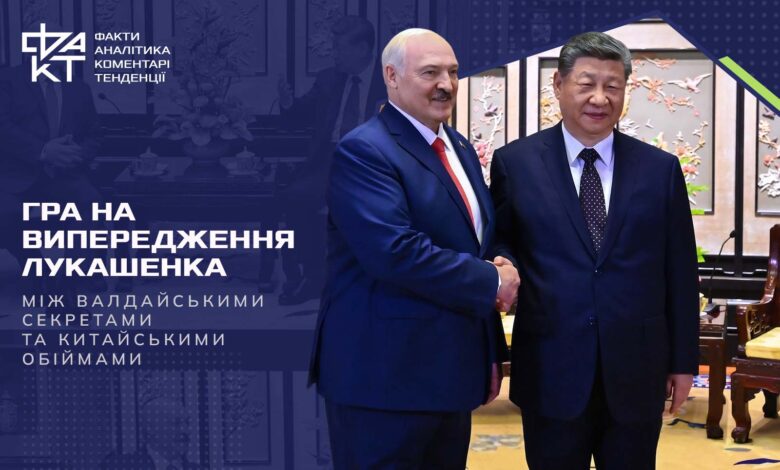
Alexander Lukashenko’s sudden and unannounced visit to China, immediately after protracted closed negotiations with Putin in Valdai, brought the hidden security contradictions of Eastern Europe to the plane of global diplomacy. The holding of this meeting indicates the urgent need for the Belarusian leadership to fix its own position on the international arena. Having found itself under cross-pressure from the Kremlin and security ultimatums from the Ukrainian president, the Belarusian side is forced to reformat its external contacts in order to preserve political autonomy. Xi Jinping’s official statements about the “historic peak” of relations indicate Belarus’ desire to use China as a geopolitical shield capable of deterring Russia from opening a second front from the north and to obtain public guarantees from Beijing of the inviolability of sovereignty.
Lukashenko’s surprise visit to China: what preceded it and how it went
Secret diplomatic trips usually indicate a critical lack of stability, so Alexander Lukashenko’s surprise visit to China was a vivid confirmation of this rule. The Belarusian leader landed in Beijing on June 29, without burdening his own press service with preliminary announcements. The meeting with Chinese President Xi Jinping had the appearance of an emergency evacuation from the information field of Eastern Europe, where a ring of security challenges is rapidly tightening around Minsk.
The Chinese leader greeted the guest with compliments that relations between the states are now at their historic peak. Lukashenko hastened to note in response that they had previously only talked about and even dreamed of such a level of global cooperation. At the same time, Beijing once again declared its readiness to support Belarusian sovereignty and territorial integrity, calling for the continuous development of strategic communication. However, behind this diplomatic etiquette lie much more prosaic motives.
It should be noted that the leaders of Belarus and China traditionally exchanged gifts during protocol events and called each other “iron friends”. The practical part of the meeting was entirely devoted to economic and technological cooperation within the framework of the announced Years of Industrial Cooperation between Belarus and China. During the conversation, Lukashenko officially stated that Belarus uses Chinese technologies “in all directions” and is completely satisfied with their quality and supply.
The parties signed packages of documents on expanding investments and attracting new residents to the Sino-Belarusian industrial park “Big Stone”, and also agreed to increase the scale of joint industrial assembly. In addition, Lukashenko noted that he constantly informs Xi Jinping about the security situation in the Eastern European region, and the leaders recorded an agreement to continue these regular contacts in the future.
This Asian flight was preceded by a long closed marathon at the Valdai residence, where Lukashenko talked with Putin for five hours. The Russian side assures that the topic of Belarus’ involvement in hostilities against Ukraine was allegedly not raised at all, and all the leaders’ attention was focused on a purely economic agenda. Putin even allowed himself to be ironic about Ukrainian warnings to his Belarusian colleague, noting that such sharp statements do not cause panic in Lukashenko due to his exceptional calm and poise. However, the lack of official comments on the results of the long Valdai meeting and Lukashenko’s sudden departure to China indicate that the conversation was far from as cloudless as the Kremlin’s political strategists are trying to portray it.
Kyiv has recently switched to the language of specific ultimatums, which has seriously disturbed the usual coziness in Minsk. On June 19, the President of Ukraine publicly gave Belarus exactly one week to dismantle special repeaters used to guide Russian drones. Volodymyr Zelenskyy then clearly warned that if this requirement was ignored, the facilities would be liquidated by Ukrainian forces. Already on June 24, he stated that the operation of this equipment had been stopped, although he noted that there was still no one hundred percent confirmation of the dismantling of the equipment.
The next day, relying on fresh data from the Foreign Intelligence Service, the President of Ukraine announced the completion of the construction of Belarusian road infrastructure, as well as fuel and ammunition depots directly near the border. At the same time, Kyiv sent a clear signal that the development of a bridgehead for potential aggression must be immediately stopped if Minsk truly seeks peace.
Trying to offset reputational losses, pro-government Belarusian media resources launched a large-scale information counterattack through the publication of foreign reviews. These materials contain very specific theses designed to justify Minsk’s position to the domestic and foreign audience. Moreover, they try to present the situation in such a way that Zelensky himself is allegedly dragging Belarus into confrontation with his threats, while Moscow is only observing the process.
Between the Kremlin and Beijing: How Lukashenko Seeks Protection from Xi Jinping and What to Expect from Ukraine
Behind the scenes of official protocol smiles and loud statements about a historic peak in relations, there are always tough pragmatic calculations that the parties prefer not to advertise to the general public. The main catalyst for Alexander Lukashenko’s surprise visit was the urgent need to find a reliable shield from the increasingly strong pressure from the Russian Federation.
The Belarusian president is well aware of his own vulnerability to the Kremlin’s plans, which are considering scenarios of the country’s final takeover or the replacement of its leader with a fully controlled figure. Having received public assurances from Xi Jinping in support of independence, Lukashenko has effectively acquired a kind of security letter from Beijing for personal rule. Now any attempts by Moscow to stage a coup or put too much pressure on the Belarusian leader automatically turn into a serious diplomatic risk for Russia itself, which will have to spoil relations with its main global partner.
An equally important factor for the Belarusian side is the protection of the last land corridor to the European Union, since the country remains a strategic transit hub for the Chinese megaproject “One Belt, One Road”. Constant threats from Warsaw, Vilnius and Riga to completely block the borders due to constant hybrid attacks by artificial migrants and the deployment of tactical nuclear weapons cause serious irritation in Beijing.
Lukashenko arrived personally to guarantee the Chinese leadership that he is able to maintain control over the borders of the North Atlantic Alliance and ensure the stability of logistics, despite the regular attempts of the Russian Federation to provoke another escalation. At the same time, this visit became a powerful domestic political signal for the Belarusian nomenclature and generals. Difficult two-day talks in Valdai without a single joint photo gave rise to rumors among local elites about the boss’s capitulation to Putin, so the impromptu three-hour meeting with the leader of the world’s second-largest economy was supposed to demonstrate to his entourage that Lukashenko retains subjectivity and has alternative support.
A separate important aspect of the negotiations was the issue of Belarus’ military vulnerability after the decisive actions of the Ukrainian leadership. When the Ukrainian president made a tough demand to turn off the equipment for guiding drones, Belarus acutely felt the lack of modern defense technologies, since Russia is unable to provide additional air defense systems due to their shortage on its own front.
In Beijing, Lukashenko tried to beg for advanced electronic warfare systems and new components for the Polonaise multiple launch rocket systems, seeking to close the sky without the direct involvement of the Russian military. For its part, the Kremlin demonstrates public composure, but behind closed doors Moscow’s reaction fluctuates between hidden irritation and forced acceptance of the Chinese rules of the game. The Russian leadership is forced to swallow this demarche, because it is now totally dependent on Beijing in economic and technological terms.
For the course of the war in Ukraine, this visit has dual and rather contradictory consequences that affect the situation in the region. On the one hand, China’s diplomatic intervention performs an obvious deterrent function, significantly reducing the risk of a second offensive from the north. At the same time, Xi Jinping’s clear statement in favor of the inviolability of the Belarusian borders frees Lukashenko’s hands to once again refuse Putin to send Belarusian regular troops to the combat zone.
The Chinese side absolutely does not need the destabilization of an important transport hub for it, so Beijing outlined clear “red lines” for the Kremlin, demonstrating the inadmissibility of opening new active fronts in Eastern Europe. In essence, the Minsk leader was able to successfully use China’s authority to evade the most dangerous whims of Russian generals.
On the other hand, there are serious hidden threats for Ukraine associated with the expansion of industrial cooperation between Minsk and Beijing. As China fears severe secondary sanctions from the United States and the European Union for direct military assistance to Moscow, Belarus is beginning to actively play the role of a gray logistical “gasket”. Under the guise of contracts for the modernization of civilian enterprises and the development of a joint industrial park, the PRC is able to legally supply Minsk with dual-use goods, microcircuits, and high-tech equipment.
Subsequently, these critically important components are freely redirected to Russian factories through the mechanisms of the Union State to saturate the aggressor’s military-industrial complex. Thus, by purchasing its own security and protection from direct entry into the war, Belarus pays off the Russian Federation by transforming its industry into a closed hub for circumventing international sanctions restrictions.
It should be noted that Alexander Lukashenko’s public rhetoric has once again diverged from his real backstage steps. In front of the cameras, he traditionally mocked Zelensky and demonstrated confidence, declaring during a meeting in Gomel that Belarus is capable of repelling any attack, and that threats from Kyiv are useless. However, behind the scenes of these statements, Belarus has curtailed the work of Russian drone repeaters, just a week after Zelensky’s ultimatum. The Belarusian authorities are clearly aware that Ukraine is not planning a ground offensive, but the decisive factor has become a new format of air warfare. The experience of successful strikes on oil refineries in the Russian Federation has clearly proven that to undermine the Belarusian economy and destroy the Mozyr refinery, the Armed Forces of Ukraine do not need troops on the border – one massive attack of long-range drones is enough.
Thus, Lukashenko’s visit to China has recorded new political processes on the northern border of Ukraine: the land threat from Belarus is receding into the background, giving way to a more complex technological confrontation. At the same time, the balance of power in the Kyiv-Minsk-Moscow triangle has changed, where China has finally taken over the role of the main guarantor of stability in Belarus.
At the same time, for Ukraine, this geopolitical step radically changes the nature of the threat from the north, since an invasion by the Belarusian army becomes unlikely due to the need for the Russian Federation to take into account China’s position. Although land transit to Europe is currently effectively blocked due to sanctions and the tough position of Poland and Lithuania, the PRC seeks to preserve this strategically important logistical potential for the future. Therefore, Xi Jinping is categorically not interested in turning Belarusian territory into a zone of active hostilities, which forces Russia to restrain its military appetites in this direction.
However, it is too early to rejoice in the reduction of land danger. Ukraine faces a much more complex, long-term challenge: Belarus is finally turning into an untouchable technological bridgehead for the Kremlin, shielded from retaliation by China’s authority. The main task of Ukrainian diplomacy and intelligence will now be to counter the hidden supply chains that continue to fill Russian weapons with foreign components through Minsk factories.
Lukashenko’s public appeal to Xi Jinping for confirmation of sovereignty and the inviolability of borders is an attempt to build a strong geopolitical counterweight to Russian dictatorship, where official statements about reaching a historic peak in relations hide Belarus’ pragmatic desire to preserve subjectivity and modernize its defense potential, in particular air defense and electronic warfare systems, with the help of Chinese dual-use technologies.