
Day of Mourning and Commemoration of War Victims: Unlearned Lessons of World War II in a Modern Dimension

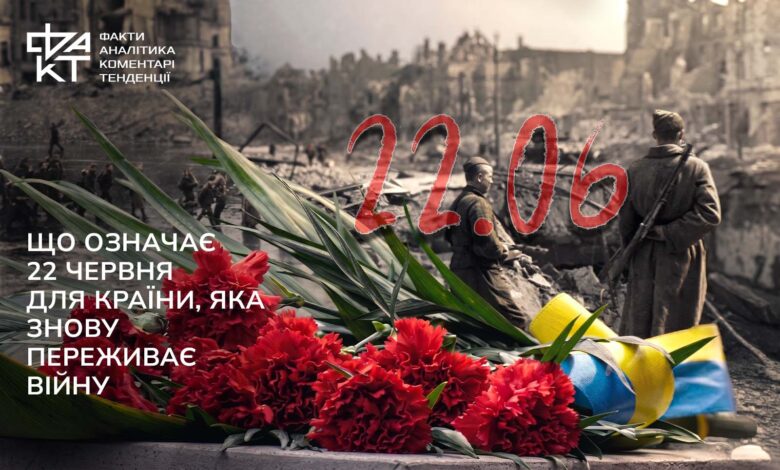
Today, Ukraine marks the Day of Mourning and Commemoration of War Victims — a date that, 85 years after June 22, 1941, still resonates in Ukrainian families. On this day, at 4 a.m., Ukrainians woke up to the sounds of explosions, and from that moment on, the lives of each of them changed forever. Someone went to fight as a volunteer or became a partisan, someone worked in factories for days, someone evacuated, losing their homes, and someone was captured, in concentration camps, or was taken to Germany. The acute problem of today is that the memory of World War II, in which the life of every fifth Ukrainian was cut short, has not saved us from a new tragedy, which also began symbolically at 4 a.m. in 2022. Now, when the great-grandchildren of the victims of Nazism are again dying, maimed, and forced to hide in shelters from Russian missile and drone strikes, it becomes obvious that the unlearned lessons of history are returning, and society is once again paying the same terrible price for the right to live.
Geographical epicenter: Ukraine’s role in World War II
In modern politics, history is increasingly turning into a tool for creating myths, justifying aggression, or returning former territories. At the same time, some countries are trying to appropriate all the glory for the victory over Nazism in 1945. They do this to raise their own authority in the world or to justify their current aggression against other states. This especially applies to Russia. In such public discussions, real facts often give way to political expediency, which is why the real human tragedies and the geographical scale of the participation of entire peoples are lost.
It is worth understanding that no nation in the world can have the exclusive right to the truth in assessing the events of World War II, since this defeat was the result of the planetary resistance of dozens of states and millions of individual efforts. There was no single decision-making center or linear division of nations into “main” and “secondary”. At the same time, for Ukraine, this war had the character of total extermination, since its territory turned into the largest arena of resistance to German Nazism. Tank battles, large-scale encirclements and bloody defensive operations swept through Kharkiv and Kyiv, Odessa and Dnipro, Crimea and Donbas, Lviv, Zhytomyr and Poltava. The lands of Ukraine became a direct battlefield, where people, cities, industry, infrastructure and agriculture were methodically destroyed.
The total demographic losses of humanity in that meat grinder range from 50 to 85 million people, and in this terrible list, Ukraine’s share is from 8 to 10 million human lives. Every fifth Ukrainian died in this war, and these tragic figures consist not only of those killed on the military fronts, but also of millions of civilians. People died during air raids, became victims of punitive actions, died of hunger or died in forced labor in the Third Reich. The scale of this tragedy lies in the fact that there is not a single region left in Ukraine that would not have been affected by this bloody confrontation.
The contribution of Ukrainians to the defeat of Nazism is truly global, because they fought on the most diverse fronts and in completely different uniforms, united by a common goal. The largest and most tragic number of our compatriots ended up in the ranks of the Red Army. More than 6 million Ukrainians passed through this crucible, bearing the brunt of the fighting on the Eastern Front.
At the same time, hundreds of thousands of other Ukrainians, scattered by history and emigration around the world, took up arms as part of the regular armies of the Western Allies. The presence of Ukrainians in the Polish Army, where about 112 thousand of our ethnic compatriots courageously fought against the Nazi invasion, was extremely significant.
On the other side of the ocean, as part of the US Armed Forces, 80 thousand soldiers of Ukrainian origin were brought closer to victory, participating in battles in Europe and in the Pacific Theater of Operations. Another 45 thousand Ukrainians fought loyally under the flags of the British and Canadian armies, demonstrating resilience in the fiercest air and sea battles of the Allies. Even in occupied Western Europe, our compatriots found a way to resist, as about 6 thousand Ukrainians with weapons in their hands defended freedom as part of the French Armed Forces and the local resistance movement. All these figures are irrefutable proof that the Ukrainian dimension of victory cannot be limited by the borders or interests of any one state.
A separate documented horror of that era was the Nazi camp system, which covered the territory of Ukraine with hundreds of facilities for forced detention and extermination. The least protected category was Soviet prisoners of war, whose mortality rate exceeded any critical limits due to the deliberate deprivation of their food and medical care. More than a million prisoners of Ukrainian origin never left these torture chambers. Evidence of this crime is, for example, the archival materials of the “Groslazaret” in the Khmelnytskyi region, where the prisoners themselves secretly kept records of the dead. These registers recorded over 20,000 names, indicating their civilian professions and origins. Now this list serves as a terrible paper monument to people who faded from exhaustion, torture and medical experiments.
The German occupation regime on Ukrainian lands was fundamentally different from the control methods that the Third Reich used in Western Europe. If in France or Belgium the Nazis mostly limited themselves to maintaining the loyalty of local administrations, then on the territory of the Reich Commissariat in Ukraine racial genocide was systematically implemented. Mass executions in Babyn Yar in Kyiv, Drobitsky Yar in Kharkiv, the tragedies of Kamianets-Podilskyi and Bohdanivka turned the Holocaust into an industry of death.
The liberation of our territories was perceived by the exhausted inhabitants as a dreamy salvation from the minute threat of physical liquidation, although this joy was immediately overshadowed by the realization that the Nazi terror was being replaced by the ruthless punitive machine of Stalinism.
Rethinking the commemoration of the war dead: from ideological triumph to ethical silence
In those distant May days of 1945, when the guns finally fell silent on the European continent, the world seemed to be in a deep stupor amidst the ruins, ashes of concentration camps and millions of human losses. The news of the unconditional surrender of Nazi Germany brought not instant healing, but only the first relieved silence after many years of nightmare. Despite the fact that crowds of people were roaring on the streets of many capitals at the time, celebrating the long-awaited ceasefire, on a global scale this memory was never easy or unambiguous.
Ukraine began to rethink these events in 2015, and thanks to the law of 2023, it fully harmonized its days of remembrance and official events with European countries. A kind of starting point was May 8, which is the Day of Remembrance and Victory over Nazism, established at the time by the UN General Assembly. This date focuses society’s attention precisely on the mournful remembrance of everyone who resisted totalitarianism, regardless of citizenship, as well as the millions of nameless victims tortured in captivity and disappeared.
It is worth noting that the process of transition from the usual Soviet date of “Victory Day” on May 9 to the mournful reflection of May 8 turned out to be long and mentally painful. For many decades, the date of May 9 served as the main marker of family honor, when at a common table they remembered front-line soldiers, former prisoners of the Gulag and German camps, as well as those who survived evacuation or under the occupation press. The tradition, filled with fresh flowers on granite slabs, eyewitness memories and specific front-line rituals, has firmly taken root in the consciousness of the older generation. Attempts to suddenly change or cancel this date were often perceived by older people as an attack on their personal history and a devaluation of the feat of their parents.
On the other hand, Ukraine’s military experience after 2014 and the catastrophic events of the full-scale war of 2022 forced the younger and more active part of society to critically reassess the content of the old celebrations. It became obvious that behind the facade of the “Great Victory” were hidden new waves of Stalinist repressions, deportations of entire peoples, and the return of front-line soldiers not to the dreamed-of freedom, but to the grip of a renewed dictatorship. For many citizens, May 9 has finally lost the signs of a day of remembrance, turning into an aggressive tool of modern Russian propaganda and a marker of the colonial past.
The current conflict of traditions reflects a complex transformation of collective memory, as society tries to find a new language to describe its past and present struggles, balancing between private family longing and the need to decolonize history.
The international architecture, built on the ashes of the middle of the last century, was based on the unconditional condemnation of any armed expansion and war crimes. The Nuremberg Trials were not only intended to punish specific functionaries of the Nazi regime, but also to form reinforced concrete legal barriers against the revival of ideas of racial or state superiority. The world has long relied on these institutional safeguards, considering the inviolability of borders an axiom of international coexistence.
However, the events of 2022 demonstrated the fragility of these hopes, when the Russian Federation, with its full-scale and brazen invasion of Ukraine, completely devalued the post-war legal consensus. This step became a deliberate destruction of the entire UN collective security system. Methods of waging war have burst into modern life: the creation of filtration camps, the forced deportation of hundreds of thousands of children, targeted attacks on civilian infrastructure, and mass torture.
Today, when there are almost no witnesses to the events of 1939–1945 left among the living, humanity is rapidly losing its emotional immunity to war. Those who went through the hell of World War II carried within themselves their whole long lives the belief in the inviolability of the principle of non-return of the horrors that war brought with it. They could not even imagine that in a few decades the tanks of the Russians, who once participated in the defeat of Nazism side by side with the Ukrainians, would destroy residential buildings in Ukrainian cities and villages, and the slogans of “denazification” would turn into a screen for the destruction of a sovereign nation.
The Nazi doctrine that brought Adolf Hitler to absolute power in 1933 was built on the denial of basic humanistic values and the artificial division of humanity into “dominant” and “inferior” races. The surrender of Berlin in May 1945 created the illusion of the final eradication of this threat, but the reality of the 21st century turned out to be much more alarming. Modern radical movements have learned to hide their true goals under legal national platforms, continuing to broadcast xenophobic ideas through digital channels. Moreover, the signs of this misanthropic ideology are now clearly visible in the state policy of the Russian Federation, where official media openly call for the destruction of Ukrainian statehood, copying the propaganda patterns of the Third Reich.
This civilizational break has significantly complicated internal discussions in Ukrainian society regarding the reform of the space of memory and the fate of Soviet monuments. The process of removing USSR markers often causes serious tension, since under many monuments to Soviet soldiers are located the actual burial places of ethnic Ukrainians who defended their land. For a significant part of older citizens, these memorials are devoid of political context and are places of personal mourning for their deceased relatives. When monuments are hastily demolished or simply destroyed, it only adds unnecessary disputes in a society that is already exhausted by the current war.
The way out of this situation may be ordinary common sense, when it is necessary to clearly separate Russian propaganda and human burials of the heroes of World War II. Communist symbols and slogans should be removed, but the graves of soldiers should be clearly marked and left alone. If we do not learn now to calmly deal with our own history without historical myths, it will be much more difficult for us to understand what values we are fighting for today and what future we want to build.
Unlearned Lessons of World War II in a Modern Dimension
Russia’s modern war against Ukraine is the logical result of the world consistently ignoring and distorting the lessons of World War II. While European diplomacy has been preserving the memory of the catastrophe of the middle of the last century for decades, a totalitarian relapse has been ripening in the very center of Europe, which has completely devalued the post-war legal consensus. The main mistake of the international community was to repeat the disastrous policy of appeasing the aggressor. Attempts to “pacify” the Kremlin after the invasion of Georgia in 2008 and the occupation of Crimea and Donbas in 2014, instead of reinforced concrete isolation, only led to financing the Russian military-industrial complex through the purchase of energy resources. Despite the war, the construction of the Nord Stream 2 gas pipeline continued until the beginning of the full-scale invasion of the Russian Federation into Ukraine. In the first year after 2014 alone, Europe paid Russia over 150 billion euros for oil and gas, which allowed the Kremlin to modernize its army.
However, now the leaders of the United States, Great Britain and EU countries publicly admit that the soft response to previous acts of aggression only encouraged the Kremlin to a major war. When a totalitarian state is forgiven for minor aggression, it perceives this as weakness and inevitably prepares a major war, as demonstrated by the full-scale attack on Ukraine.
The second unlearned lesson was the lack of legal and moral assessment of Soviet totalitarianism. While the Nuremberg Trials clearly condemned Nazism, the crimes of Stalinism – deportations of peoples, the Gulag, artificial famine and forced Russification – never received an international tribunal. This impunity has allowed modern Russia to claim the exclusive right to victory, transforming family mourning for millions of dead into an aggressive military doctrine. Russian state propaganda has completely copied the racial and geopolitical patterns of the Third Reich, declaring the sovereign Ukrainian nation “inferior” and legitimizing attacks on civilian infrastructure, filtration camps, and the deportation of children under the slogan of “denazification.”
In addition, the global security architecture has failed the test of viability due to the complete absence of real mechanisms of force. The United Nations, created in the ashes of 1945 to prevent new global conflicts, has turned out to be a helpless illusion, where an aggressor state with nuclear weapons and a veto can block any decision. The world has forgotten that international law only works when it is backed by a willingness to apply tough economic and military instruments of deterrence. The direct consequence of these unlearned lessons has been a terrifying closing of the historical circle: the great-grandchildren of those Ukrainians who in 1941 were fleeing Nazi bombs are now forced to sit in basements under the blows of Russian cruise missiles and drones, and an exhausted society is once again paying the same terrible price for the right to life.
Attempts to explain the current catastrophe solely by “unlearned lessons of the past” often blur the main point: the war continues not because of errors in history textbooks, but because of the specific, pragmatic and aggressive goals of the Russian Federation. At the heart of this conflict lies the undisguised imperial revanchism of the Kremlin, which painfully perceives the very fact of the existence of an independent, sovereign Ukraine. For the Russian political leadership, a successful, democratic Ukrainian state is a direct denial of their own imperial mythology and a threat to the preservation of the dictatorial regime within Russia itself. The aggressor’s goal remains unchanged — the complete liquidation of Ukrainian statehood, the destruction of national identity, and the return of territories under its absolute control.
The tragic duration of the modern war is due to the failure of the initial Russian blitzkrieg in 2022. Having met fierce resistance from the Armed Forces and the entire society, the Kremlin has moved on to a long, exhausting war of total destruction. Russia is deliberately destroying Ukrainian infrastructure, burning down cities, destroying economic potential, and provoking a demographic crisis, trying to make the price of independence unbearable for Ukraine. For the Ukrainian people, this struggle is existential. Тут немає простору для компромісу, адже капітуляція означатиме не омріяний мир, а фізичне винищення, масові фільтраційні табори та репресії, що вже було задокументовано на кожному звільненому від окупації клаптику української землі.
Поки Україна веде довготривалу війну за власне виживання на полі бою, вона одночасно змушена своїм досвідом повертати світовій спільноті розуміння того, що безпеку та суверенітет захищають не декларації, а реальна сила та безкомпромісна відсіч агресору.


