Children face another danger during war: Khmelnytskyi banned electric scooters in parks after boy’s death

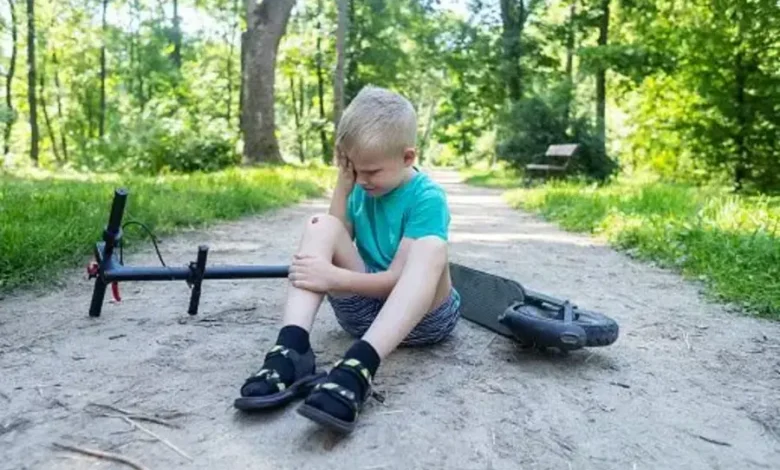
While Ukrainian children live in the reality of air raids, shelling, moving and constant anxiety of adults, another less noticeable but very real threat remains in cities – injuries on electric scooters. They are often perceived as ordinary entertainment, although the speed, weight of the device, lack of protection and inexperience of the child can lead to fatal consequences even in the park or on the bike path.
Tragedy in Khmelnytskyi
In Khmelnytskyi, the decision to ban electric scooters in some pedestrian zones was made after the death of an 11-year-old boy. The tragedy occurred on May 4, 2025 in the Mykhailo Chekman Park, where the child was riding an electric scooter on a bike path, lost control, fell and received a serious head injury.
The boy was hospitalized in the intensive care unit of the Khmelnytskyi City Children’s Hospital, but doctors were unable to save his life. After that, the police opened a criminal case under Article 291 of the Criminal Code of Ukraine, which concerns violation of rules, norms and standards for traffic safety.
Electric scooters banned in Khmelnytskyi
The Khmelnytskyi city authorities announced that they had banned the movement of electric scooters in pedestrian zones in six locations. Restrictions were introduced in the Mykhailo Chekman Park, Ivan Franko Park, Shevchenko Park, Podillia Arboretum, the station square and the area near the lake in the Ozerna microdistrict.
At the same time, bicycle paths for electric scooters remain available. On the pedestrian part of Proskurivska Street, they plan to introduce a speed limit of up to 10 km/h to reduce risks for pedestrians and the users themselves.
An electric scooter often looks like light city transport, but for a child it can be dangerous due to sharp acceleration, instability on uneven surfaces, difficulty braking and lack of reaction skills in a crowd. In parks where children, the elderly, parents with strollers and cyclists walk nearby, even one mistake can result in serious injury.
The problem is exacerbated by the fact that electric scooters are often purchased or rented without sufficient understanding of the rules. Children can ride without a helmet, without adult supervision, without driving experience and without realizing that falling at a speed of even several dozen kilometers per hour can cause serious consequences.
What parents should consider
The Khmelnytskyi City Council emphasized that adults who buy electric scooters for children must first familiarize themselves with the rules of use and explain them to the child before the first independent trip. This requirement has practical significance, because an electric scooter cannot be perceived as a toy, especially when the child moves next to pedestrians or other road users.
Parents should take into account the child’s age, physical fitness, ability to maintain balance, use brakes and judge distance. Of particular importance are a helmet, knee pads, elbow pads and a ban on riding in places where there are many people or there is no safe space for maneuver.
The situation in Khmelnytskyi has become part of a broader debate about the safety of electric scooters in Ukraine. In 2024, the number of court cases involving electric scooters increased by 42% compared to the previous year, and a total of 71 such proceedings were registered.
Other cities have also begun to discuss or introduce restrictions. In Kyiv, options for regulating the movement of electric scooters are being considered, and in some communities their use is already being restricted in central areas or places with a large flow of pedestrians. There is still no general law that would fully regulate the status of electric scooters in Ukraine.
After the death of a child in Khmelnytskyi, the issue of electric scooters has ceased to be just a topic of urban comfort. It concerns the safety of children, who during wartime already live with an increased level of risk, and in peaceful urban spaces may be exposed to danger due to transport that does not have sufficiently clear rules for use.
The park ban was a response to a specific tragedy, but further regulation requires a broader approach: defining age restrictions, speed limits, zones for movement, parental responsibility and rules for rental services. Without such solutions, e-scooters will continue to be a means of transport that is being used en masse faster than the state and cities can explain how to do it safely.