Corruption in the CCC: how the facts of illicit enrichment established by the NACP are exacerbating the crisis of confidence in the army

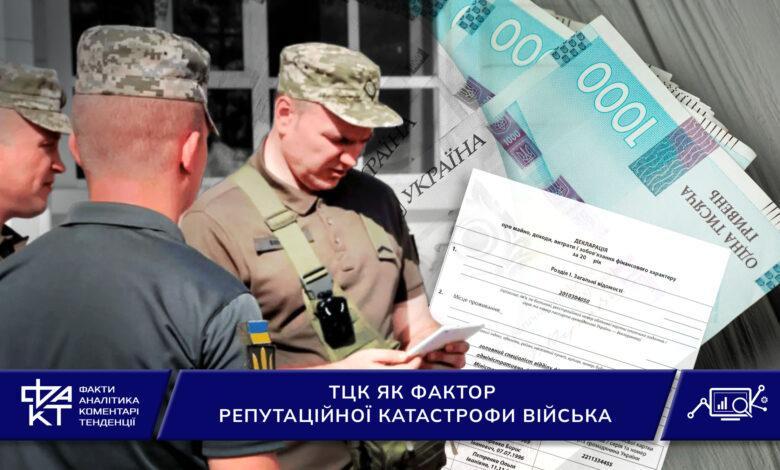
War always exposes the limits of trust between citizens and the state, but now this limit is becoming especially acute. Territorial assembly centers, which were supposed to become an instrument of an orderly defense policy, are increasingly perceived as a source of violence, humiliation and repressive pressure. The methods by which some TCCs carry out mobilization tasks — street raids, detention without court decisions, threats, intimidation, physical violence destroy the main thing: respect for the military. Those who are supposed to personify honor and duty are increasingly identified in the mass consciousness not with defenders, but with people from whom their fellow citizens should be saved. This is a deep moral trauma for society, which only yesterday unconditionally supported the army. The reputational crisis is exacerbated by declarations in which TCC officers indicate millions in cash, currency, real estate and car fleets, society can no longer remain silent.
Results of inspection of declarations of TCC officials
Corrupt actions of employees of the Territorial Centers of Recruitment and Social Support (TCC and SP) during the full-scale war repeatedly became the subject of high-profile scandals, internal official investigations, media resonance and court proceedings. However, even against the background of these developments, the results of the full audits carried out by the National Agency for the Prevention of Corruption in 2024-2025 outline a much deeper problem – a systemic crisis of trust in the rear vertical that serves the mobilization process.
In total, NAZK started full inspections of only 23 declarations of TCC officials, of which 18 have already been completed. It is to be hoped that they will continue. As a result, signs of unreliable information for more than UAH 28.5 million, signs of illegal enrichment for more than UAH 5.6 million, and another UAH 2.6 million of unsubstantiated assets were revealed. At the same time, the total amount of violations — UAH 36.8 million — creates the impression not of isolated incidents, but of a well-rooted culture of abuse, in which front-line employees use martial law as an opportunity to avoid public accountability.
The case of the head of the Dnipropetrovsk regional TCC became the most resonant. In his declaration for 2022, signs of illegal enrichment were established. During 2021–2023, close relatives of this official acquired assets worth more than UAH 8.8 million without confirmed sources of origin. Among the items acquired are two apartments in Dnipro, Volkswagen Passat and Ford Ranger cars, as well as monetary assets in the amount of 65,000. US dollars donated by the father-in-law with income that does not allow to explain such a donation. In addition, the declarant did not specify six real estate objects, two cars, the income of his family and the use of real estate, which is also qualified as significant violations. Based on the materials of the NAKC, the National Police initiated criminal proceedings under Articles 366-2 (“Declaration of false information”) and 368-5 (“Illegal enrichment”) of the Criminal Code of Ukraine. The investigation has been completed, the case has been referred to the court.
Similar schemes, albeit on a smaller scale, have been recorded in other regions. So, in Odesa, the officer of the recruiting department did not declare the land plot, the use of the apartment, two apartments belonging to the daughter, underestimated the value of other real estate, vehicles and a motorcycle, and also did not indicate corporate rights. The total amount of unreliable information exceeded UAH 3.8 million. According to the results of the inspection, the NAKC transferred the case to the NPU, now criminal proceedings are underway.
In the Kharkiv region, the commander of the security department of the Bogodukhiv State Central Committee and the JV did not declare land plots, an apartment, income from financial support and funds in accounts. In the declarations for 2022 and 2023, the total amount of unreliable data reached UAH 4.6 million. The State Bureau of Investigation has started criminal proceedings.
Similar circumstances were found in the Rivne region. In 2023, the head of the military accounting department for sergeants and reserve soldiers of the Dubensky RTCC did not declare the residential building and land plot used by his family. The amount of unreliable information is more than UAH 1.6 million. The proceedings are ongoing.
A separate example was the decision of the Leninsky District Court of Kharkiv regarding the commander of the branch of the Kharkiv Regional TCC, who was found guilty of committing an administrative offense under Part 4 Art. 172-6 of the Code of Administrative Offenses. He did not declare two plots of land, understated the value of the car and provided false income data. The court imposed a fine of 17,000. hryvnias, and the amount of established unreliable information amounted to 645 thousand. UAH
These examples demonstrate not only the propensity of individual officials to deliberately conceal property, but also the uniformity of the schemes. Typical schemes are repeated – real estate registered to relatives, vehicles, “gifts” from low-income relatives, corporate rights that “forgot” to declare, undervaluation of assets. All these methods are not new for the Ukrainian practice of dishonesty, but they acquire special importance in the context of the work of an institution that directly intervenes in the lives of citizens in the most sensitive way – through mobilization.
Here are some recent, but unfortunately not the last, examples of corrupt and daring actions of TCC officials. On May 20 of this year, it became known about an incident in the Transcarpathian region, which caused a wide response and called into question the effectiveness of the justice system. Oksana Livyk, the head of the first department of the Berehiv district territorial center of recruitment and social support in the city of Vynogradiv, was exposed in the organization of schemes to evade mobilization on a commercial basis. The investigation provided evidence, seized funds, and the prosecution brought serious charges. However, despite this, Livyk did not suffer a prison sentence and was reinstated in her position.
Such a result became possible due to inaction on the part of the Berehiv district prosecutor’s office, which did not use its procedural powers and did not even submit a request for the extension of the preventive measure. This case clearly demonstrates how the lack of effective response by law enforcement agencies creates conditions for the retention of positions by persons involved in organized corruption mechanisms.
According to the case materials, the scheme coordinated by Livik provided for the possibility of issuing fictitious medical documentation worth from 9 to 14 thousand dollars. In particular, it was about certificates that allegedly certified mental disorders in conscripts. On the basis of these documents, men were excluded from military registration, which allowed them to leave the territory of Ukraine without hindrance during the period of martial law. Despite the proven nature of this practice, the official’s participation in the implementation of the scheme did not cause any long-term consequences. The case proves not only the existence of a demand for such a “service”, but also the stability of the conditions under which it can function – even after exposure.
In February 2025, the Volyn regional territorial center of recruitment and social support found itself at the center of another corruption scandal related to evasion of mobilization. The law enforcement officers exposed an organized group, which, according to official data, included officials of one of the regional TCCs of the Volyn region and a local businessman. According to the investigation materials, for USD 12,000, they helped avoid military service by preparing relevant documentation and agreeing to procedures.
In response to this, the Volyn OTCC published a public position in which it emphasized the condemnation of any form of corruption among its personnel. The press service of the institution reported that all those involved in the case were suspended from performing their duties for the period of the investigation, and if the case is transferred to court, they will remain suspended until the verdict comes into force. In addition, one of the suspects — the head of the regional TCC — has already been dismissed from the Armed Forces of Ukraine.
At the same time, the nature of the case does not allow to reduce the incident to the individual responsibility of several people. The very structure of the conspiracy with the participation of several representatives of the TCC and an external mediator once again confirms the functioning of established informal schemes for evading mobilization. The $12,000 in ill-gotten gains documented illustrates the level of demand for a “service” that, according to public reports, had all the hallmarks of a repeat practice.
In such a configuration, the institution’s formal response does not change the key fact: the mobilization administration once again turns out to be a party in the organized process of exclusion from duty. And while in some regions the amount of the bribe is being discussed, street arrests without summons continue in others. This contrast is the source of social irritation — not towards the army as a whole, but towards its representatives who wear epaulettes and represent the state.
Social tension and reputational crisis
Against the background of social tension caused by mass arrests, violent actions of TCC employees, ignoring legal procedures, the facts of enrichment are the last straw. They legitimize outrage, devalue perceptions of military service, and deepen the divide between the military and society. Suspicion instead of trust. Instead of respect – rejection. The system, which is supposed to coordinate the protection of the state, is increasingly associated with pressure and profit.
The very logic of public service provides for limited powers, accountability, control and separation of personal and official. But the war created exceptional conditions, and it was in them that the line between the function of the TCC as a staffing body and a system of private influence on people’s destinies was blurred. Instead of a clearly regulated model with objective selection criteria, society received a mechanism of selective mobilization, where the decision is based not on documents, but on the money of conscripts.
Today, no one asks where the property, cash, expensive cars or assets registered to relatives of the employees of individual TCCs come from. The answer is obvious: according to a simplified but well-known scheme. The one who has funds “solves the issue” – fictitiously registers ineligibility, leaves the country or simply does not get into the field of view. Others—those without money, connections, or status—find themselves on the front lines, sometimes without a full cycle of medical examination or combat training. This creates not only inequality, but generally destroys the principle of service as a common duty. Consequently, mobilization turned into a selective punishment for the poor.
At the same time, in response to growing criticism in the public space, the opinions of military personnel and experts defend the actions of TCC officials. The arguments are: “if it weren’t for them, no one would fight”, “the enemy would already be in Lviv”, “no one wants to – we have to use force”. Formally, this corresponds to reality: the defense system depends on their functioning. But public indignation is directed not against the function as such, but against the fact that it is performed selectively, with a commercial component and double standards and corruption schemes.
That is why the public reaction not only continues, but also changes form. More and more often we see not just criticism, but open opposition of Ukrainians. Cases of physical clashes, attacks on representatives of the TCC, refusal of citizens to comply with their orders are recorded. In some regions, residents band together, defend each other, publicly expel “TCKashniks”, film their actions and share them on social networks. This is not spontaneous aggression, but the result of accumulated mistrust of the entire system, which has lost its internal legitimacy. Coercion loses its effectiveness if it is no longer perceived as part of a general duty.
The public attitude towards the military is changing not because of the front, but because of the rear. Anyone who sees how for cash you can stay at home, and without it – to be on the front line, stops believing in the honesty of the state. The image of a military man is gradually splitting: there is the one who fights, and the one who “authorizes” others to fight, and is in the rear, while being a professional soldier. And it is this crack that becomes a reputational disaster, it gradually destroys the idea of the defender as a figure of trust and honor. At the same time, the line between military service and coercion is increasingly blurred, in public perception, the TCC employee ceases to be the personification of defense and is increasingly perceived as a representative of administrative pressure.
Someone who once commanded respect now often causes anxiety. A person in uniform appears on the street, but his presence is not perceived as a sign of safety, but as a potential threat. At the same time, facts are accumulating that form another dimension of the crisis — declarations with millions of cash, incomprehensible amounts of property, numerous violations recorded during inspections. This context supplants the concepts of duty and service, replacing them in the public imagination with material interests. As a result, the military uniform loses its symbolic clarity. For many, it is not associated with risk and protection, but with a powerful resource and opaque opportunities.
This process has already gone beyond individual episodes. What was called alarming signals a year or two ago, today has the features of a systematic destruction of rear authority. If the state does not intervene, but not at the level of comments and promises to “deal with the situation”, but at the level of revising the very principle of mobilization justice, the conflict will continue to escalate. After mistrust comes isolation, after isolation comes sabotage. And then not only the legal, but also the moral foundations of defense will be under great question.